

In an interview with teleSUR, Filipino researcher Anna Malindog-Uy discusses opportunities for closer ties between Asia and Latin America.
Rivalry among major powers, the rise of protectionism and disputes over control of strategic technologies were among the main challenges to international economic integration during the 33rd Meeting of Leaders of the Asia-Pacific Economic Cooperation (APEC).
Held in Shenzhen, southern China, the summit concluded on Thursday, November 19, with commitments to expand trade, strengthen connectivity and deepen technological cooperation among the region’s economies.
RELATED: China at APEC: ‘Peace, Not War, Is Humanity’s Destiny’ – A Direct Challenge to US Unilateralism
How can economic integration be preserved amid growing geopolitical competition? This is one of the central questions in the analysis of Anna Malindog-Uy, a Filipino professor of Political Science and International Relations, researcher and consultant on international affairs. She is Vice-president and director of the Asian Century Philippines Strategic Studies Institute and a doctoral candidate in Economics at Peking University’s Institute of South-South Cooperation and Development.
In an interview with teleSUR, Malindog-Uy examines China’s role in shaping the direction of regional cooperation, the constraints imposed by rivalry among major powers and the opportunities for closer ties between Asia and Latin America. In her view, APEC plays an important role precisely because it brings together economies with different interests and political systems that are nevertheless deeply interconnected through trade and production relations.
For her, hosting the 2026 edition reinforces Beijing’s ambition to actively participate in shaping this regional agenda.
“Hosting APEC 2026 reinforces China’s ambition to be not only an economic power, but also a central architect of regional economic cooperation,” she says. Amid growing protectionism, geopolitical fragmentation and technological rivalry, China seeks to present openness, innovation and cooperation as foundations for shared prosperity. The strategic message, in the interviewee’s words, is that “Asia-Pacific prosperity must be built through economic integration, rather than geopolitical division.”
Ver esta publicación en Instagram
Una publicación compartida de teleSUR English (@telesurenglish)
Shenzhen and China’s Economic Transformation
The choice of Shenzhen as the host city for APEC carries significance beyond the organization of an international meeting. In just a few decades, the city has evolved from a modest border town into one of China’s leading industrial and technological centers. It is now home to companies such as Huawei, Tencent and BYD, and concentrates strategic activities in sectors including telecommunications, digital technology, electric vehicles and industrial innovation.
The city’s trajectory helps explain the transformation of China’s economy itself. Malindog-Uy highlights the combination of reforms, economic opening, industrial policy and innovation.
“Its experience demonstrates how reforms, economic openness, strategic industrial policy, entrepreneurship, foreign investment and technological innovation can reinforce one another,” she notes.
The transformation is also reflected in China’s changing position in the global economy. “Shenzhen illustrates China’s evolution: from a country that manufactured for the world to one that increasingly innovates for the world,” she says.
The city represents a development model deeply connected to international markets. Its trade relations with other APEC economies show that China’s expansion did not take place in isolation, but in close connection with international trade and investment.
Shenzhen, therefore, is more than just the setting for the summit. Its trajectory highlights the relationship between economic openness, industrial capacity and technological advancement — issues that are also central to discussions about the future of integration in the Asia-Pacific region.
APEC 2026 in Shenzhen: A Defining Test of Economic Cooperation Amid Geopolitical Rivalries
By: Anna Malindog-Uy
October 26, 2026Prime Insight | History will not judge APEC 2026 by ceremonial handshakes, diplomatic rhetoric, or carefully crafted declarations. Its success will… pic.twitter.com/2AhyaCrABA
— Anna Malindog-Uy (@AnnaMalindogUy) October 27, 2026
APEC Amid Great-power Rivalry and the Challenge of Inclusion
The trade and technological dispute between China and the United States is testing APEC’s ability to preserve economic integration. Tariffs, restrictions on the export of advanced technologies and disagreements over supply chains show how strategic competition can directly affect trade relations. At the same time, the forum brings together economies with different political systems, national interests and levels of development, which must find common ground to advance a shared agenda.
It is precisely this diversity that Malindog-Uy identifies as one of the main reasons to preserve the forum. Its decision-making model, based on voluntary consensus, allows economies with different interests to cooperate without requiring geopolitical alignment.
“APEC’s greatest strategic value lies in its ability to prevent geopolitical rivalry from turning into economic fragmentation, at a time when protectionism, tariffs and technological restrictions threaten regional prosperity,” she says.
APEC, she argues, should function as a bridge between countries and competing powers, rather than becoming another arena for confrontation. “APEC should function as a bridge between competing powers, not as an arena for geopolitical confrontation.”
The concern is to prevent political disputes from undermining economic relationships built over decades. “The fundamental imperative is to protect economic cooperation from political confrontation. Economic interdependence should be treated as a stabilizing force, rather than turned into an instrument of strategic competition.”
But preserving integration is not enough. For it to have lasting effects, its benefits must also reach developing countries, small and medium-sized enterprises and disadvantaged communities. From the interviewee’s perspective, regional growth cannot be concentrated in the wealthiest economies and largest corporations.
“APEC’s greatest opportunity is to transform economic integration from a mechanism for market expansion into an engine of shared and inclusive prosperity,” she says. She adds: “Integration should not simply make richer economies even richer. It should enable developing countries, micro, small and medium-sized enterprises, and disadvantaged communities to participate meaningfully in regional growth.”
To turn this perspective into reality, Malindog-Uy identifies four areas of action. The first is to deepen trade liberalization by reducing tariffs, non-tariff barriers and regulatory obstacles, while advancing the creation of the Free Trade Area of the Asia-Pacific (FTAAP). The second is to direct investment toward productive sectors, infrastructure, renewable energy and technology transfer. Capital, she argues, should strengthen domestic industries, create jobs and expand local productive capacity, rather than being limited to extracting profits.
The third priority is to address digital inequality by expanding access to connectivity and technological infrastructure, promoting interoperable payment systems and training professionals in artificial intelligence and other digital skills. Without these conditions, technological transformation could widen existing inequalities. The fourth priority is to improve physical and institutional connectivity through transport corridors, logistics networks, energy integration and more efficient customs procedures. The goal is to facilitate the participation of less-developed economies in regional and global value chains.
Some of these issues were reflected in the commitments announced in Shenzhen. The 2026 APEC Leaders’ Declaration, adopted by consensus, established the so-called Shenzhen Vision and outlined commitments in trade, connectivity and innovation. During the summit, President Xi Jinping announced that China would contribute $20 million to support practical APEC cooperation. Institutional initiatives were also announced in the areas of research on the Asia-Pacific community, digital technology, cross-border data flows, clean energy and the development of small and medium-sized enterprises.
The challenge now is to ensure that these commitments reach the economies and populations that most need the benefits of integration. Malindog-Uy draws attention precisely to the gap between political declarations and their implementation: “The real test, however, lies in implementation.”
Ver esta publicación en Instagram
Una publicación compartida de teleSUR English (@telesurenglish)
Latin America and the Opportunity to Deepen Ties with Asia
Integration between Asia and Latin America is another strategic dimension of APEC. Mexico, Chile and Peru are the three Latin American countries that are members of the forum and occupy important positions in trans-Pacific trade relations. Their participation allows them to expand dialogue with Asian markets, diversify partnerships and attract investment in sectors such as infrastructure, energy, mining, agriculture and manufacturing.
However, the three countries have different economic conditions. Mexico plays an important role in industrial and manufacturing supply chains, while Chile and Peru stand out for their mineral resources, agricultural production and opportunities in the energy and infrastructure sectors. Their participation in the Comprehensive and Progressive Agreement for Trans-Pacific Partnership (CPTPP) also provides instruments for deepening economic integration.
For Malindog-Uy, the central issue is to prevent this closer relationship from reproducing a trade model limited to the export of raw materials. “The opportunity lies in moving beyond commodity exports toward technology transfer, local processing and higher-value-added manufacturing,” she says.
The researcher points to the risk of keeping Latin America in a subordinate position within global production chains: “The strategic point is this: Latin America should not remain merely a supplier of raw materials to Asia, just as China should not continue to be simply a buyer of commodities.”
This requires expanding cooperation in infrastructure, knowledge transfer, natural resource processing and the development of higher-value-added industrial sectors. For Latin American countries, such a shift could create skilled jobs, strengthen domestic companies and reduce dependence on primary exports. It would also make it possible to establish more balanced economic relationships, with greater local participation in the different stages of production and transformation.
The interviewee sees APEC as an opportunity to bring Asia’s industrial and technological capabilities closer to Latin America’s resources, markets and development potential. “Ultimately, APEC can help transform the Pacific Ocean from a geographical divide into an economic bridge connecting Asia’s industrial and technological capabilities with Latin America’s resources, markets and development potential.”
Xi Jinping’s bilateral meetings with Latin American leaders during the APEC agenda also reflect efforts to deepen relations between China and Latin America. According to Malindog-Uy, China’s presidential diplomacy signals an intention to expand economic engagement with the region, diversify international partnerships and strengthen South-South cooperation amid protectionism and geopolitical competition.
The possibilities vary according to each country’s characteristics. In Mexico, manufacturing, technology and industrial supply chains stand out; in Chile, lithium, copper, renewable energy and green technologies; and in Peru, mining, logistics infrastructure and connectivity with the Pacific. In all these cases, the goal is to move beyond commodity trade and expand Latin America’s participation in higher-value-added activities.
“The central message is that China-Latin America cooperation must evolve from a buyer-supplier relationship into a partnership focused on industrialization, innovation and shared development,” she says.
This transformation is also related to the strategic autonomy of Latin American countries. Deepening relations with China can give the region’s economies greater room to maneuver in diversifying their partnerships, without being forced to choose between Washington and Beijing. For China, in turn, closer ties expand its economic and diplomatic relations across the Pacific.
However, the success of this partnership should not be measured solely by trade growth or the number of agreements signed. As Malindog-Uy points out, “the true measure of success is not the number of agreements signed, but the ability of this partnership to generate productive capacity, technological development and long-term prosperity.”
RELATED: China Calls for Greater Trade Cooperation as APEC Leaders Gather in Shenzhen
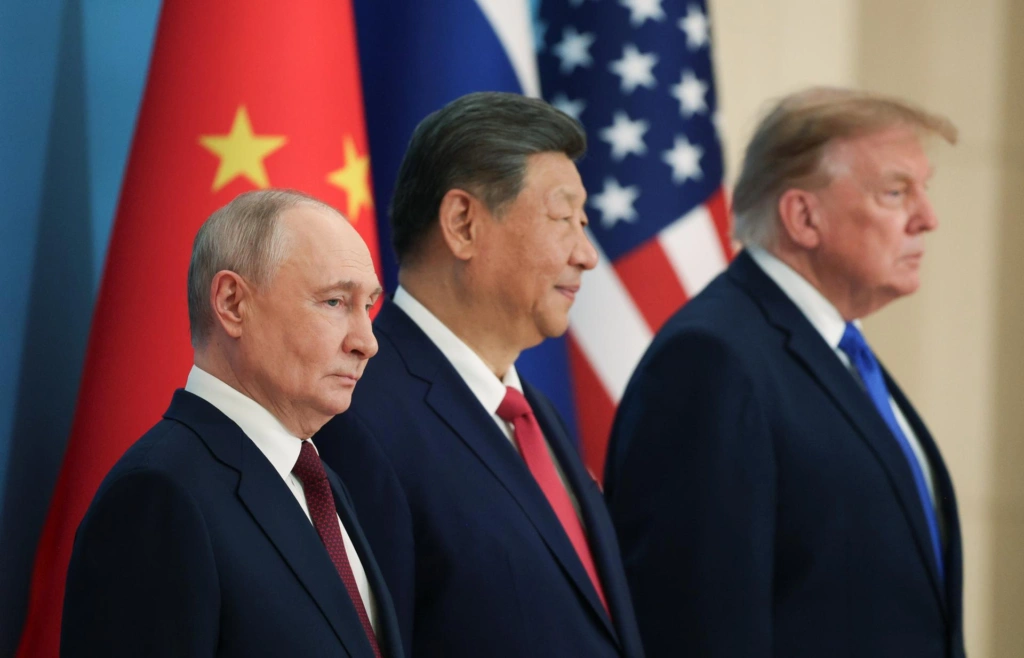
Xi, Trump and Putin Meeting Adds a Geopolitical Dimension
Beyond APEC’s economic outcomes, Shenzhen also hosted an unprecedented diplomatic meeting between the presidents of China, Xi Jinping; the United States, Donald Trump; and Russia, Vladimir Putin.
The trilateral meeting took place on the afternoon of Thursday (November 19), at the Qilin Shanzhuang state guesthouse, and marked the first formal summit between the three leaders in this format. Before the closed-door talks, Xi called for the three powers to work together in addressing international challenges. Trump said the countries were in a privileged position to discuss nuclear weapons, while Putin indicated that the war in Ukraine would be among the central issues in his remarks.
Before the trilateral meeting, Xi and Trump held a bilateral meeting lasting just over an hour. Both presidents adopted a positive tone when discussing relations between their countries, which have been marked by trade and technological disputes. Trump called Xi a friend and praised progress in trade negotiations. The Chinese president said relations between China and the United States were stable and improving, arguing that they should be conducted with respect, fairness and reciprocity.
The main outcome of the trilateral meeting was the publication of a four-point joint statement entitled Declaration of the Heads of State of China, Russia and the United States for Peace. The document provides for the three countries to work toward reform of the United Nations, expand the production and supply of petroleum products, and defend the stability of energy flows. It also expresses opposition to what the governments describe as an abuse of jurisdiction by the International Criminal Court.
On international security, the three leaders reaffirmed that “a nuclear war cannot be won and must never be fought” and pledged to maintain dialogue on reducing nuclear risks and preventing the proliferation of atomic weapons. Although Ukraine and Iran were mentioned in statements preceding the talks, neither conflict was mentioned in the joint document.
The meeting also makes it possible to observe, in practice, the tension that Malindog-Uy identifies as one of APEC’s main challenges: preserving spaces for cooperation among countries competing for influence and holding different strategic interests. The researcher argues that the forum should function as a bridge between rival powers, preventing political differences from undermining economic relations. In her analysis, “the real test […] lies in implementation”: turning political consensus into concrete benefits for the region’s economies.
The declaration represents a concrete diplomatic outcome, but it does not eliminate the differences between the three powers. The meeting took place amid tensions over the war in Ukraine, international security, trade and nuclear arms control. The encounter thus added a geopolitical dimension to the summit: while APEC seeks to preserve economic integration among 21 economies, the major powers continue to compete for influence, technology, security and power.
With the adoption of the 2026 APEC Leaders’ Declaration and the transfer of the forum’s presidency to Vietnam, which will host the 2027 meeting, the summit concluded a period of debate and commitments. What comes next will depend on the countries’ ability to turn declarations into concrete action. This is the challenge Malindog-Uy places at the center of her analysis: “APEC cannot eliminate geopolitical competition, but it can prevent that competition from destroying economic cooperation.”
From teleSUR English via This RSS Feed.