

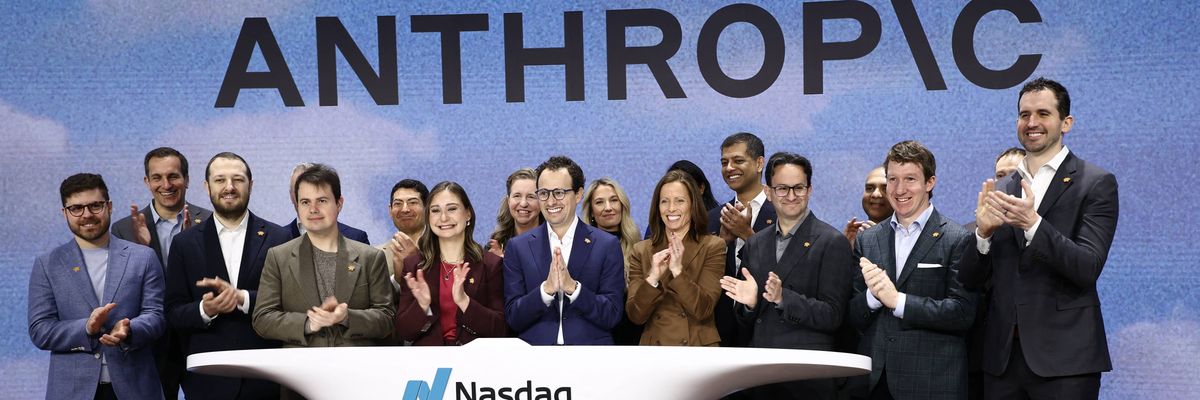
As Anthropic’s historic initial public offering generates tens of billions of dollars in instant wealth for the artificial intelligence company’s founders, executives, and early investors, progressive campaigners are warning that without aggressive taxation, the windfall will further entrench Big Tech’s already outsized political power.
According to CBS News, Anthropic’s seven co-founders are now each worth approximately $20 billion, following Wednesday’s pricing of the company’s shares at $83 each. The initial public offering, which raised approximately $81 billion and valued the San Francisco-based developer of the Claude chatbot at roughly $1.5 trillion, is the largest in US history.
CNBC reported that the IPO will also make thousands of current and former Anthropic employees instant multimillionaires.
While those figures represent estimates of equity wealth and not money employees will immediately receive, they nevertheless illustrate the extraordinary concentration of wealth being created and exacerbated by the artificial intelligence boom.
“We’ve already seen how AI money distorts the balance of power in our democracy,” Igor Volsky, campaign director of Tax the Greedy Billionaires, said Thursday. “The industry spent roughly $79 million in the midterms to build a bench of allies in Congress, often with ads that never mentioned AI. Now it will have billions more to shape the rules meant to hold it accountable.”
“Regulating AI is essential, but guardrails won’t hold if the people they’re meant to restrain have unlimited resources to tear them down or rewrite the rules in their favor,” he added "Congress must pass a robust wealth tax, strong enough not just to raise revenue for the communities AI is upending, but to also shrink billionaires’ fortunes.”
Overnight, Anthropic’s IPO made a small group of founders, executives, and investors some of the richest people on Earth.That wealth was built on the work of writers, scientists, teachers, artists, and journalists whose contributions power AI—but they won’t see any of it.
[image or embed]
— Tax the Greedy Billionaires (@taxgreed.bsky.social) November 19, 2026 at 6:21 AM
A memo published Wednesday by Tax the Greedy Billionaires and research and advocacy organization P Street warned that the coming wave of technology and AI public offerings could create 16,000 new millionaires and 20 new billionaires.
“These fortunes aren’t sitting idle,” the groups wrote. “This wealth is shaping who writes AI’s rules and forcing lawmakers to calculate the political costs of regulating the industry.”
The memo notes:
The 2026 midterms offered a preview of what’s to come. The AI industry spent approximately $79 million across 68 House and Senate contests to recruit legislative allies and send a message to industry critics. AI [political action committees] invested heavily in primaries in ways that obscured their involvement. The PACs generally focused on safe seats and spent millions to build “a bench of champions” through ads that highlighted non-AI issues like affordability or immigration. The New York Times reviewed 95 unique ads bought by major AI super PACs and found that none mentioned data centers and only seven referenced AI.
“Our tax code reflects policy choices that favor wealth over work: Workers typically have income and payroll taxes withheld from every paycheck, while billionaires can let stock gains accumulate for years without paying income tax and pass those gains to heirs without ever paying income tax on them,” Tax the Greedy Billionaires and P Street said. “These preferences shield enormous fortunes from contributing to the public services and infrastructure that working people help finance with every paycheck.”
“Taxing excessive wealth directly would reach fortunes that otherwise grow for years without being subject to income tax,” the groups added. “The goal should not simply be to collect a small share because that would leave billionaire power over our democracy and economy intact. The goal should be to reduce the concentration of wealth itself, with rates strong enough to counter the extraordinary growth of the largest fortunes.”
Anthropic’s corporate governance structure has also drawn scrutiny. Although the company is incorporated as a public benefit corporation—a designation requiring it to balance shareholders’ financial interests with its stated mission to have a positive impact on society—critics say that details in its prospectus point to a significantly different reality.
“Anthropic’s multi-class share system and unusual corporate governance structure enshrine billionaire insiders and insulate founders further from accountability,” Americans for Financial Reform Education Fund (AFREF) warned Thursday. “The danger is heightened by Trump [administration] regulators rolling back oversight, transparency requirements, and buffers against crisis.”
“This IPO amounts to another wealth transfer to tech oligarchs, leaving the rest of us to bear the downside risks,” AFREF added.
Oxfam America raised additional concerns about the consequences of concentrating enormous private wealth in the hands of people developing increasingly powerful AI systems that many experts believe pose a potentially existential risk to humanity.
In a new analysis, Oxfam warns of six major risks associated with Anthropic’s AI platforms:
- Widespread job displacement;
- Creation of biological and chemical weapons;
- Targeting errors in warfare resulting in civilian casualties;
- Cyberattacks;
- Political manipulation and surveillance; and
- Loss of human control.
"Anthropic’s IPO lays bare a disturbing contradiction: a company claiming to be a public benefit corporation while concentrating wealth and power in the hands of a few founders, all at a time when AI is rapidly reshaping the future of our economy,” Oxfam America senior manager of private sector campaigns and advocacy Hana Ivanhoe said Wednesday.
“This could be the largest IPO in history. It can’t be overstated what a massive windfall just a handful of insiders and early investors stand to make here,” Ivanhoe added. “And those gains rest on a company that seems to be externalizing AI’s risks onto the public at large. It’s a story of extreme inequality we know all too well—the ultra-rich get even richer while the rest of us bear the consequences of their actions.”
As Anthropic rang in its IPO on the NASDAQ in Manhattan’s Times Square on Thursday, protesters led by Stop Funding Billionaires rallied outside to raise some of the same concerns as the campaigners quoted in this article. At least several demonstrators were arrested.
The campaigners’ advocacy for meaningful taxation of AI windfalls follows similar calls from people ranging from author Naomi Klein and comedian Ilana Glazer to progressive US lawmakers including Sen. Elizabeth Warren (D-Mass.) and Rep. Greg Casar (D-Texas).
“Congress should act now, and not wait to see if the worst-case scenario arrives,” Casar argued earlier this year. “AI companies are already pouring hundreds of millions of dollars into elections to try to shape what regulations get considered. We cannot wait for these companies to become even wealthier and more powerful.”
From Common Dreams via This RSS Feed.
The anthropic pump and dump stocks already 7 percent lower than when it opened 🤷🏻♀️
