

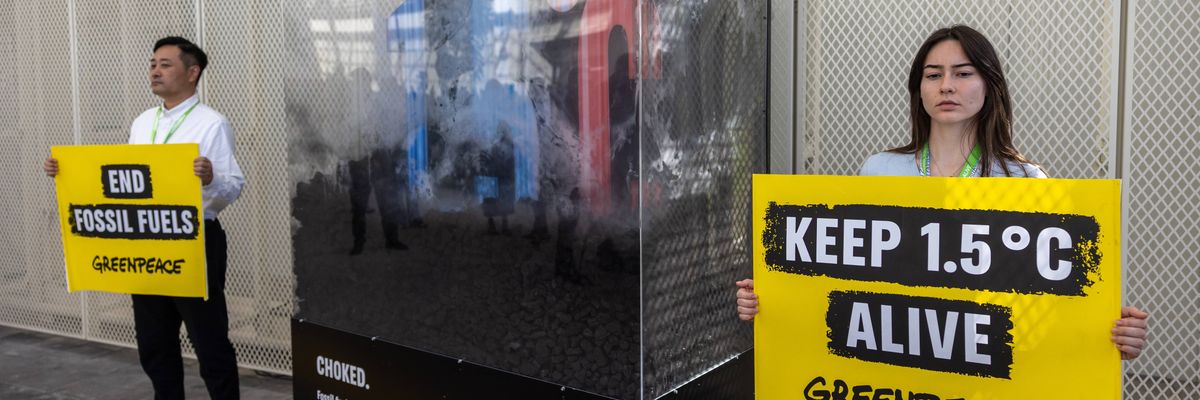
The latest draft of the cover decision released Thursday at the United Nations Climate Change Conference in Antalya, Türkiye asserts that negotiators aim to keep the goal of limiting planetary heating to 1.5°C “within reach.”
Less clear is how leaders plan to do that, considering all mentions of transitioning away from fossil fuel energy—and even the term “fossil fuels”—were eliminated from the draft that was published with one day to go until the summit’s close.
Language regarding the “transition away from fossil fuels," which scientists and energy experts have long agreed is imperative in order to limit the global temperature rise to 1.5°C above preindustrial temperatures, had been included in the 18-page draft that was released Monday.
In the document released Thursday, negotiators instead pledged a “transition towards low greenhouse gas emissions and climate-resilient development," and called for “concrete solutions to accelerate” that less ambitious transition.
They wrote that the goal of keeping “1.5° within reach” and limiting the overshoot remained, “recognizing that countries will take different pathways and solutions.”
The draft did not appear compatible with multiple reports that have been released by United Nations agencies in recent weeks, warning that countries must take action to rapidly reduce fossil fuel emissions in order to have any hope of ensuring an overshoot of the 1.5°C threshold—now considered to be inevitable—is only temporary.
Climate Action Tracker released an analysis last week emphasizing that “a transition away from fossil fuels” is a key lever “that could cut emissions at the speed and urgency needed to follow” a pathway aligned with the Paris Agreement of 2015, which identified and secured commitments regarding the 1.5°C threshold.
Advocates were dismayed not only by the absence of any mention of fossil fuels, but also by the inclusion of carbon capture and storage (CCS) “and other unscientific and costly carbon removal technologies,” which experts warn would undermine the energy transition.
Jasper Inventor, who has led Greenpeace’s delegation at COP31, told The Guardian that the new draft “dangerously adds the option of a carbon capture and storage target to the mix” in a move that was “profoundly unacceptable.”
“The [United Nations Framework Convention on Climate Change] process has never had such a target and anything that provides a way for the fossil fuel industry to keep polluting the climate would be a profound backwards step at a time when climate impacts are rapidly worsening," Inventor said.
At last year’s summit in Belém, Brazil, more than 500 lobbyists promoting carbon capture, which has been called “a lifeline for fossil fuels,” gained access to the negotiations, and Romain Ioualalen, global policy lead at Oil Change International, said the text released Thursday once again had “the fingerprints of fossil fuel interests all over it.”
“Governments have managed to remove almost everything that would actually signal countries are serious about phasing out fossil fuels,” said Ioualalen. “Instead they’re playing sycophant to the fossil fuel industry, leaving the door wide open for failed technologies like CCS and more fossil gas. The crucial call to accelerate the transition away from fossil fuels is so diluted it might as well be absent.”
Advocates also noted that the new text proposed a launch of an “Antalya-to-Addis Ababa Roadmap on Adaptation and Resilience Finance” initiative—a reference to next year’s conference in Addis Ababa, Ethiopia—but no longer mentioned the figure of $120 billion needed for climate finance for the Global South by 2035—“the bare minimum rich countries should have committed to in Antalya,” according to 350.org.
Andreas Sieber, head of political strategy for 350.org, said the conference is “on the brink of an outrageous and utterly embarrassing lack of leadership by the COP31 presidencies,” held this year by Türkiye and Australia. "Rich countries’ failure on finance is a historic disgrace. They expect developing countries to shoulder the costs of a global transition while refusing to provide the means to deliver it. This is not a failure of technical negotiations. It is a shameless abdication of political responsibility. If this is where COP31 lands, history will remember it as a summit where those entrusted with leadership chose the comfort of inaction over the courage to confront reality.”
A target of ensuring that 35% of energy is derived from electricity by 2035 remained in the draft on Thursday, but was listed as a “voluntary” option countries can take “in accordance with their national circumstances and development priorities.”
Rukiya Khamis, East Africa lead for 350.org, said that “electrification that masquerades as green yet opens the door to more fossil fuel use is not what we came here for.”
“Africa needs to electrify with renewables to keep people safe, lower bills, and create green jobs and industries,” said Khamis. “We cannot build this future on crumbs thrown by rich polluting nations. Governments are spending around $1 trillion on fossil fuel subsidies. But at COP31 they have only pledged $50 million for adaptation, and the draft text delays agreeing on a baseline for tripling adaptation finance with yet another process. If that isn’t fixed, Ethiopia will be left to clean up the mess that rich nations, particularly European nations, made in Antalya by blocking climate finance.”
“Developing countries and frontline communities don’t need another process, they need the money,” Khamis added. "COP31 must set the baseline now and get it delivered. Anything less is a cruel injustice and an insult we will not accept.”
The draft was released a day after Juan Carlos Navarro, Panama’s environment minister, warned that negotiators at the meeting were “being held hostage by the petroleum mafia” and had been “stricken by Stockholm disease.”
“We are being held hostage by the petroleum mafia,” says @juancanavarro. https://t.co/CEgPrdCy3k
— Fossil Fuel Treaty Initiative (@fossiltreaty) November 18, 2026
“They are so smart that they have convinced us that they are actually doing this for our own good,” said Navarro. “They destroy our planet for our own good. They destroy nature to help us… We must look forward, tell the truth, and act with urgency in our own national interest.”
Navarro, leading Panama’s delegation, wrote a letter Thursday to the COP31 presidencies saying the country would block any outcome of the talks that does not meet its demands. The final agreement out of the meeting must be unanimous.
“While we listen to endless oratory, the planet is being destroyed,” said Navarro, who has pushed for a cap on oil production. "Outside this room and this conference, the world needs and expects radical change from us, and we are not delivering it… Accordingly, I inform you that Panama will not join any consensus, and will formally object in the closing plenaries, to the adoption of any decision that does not lead to an outcome satisfactory to our principles and our values.”
“Panama will not lend its name to an outcome that continues to ignore and attempts to excuse each nation’s individual responsibility," he added, “and by so doing prolongs and worsens the crisis.”
From Common Dreams via This RSS Feed.