

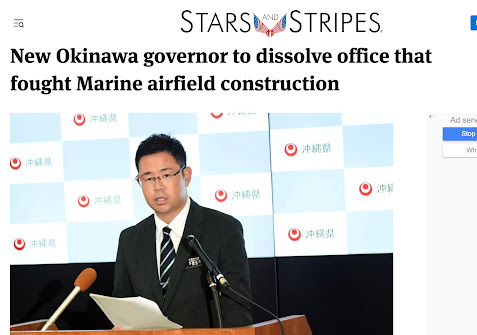

Stars and Stripes (Sep. 30, 2026) reports that Governor Koja closed the Henoko New Base Construction Countermeasure Division.
By Hideki Yoshikawa, Okinawa Environmental Justice Project, November 19, 2026
Okinawa’s 30-year struggle to halt construction of a new U.S. military base at Henoko-Oura Bay is at another crossroads. The September gubernatorial election brought Genta Koja, a proponent of the Tokyo government’s Futenma-Henoko plan, to office, replacing Denny Tamaki, a staunch opponent of the plan. The new governor now appears to be fully and subserviently collaborating with the Tokyo government to advance the plan. The Okinawa Environmental Justice Project and other civil society organizations need to intensify our challenge to the administration and the Tokyo government.
Backed by the Liberal Democratic Party, other conservative parties and the Tokyo government, Koja ran his campaign primarily on economic development (e.g., he promised doubling people’s income in 10 years). He downplayed the Henoko base issues and took the stance of “accepting” the Henoko project. Koja’s landslide victory has certainly given the Tokyo government the political confidence to proceed with the project.
However, this political confidence does not mean the Tokyo government can resolve the technical challenges posed by the soft seafloor at the construction site. Neither can it erase the environmental destruction the construction has already caused and continues to cause. Political decisions and agreements cannot make the physically real unreal or the physically impossible possible. This, what I call “environmental realism,” is the fundamental issue that the Henoko base construction project faces.
The Tokyo government knows this well. Still, 30 years of political inertia, the money being poured into it, and the fear of losing face keep the government committed to the project. It continues to manipulate information and use performative tactics to create the impression that the project is proceeding as planned, without environmental impacts, and that, once it is complete, the dangerous Futenma Air Station will be returned.
Now, under Tokyo’s watch, the Koja administration has begun pursuing its own information tactics. It has closed the prefectural government’s Henoko Base Construction Countermeasure Division and removed much of the critical information about the Henoko base issues—including crucial details about the seafloor—from the prefectural government’s website, where the Denny Tamaki administration had posted it. The Koja administration also appears to have decided not to pursue further efforts to obtain information about the Henoko base construction.
Given this situation, the Okinawa Environmental Justice Project (OEJP) needs to engage more effectively in this information battle and in lobbying domestic and international institutions.
Thus, we will be:
- Tracking progress or delays in the Henoko base construction project;
- Assessing the environmental damage of the project;
- Assessing the environment’s resilience to this onslaught;
- Sharing the information with the public and relevant institutions, including UN institutions and the U.S. government, so that they can act to help stop this ecocide project.
Let’s start by discussing the recent issue involving a caisson brought into Oura Bay in October…
A Caisson in Oura Bay: A Sign of Progress or a Delay to the Henoko Base Construction Project
On October 3, the Okinawa Defense Bureau towed a massive caisson (15 m in height, 50 m in length, 20 m in width) constructed in mainland Japan to Oura Bay. It now sits “temporarily” in the work yard in Oura Bay.
Given that the reclamation of the Henoko side, shallow water and stable seafloor, has been almost completed, the presence of this gigantic hybrid concrete structure near the construction site may give the impression that construction is moving forward smoothly and that another round of seawall construction and landfilling is imminent.
However, this is far from reality.
Before this caisson and others are positioned for seawall construction, two additional engineering procedures must be completed. First, the soft seafloor must be reinforced; second, base mounds must be constructed underwater by laying rocks on the solidified seafloor. Only then can the caissons be placed on the base mounds, and landfilling can begin.
As many experts have pointed out, seafloor reinforcement work has faced and continues to face technical difficulties. From January 2025 to September 2026, the Okinawa Defense Bureau (ODB) drove 9,500 sand piles out of 71,000 planned piles in the seafloor, or 13 percent of the total. These piles were installed in areas where reinforcement work is considered relatively easy. The water is shallow, and the soft seafloor layers are not very thick. The large remaining areas present far more challenging seafloor topography and geology.
Constructing base mounds on the seafloor will be equally difficult. Some mounds need to be over 15 m high, and they must also be levelled and solidified, all underwater.
According to Tsuyoshi Kitaueda, a retired civil engineer and long-time activist against the Henoko base construction, even if everything goes as planned, the ODB must keep the caisson in Oura Bay for at least 20 months before installing it alongside other caissons for seawall construction.
Moreover, the Bureau’s plan appears to fail to account for the harsh weather at sea around Okinawa. Indeed, this year, reinforcement work has been halted for four months because of typhoons.
Importantly, the public still does not know or understand the details of the construction work and process, and the dispute over the feasibility of the Henoko construction project remains unsettled.
We need to gather accurate information from the Defence Ministry and the construction companies.
On November 27, we will have the opportunity to do so. The Save the Dugong Campaign Center will meet with officials from the Defense Ministry, and I will participate as the International Director of SDCC and Director of OEJP. We have submitted questions about seafloor reinforcement work and environmental destruction. We hope to inform you of what the Ministry discloses.
The post An “Information Battle” on Okinawa appeared first on World BEYOND War.
From World BEYOND War via This RSS Feed.