

By Mawadda Iskandar – Nov 18, 2026
Sanaa’s advance along Yemen’s western coast has overturned Saudi-backed deployments, bringing the battle closer to Aden and tightening its grip on Bab al-Mandab.
The fighting on Yemen’s western coast has moved beyond the fall of Mokha and the subsequent withdrawal of Saudi-backed forces from their former positions.
Since September, the Ansarallah-led Yemeni Armed Forces (YAF) have advanced from the western coast and the areas around Mokha, Khokha, Dhubab, and Bab al-Mandab into the highlands overlooking the strait, then toward Kahbub, Al-Mudaraba, Ras al-Ara, and Khor Umaira in Lahij Governorate, reaching areas close to Aden.
The battlefronts are closely connected. The western coast stretches from Mokha and Dhubab to Bab al-Mandab, the strait linking the Red Sea to the Gulf of Aden. The inland highlands of Taiz and Lahij, particularly Al-Waziiyah and Al-Maqatira, control transit and supply routes to the coast.
Kahbub, Mudaraba, Ras al-Ara, and Khor Umaira form a coastal extension south of the strait toward Aden’s western approaches. Movement across these fronts therefore concerns the roads linking the coast to the highlands and supply centers, rather than isolated positions.
Speaking to The Cradle, Brigadier General Mujib Shamsan explains the strategic importance of this geography, saying that the liberated areas directly overlook Bab al-Mandab, one of the region’s most important shipping arteries.
He adds that Saudi Arabia amassed seven military divisions comprising 38 brigades around Bab al-Mandab, Mokha, Dhubab, Hays, and Khokha, which he considers an indication of the area’s importance to Saudi plans.
Shamsan identifies two connected geographical stretches. The first is the Red Sea coastal strip, encompassing Hays, Khokha, Mokha, Dhubab, and Bab al-Mandab. The second extends toward the Gulf of Aden, including Al-Suqayya, Ras al-Ara, and Khor Umaira.
In the highlands and rear areas, the Kahbub mountain range stands out as commanding terrain from which forces can exercise fire control over routes leading to the coastal districts, blocking attempts to recapture positions or launch new attacks. He also points to the importance of Jabal Al-Kharaz and positions in Suqayya, Ras al-Ara, and Khor Umaira in securing the coastline from Aden to Bab al-Mandab and Dhubab.
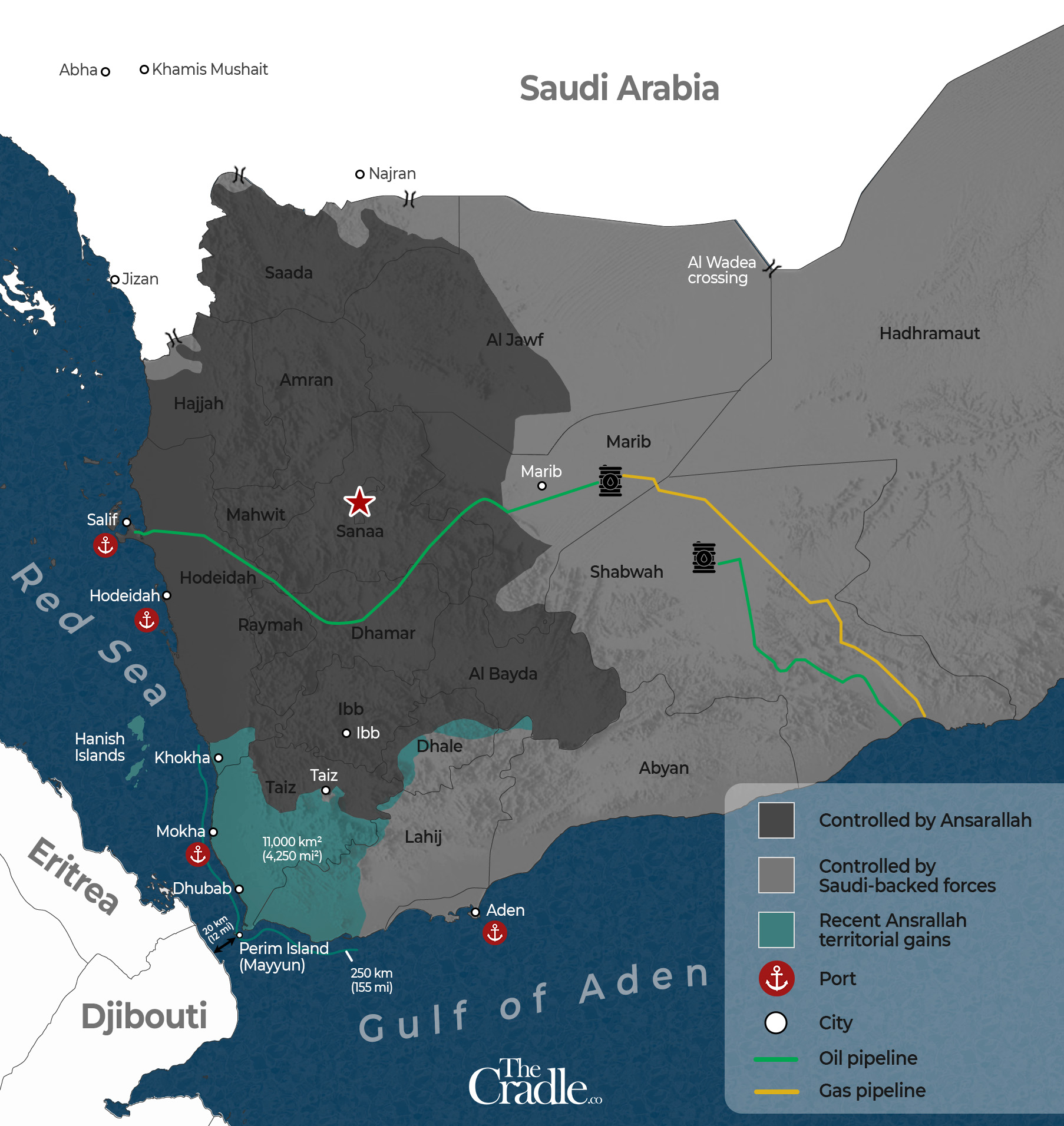
Yemen control map as of 18 November 2026.
A pincer from the mountains to the seaOn 17 November, the YAF announced the conclusion of “Operation And Allah Encompasses Them from Behind,” saying its forces had secured 10 districts in Taiz and Lahij covering 7,100 square kilometers, routed what it described as 12 military divisions comprising 60 brigades from Saudi troop concentrations, and destroyed or captured hundreds of vehicles and armored vehicles.
The announcement capped a battlefield campaign that had begun weeks earlier, as fighting shifted from the western coast to the highlands and inland roads connecting Taiz with coastal areas of Lahij. Sanaa puts its cumulative territorial gains since the launch of “Operation Dawn of Yemen” in early October at 10,600 square kilometers – slightly more than Lebanon’s entire area.
Since September, Sanaa’s forces have begun advancing toward positions around Mokha and elsewhere along the western coast, prompting Saudi-backed forces to launch counteroperations in October to regain lost ground. The fighting gradually expanded into the highlands and mountain passes of Taiz, which provide transit and supply routes toward Dhubab, Bab al-Mandab, and coastal positions in Lahij.
On 10 November, Sanaa launched a large-scale flanking operation along the Al-Waziiyah, Al-Maqatira, Kahbub, and Mudaraba axes. Beginning in the highlands and mountain passes, it advanced toward the coast over a distance exceeding 60 kilometers.
The maneuver targeted Saudi-backed supply lines and deployments between Taiz, Lahij, and Bab al-Mandab, applying pressure from several directions to encircle their forward positions.
Brigadier General Shamsan describes it as “a single, interconnected military operation carried out along multiple axes, forming the largest military pincer extending from the Kahbub mountain range to the Kharaz mountains and Khor Umaira.”
He explains that the advance through the highlands and along the coast encircled opposing troop concentrations and cut off the roads they used for movement and supplies. He adds that the theater of operations extended nearly 100 kilometers in depth, from the Kahbub mountains to the Kharaz mountains and Khor Umaira.
In his assessment, this reach, together with fire control over key positions and roads, altered the balance on the ground, preventing opposing forces from advancing, holding their positions, or launching fresh attacks toward Dhubab and the coastal areas overlooking Bab al-Mandab. The maneuver also reshaped military deployments across the area.
By 13 November, fighting had spread to the vicinity of Kharaz, Mudaraba, and Ras al-Ara, alongside clashes in Al-Fasiyah, Al-Majzaa, Al-Shatayn, and Al-Halhaliyah, and movements toward Khor Umaira. Kharaz emerged as a strategic location on this front, lying roughly 1.5 kilometers from the coast and overlooking routes between Bab al-Mandab and Lahij.
The following day, Sanaa announced the capture of the Kharaz military camp, while the Military Media Center released footage documenting advances in Mudaraba and Ras al-Ara and the evacuation of Saudi force positions.
The most significant shift came on 15 November, when southern forces announced their withdrawal from Dhubab Airport, the vicinity of Bab al-Mandab, and the outskirts of Kahbub. Movements then extended to Suqayya and other locations along the coast toward Mudaraba, Khor Umaira, and the area around the Kharaz mountains.
The Aden government presented the move as a tactical redeployment to protect Aden, secure supply lines, and prepare for another round under Operation Dawn of Yemen. Sanaa attributed the withdrawal to the flanking maneuver, which had left opposing forces unable to hold their forward positions.
Press sources reported that southern factions had been surrounded in several areas, requiring tribal mediation to arrange their withdrawal.
Activists contrasted the withdrawal with Sanaa’s prolonged operation to relieve its besieged fighters, during which forces reportedly opened routes through rugged mountain terrain amid continued fighting and airstrikes.
By 16 November, Sanaa continued expanding along the coast south of Bab al-Mandab toward Ras Imran in Aden Governorate, covering approximately 100 kilometers through Dhubab, Al-Hariqiyah, Suqayya, Ras al-Ara and its port, and finally Khor Umaira.
Khor Umaira is strategically important because it lies on the coastal road to Aden, falls within the city’s western defensive perimeter, and connects to inland routes in Lahij. Alongside these coastal developments, fighting continued in southern Taiz, particularly along the Al-Rahn, Al-Aqrud, and Kahlan axes, as Sanaa’s forces advanced on the Al-Najada front.
Cracks in the Saudi-backed ranksThe fighting also exposed weaknesses in the forces deployed across this terrain. The opposing formations include the Giants Brigades, Nation’s Shield forces, and southern forces, which differ in organizational structure, political allegiance, and support networks.
Coastal supply lines and maritime transport are especially important, as forces dispersed across mountainous and coastal areas require a continuous network to transport personnel, ammunition, fuel, and equipment. Any disruption to this network therefore affects their ability to withstand attacks and hold positions, even if they enjoy superiority in weapons and air cover.
In this context, Dr Ali Mohammed al-Mutaa, a university professor and researcher at Yemen’s Educational Research and Development Center, tells The Cradle that “The formations Saudi Arabia relied upon include parties with multiple loyalties and affiliations, united less by a common political or ideological project than by Saudi funding.”
He believes these differences, together with multiple centers of command and overlapping roles among local actors and external parties, limited cohesion on the front and exposed divisions among its components as the fighting intensified.
By contrast, Mutaa attributes the cohesion of the Yemeni army and Ansarallah to a shared cause, objective, and unified leadership, viewing the confrontation as a continuation of years of war and the destruction and suffering that accompanied it.
He says Sanaa’s announcement that it had liberated extensive areas and expelled Saudi-backed formations represents a major advance, noting that these formations comprised 12 military divisions totaling 60 brigades. He also estimates the value of captured weapons and equipment at around $20 billion.
The Saudi-backed forces’ setback also prompted changes in the command structure, with a decision to appoint Chief of the General Staff Fayyad bin Hamed al-Ruwaili commander of the joint forces, replacing Fahd al-Salman.
Mutaa links this change to the battlefield setback, describing it as part of a reorganization of command and oversight of the formations involved in the fighting. He further argues that the decision reveals external roles extending beyond Saudi decision-making, accusing the US and the Israeli entity of influencing the conduct of the confrontation behind the scenes.
Why Saudi Arabia Cannot Defend Against Yemeni Missiles and What It Means
**Is Aden next?**As the fighting moved into Mudaraba, Ras al-Ara, and Khor Umaira, Aden increasingly entered both sides’ military calculations. That proximity, however, does not necessarily mean that capturing it has become a direct objective of the operation. Reports citing military and government sources placed Sanaa’s forward positions near Kharaz, about 60 kilometers from Aden.
Brigadier General Shamsan stresses that the primary objective is to consolidate control over the liberated areas and prevent renewed attacks. He says the pincer maneuver aims to establish a defensive perimeter around Bab al-Mandab and the coastal areas, preventing hostile forces from using the area as a base for new attacks. He denies that there are plans to advance toward Aden Governorate.
He adds that portraying the operation as preparation for an advance on Aden is intended to frighten residents of the southern areas. He describes the advance as a defensive measure to protect liberated territory, stretching from Hays and Khokha on the western coast through Mokha, Dhubab, and Bab al-Mandab in Taiz Governorate, against renewed attacks.
Shamsan links the advance toward Suqayya, Ras al-Ara, and other positions to attempts by Saudi-backed forces to assemble and move troops toward the YAF on the western coast, after Sanaa had announced that it did not intend to advance into Lahij Governorate. He says the offensive aimed to consolidate control over these areas and block those movements, rather than open a front toward Aden.
Holding the coast as the war widensThese developments have forced Saudi-backed formations to regroup after losing forward positions along the western coast and around Bab al-Mandab, as pressure shifts to Lahij and the approaches to Aden.
For the YAF, the immediate priority is to consolidate their gains, maintain supply and communication lines, and prevent Saudi-backed forces from exploiting gaps to reopen fronts.
Airstrikes alone do not settle control of territory. As Saudi-backed forces retreat, Saudi Arabia is intensifying strikes on civilians and infrastructure in an attempt to pressure Sanaa and compensate for its battlefield losses.
The war has also reached deeper into Saudi territory, where the YAF have announced operations against strategic infrastructure to raise the cost of the conflict for Riyadh. Since early November, they have claimed attacks on King Khalid International Airport in Riyadh, Aramco facilities in the capital, and an oil installation in Yanbu.
They also announced drone attacks on pumping stations along the East–West Oil Pipeline, including Station No. 7 and, in a separate statement, Station No. 11 near Yanbu. On 17 November, Sanaa claimed to have launched five drones toward two further pumping stations near Riyadh.
The growing pressure on Saudi infrastructure has added to the economic and security costs of the war, compounding the territorial losses suffered by Saudi-backed forces along Yemen’s western coast. With the front lines pushed toward Aden and Bab al-Mandab increasingly under Sanaa’s control, the battle has extended from the Red Sea coast deep into Saudi territory.
From Orinoco Tribune via This RSS Feed.