

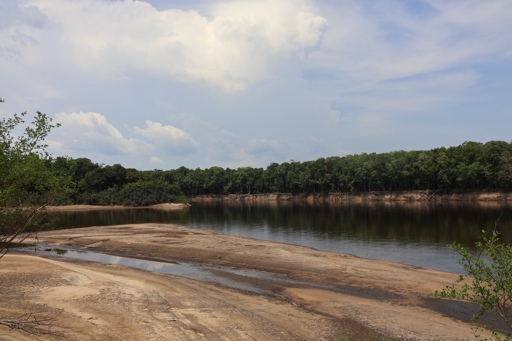
A small team of scientists was counting plants for a forest census near Manaus in northern Brazil when fire season started in October 2023. Some days the smoke was too thick to see; on other days it was too hot to wear conventional masks, so Aretha Guimarães, a biologist with Brazil’s National Institute of Amazonian Research (INPA) and her colleagues covered their faces with wet bandages in order to breathe. Even through the bandages and smoke, the smell of dead, rotting sloths was overpowering, Guimarães remembers. “Animals just kept showing up dead,” she told Mongabay over a video call. “I’ve never seen such mortality. We were shocked.” Over the following months, Guimarães and her team found dead sloths in every part of the forest they studied; some still hanging from branches. Most, they assumed, could not move quickly enough to find water when temperatures started to rise. “I can’t explain what happened, because I’ve never seen such a thing.” For decades, research has highlighted southern Amazonia, thousands of kilometers away, as the region’s climate change hotspot, where average temperatures are increasing faster than the north, exacerbated by deforestation and sweeping forest fires. Recent research published in September in Nature, however, identifies the central-north part of the Amazon Basin as the vanguard of an “alarming” increase in temperatures and dry conditions. Analyzing satellite, aircraft and observation station data between 1981-2023, the researchers found that across all of Amazonia, extreme temperatures increased more than twice as quickly as annual mean temperatures. Extreme…This article was originally published on Mongabay
From Conservation news via This RSS Feed.