

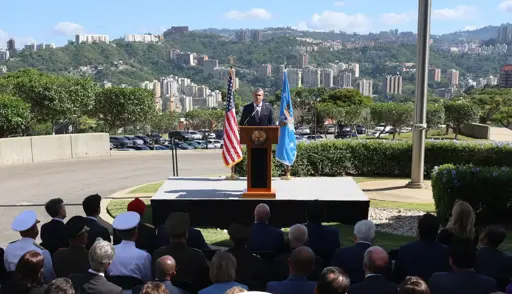
Caracas (OrinocoTribune.com)—Venezuela and the United States signed an agreement to resume military cooperation on Wednesday, November 18, during an unannounced visit to Caracas by US Secretary of War Pete Hegseth, whose forces bombed Venezuela and abducted President Nicolás Maduro and First Lady and National Assembly Deputy Cilia Flores less than a year ago.
Hegseth was received at Miraflores Presidential Palace by Venezuela’s Acting President Delcy Rodríguez. Venezuelan Defense Minister Gustavo González López and the Pentagon chief signed the agreement in the presence of officials from both countries.
Rodríguez described the resumption of technical-military cooperation as an opportunity to strengthen the Bolivarian National Armed Force (FANB) through training, equipment, and access to technology. She said she hoped the cooperation would reach its highest possible level to address what both governments describe as common threats.
Hegseth said the partnership would include joint training, intelligence sharing, and defense equipment. The full terms of the agreement were not publicly detailed in the announcements reviewed by Orinoco Tribune.
The visit brought to Miraflores one of the officials responsible for the January 3 aggression in which US forces bombed Venezuelan territory, killed Venezuelan and Cuban military personnel, and abducted the country’s president and first lady. For Chavistas and anti-imperialists, the image of Hegseth being received by Venezuelan authorities represents another humiliation and a further concession to the same imperialist power that attacked the country.
From military aggression to oil and military agreementsThe January 3 US attack killed more than 100 people, including 47 Venezuelan and 32 Cuban military personnel, while President Maduro and his wife were illegally abducted and transported to the United States. The military assault followed years of illegal US sanctions, economic blockade, threats, and “regime”-change operations against the Bolivarian Revolution and the Venezuelan people.
The military threat remains a real factor shaping the decisions of Rodríguez’s administration. However, Chavista critics have questioned whether successive and deepening concessions to Washington can be justified as necessary to prevent another attack, particularly as the US government openly boasts about the benefits it has obtained from its aggression and control over Venezuela.
Among the most consequential agreements is the oil deal that US President Donald Trump called the “deal of the century.” As Orinoco Tribune reported, the agreement involves 17 Venezuelan oil fields and the company North American Blue Energy Partners (NABEP). Rodríguez described it as a 25-year project, while the White House announced concessions lasting 100 years.
In an analysis published by Orinoco Tribune, political scientist Steve Ellner noted that the agreement grants the Pentagon a 35% ownership stake in the company involved in exploiting the fields. For critics, the participation of the US military establishment in Venezuela’s oil industry, following the bombing and presidential abduction, illustrates a relationship of neocolonial submission rather than cooperation between equals.
During Wednesday’s meeting, Acting President Rodríguez defended the oil agreement as beneficial to both countries. Hegseth also praised its economic potential while discussing military cooperation, linking US access to Venezuelan resources with Washington’s security agenda.
Defense minister cites sovereignty and mutual respectIn a statement dated November 18, Defense Minister González López described January 3 as a series of “hard and painful events” and said diplomacy should prevail as the means to overcome differences and build cooperation.
The minister said both countries had decided to resume technical-military cooperation at its previous levels, on the basis of mutual respect, national sovereignty, and reciprocity. He added that any initiative would comply with the Venezuelan Constitution and legal system, while preserving the FANB’s leadership, command, and responsibilities.
According to González López, the planned cooperation would include training, technical exchanges, technological upgrades, and the strengthening of military capabilities and equipment according to Venezuela’s institutional needs and priorities. He also referred to confronting common threats and reaffirmed a commitment to peace, regional security, international law, and Venezuela’s sovereign interests.
The assurance that sovereignty will be respected comes as the FANB is being asked to cooperate with the military that attacked it in January and whose highest civilian official used his visit to Caracas to celebrate that attack.
Hegseth celebrates January 3 attack and invokes Monroe DoctrineAfter signing the agreement at Miraflores, Hegseth went to the US Embassy in Caracas, where he used a press conference to celebrate the January 3 bombing of Venezuela and the abduction of President Maduro and First Lady Flores.
The Pentagon chief described the attack as a “day of liberation” for Venezuela. He recalled that President Maduro had challenged Washington to come and get him, and replied, “well, we answered that call,” according to mainstream reporting. However, Venezuelan journalists have demonstrated the lack of accuracy of this unsupported claim by the White House.
Hegseth boasted that US forces had solved a “27-year problem” for the hemisphere, a reference to the Bolivarian Revolution that began with the election of Comandante Hugo Chávez in 1998. He also praised the operation’s speed and sophistication, presenting the bombing and kidnapping as a military achievement rather than acknowledging the more than 100 people killed, including Venezuelan and Cuban military personnel.
The US official repeated the unproven “narco-terrorism” accusations against Maduro and claimed that the Venezuelan president had opened the country to terrorists. President Maduro and Flores have pleaded not guilty to the charges brought against them in the United States; their lawyers are seeking to dismiss the case on grounds of sovereign immunity.
Hegseth went on to describe Venezuela as having changed from Washington’s “most aggressive regional threat to a compliant security partner.” The choice of words was revealing: hours after being welcomed at Miraflores and signing a military agreement, the official responsible for the attack characterized the relationship in terms of Venezuelan compliance with US objectives.
He also thanked Acting President Delcy Rodríguez for cooperating with Washington in what the Trump administration calls the stabilization of Venezuela. According to mainstream coverage, he said the partnership could involve security and defense reforms to “modernize and professionalize” the Venezuelan military “top to bottom.”
Those remarks raise questions about the scope of an agreement whose full text has not been made public. Defense Minister González López has said the FANB will retain its leadership and command; Hegseth’s description points to US ambitions to influence the organization and operations of the same armed force Washington attacked in January.
The US secretary of war also invoked the Monroe Doctrine, the policy historically used by Washington to assert its dominance over Latin America and the Caribbean. He dismissed critics of the doctrine and said the renewed military partnership with Venezuela builds on its 200-year-old tradition and Trump’s corollary to it.
The claim was made in the capital of a country founded through an anti-colonial independence struggle and led for more than two decades by a movement that identified US imperialism as a threat to regional sovereignty. Hegseth’s defense of the doctrine directly contradicted the Bolivarian vision of Latin American independence and integration that Chavismo has long upheld.
The Pentagon chief also threatened those who Washington labels “narco-terrorists,” saying: “We will hunt you down. We will find you. And we will kill you.” He spoke of the consequences of the combined military power of the United States and Venezuela.
The threat comes after more than a year of US attacks on boats in the Caribbean and eastern Pacific. Washington has labeled those killed as drug traffickers while frequently providing no public evidence to substantiate the accusations. In one September strike documented by Orinoco Tribune, the US Southern Command announced the killing of four people without identifying them or providing verifiable evidence of drugs aboard.
Finally, Hegseth linked the US–Venezuela oil agreement to Washington’s war against Iran, claiming the deal makes the Strait of Hormuz a “nonfactor for the Western Hemisphere.” His statement presented Venezuelan oil as a strategic asset for the United States amid a war launched by Washington and its Israeli vassal against a longstanding ally of Venezuela.
Popular front rejects imperial presenceThe newly formed Venezuelan Frente Popular Antiimperialista (Popular Anti-imperialist Front) issued a statement calling on Venezuelans to defend the sovereignty and dignity of their homeland, rejecting attempts to normalize the presence of imperial and fascist forces in Venezuela.
The organization recalled the country’s independence struggles and the anti-imperialist legacy of Simón Bolívar, Augusto César Sandino, Ernesto Che Guevara and Comandante Hugo Chávez. It argued that Venezuela’s sovereignty cannot be surrendered to a power that has blockaded, attacked and looted the nation.
The front also rejected the handing over of national resources and called for respect for the sacrifices made by the Venezuelan people. Its statement reflects the indignation of Chavista and anti-imperialist sectors who see a growing contradiction between the Bolivarian Revolution’s principles and the concessions granted to Washington since January 3.
Earlier US operations and the Shield of the AmericasWednesday’s agreement formalizes a military relationship that has been developing since the US attack. In February, Acting President Rodríguez met US Southern Command chief Francis Donovan, whose command had overseen the January aggression. The Venezuelan government said the meeting addressed a bilateral agenda on security, migration, and drug trafficking.
In May, Venezuelan authorities permitted US military aircraft to fly over Caracas and land at the US Embassy for an exercise presented as an emergency drill. The operation prompted mobilizations by grassroots Chavistas and other political sectors, who condemned the presence of US military aircraft mere months after the bombing and abduction of their elected president.
In June, the Venezuelan government confirmed a joint operation with US security agencies in Bolívar state that killed Héctor Rusthenford Guerrero Flores, known as “Niño Guerrero,” the leader of the Tren de Aragua criminal gang. The White House described it as a US Southern Command strike coordinated with Venezuelan authorities. The operation drew criticism and skepticism after Venezuelan officials had dismissed earlier reports about a US deployment in the state.
More recently, reports circulated of an alleged bombing of a camp in Apure state near the Colombian border. One account, citing unnamed US officials, alleged that Washington supplied intelligence and drones for a Venezuelan attack. Other accounts differed over who carried it out.
As Orinoco Tribune reported, neither the alleged US role nor the identities of those killed and the supposed ELN affiliation of the site had been independently established. Venezuelan and Colombian authorities had not publicly confirmed the alleged operation.
These developments are taking place alongside Washington’s far-right and overtly imperialist Shield of the Americas initiative and its associated military and security coalition, presented as a campaign against drug trafficking and organized crime. The program advances a US-led regional security architecture at a time when Washington has expanded military operations and pressure across Latin America and the Caribbean to secure control of what it considers its “backyard,” thus reducing Chinese and Russian influence.
Special for Orinoco Tribune by staff
OT/JRE/SL
From Orinoco Tribune via This RSS Feed.