

By Veronika Barbosa
TACLOBAN CITY – “All the crops I planted, even if they are supposed to withstand heat, all died because of the extreme drought caused by the El Niño.”
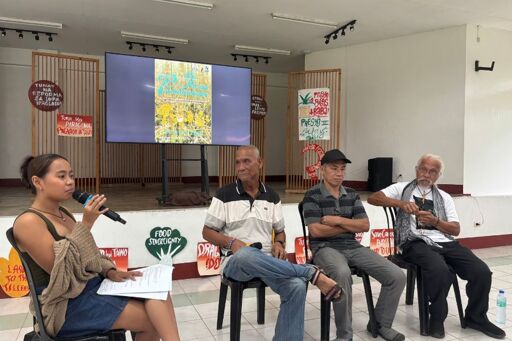
Gil Gacus, a farmer from Samar, stressed this point at the October 28 forum at the University of the Philippines Tacloban titled “Istorya Pankalibungan: A Forum on Climate Change and Environmental Challenges.”
The event was attended by members of organizations of fisherfolk and farmers, environmental defenders, development workers from Leyte and Samar, youth groups, and students from different universities in Tacloban. Farmers from Magsasaka at Siyentipiko para sa Pag-unlad ng Agrikultura (MASIPAG) shared the impact of Super El Niño on their crops.
Gacus said that the lack of a reliable irrigation system adds up to farmers’ burdens. “We have irrigation canals but there is little to no water due to drought so our crops end up dying.”
Jeremias Maligmat, a farmer from Leyte, stressed the need for government action now that farmers are suffering from the effects of El Niño. He also criticized Marcos Jr.’s lack of urgency and genuineness to help them. “He [Marcos Jr.] is asking us to use pails to collect rainwater, but how will we collect it if there is no rain?”
“If Marcos is genuine about helping farmers, his government should focus on addressing the challenges on irrigation and invest in machinery that could pump out underground water to help us farmers during times like this,” Maligmat said.
Maligmat added that on top of the environmental challenges and outright neglect from the government, landlessness is also a major problem faced by farmers. “The government should address these challenges affecting us farmers if they are so genuine about helping us as we are the ones producing food for the country.”
Roque Regis of Save Kanbatok Advocacy criticized the government’s reaffirmation to continue the halted construction of the Causeway Project in Cancabato Bay. “Since the construction of the Causeway started last 2023, there have already been recorded, irreversible damages to the bay. It destroyed the then thriving ecosystem of the bay by obstructing the natural flow of water.”
Regis said that some of his fellow fisherfolk have stopped from fishing due to the deteriorating state of the Bay. “These so-called developmental projects like the causeway project do not benefit the community or the poor, but instead benefit the rich who embezzle money through these projects.”
“Fisherfolk like Mano Roque struggled heavily, so much so that the fish, crabs, and other seafood they catch, if they have any at all, shrunk in size over the years since land was dumped on Cancabato Bay to build that Causeway,” said Jerx Aliposa of Save Kankabato Advocacy.
“Instead of coming up with solutions to address their concerns like providing subsidies and investing on technologies that could help them, the government would always think of developmental projects like the causeway project, with little to no regard of their repercussions to our communities,” Aliposa said.
Nemesio Baldesco of Tinambacan Environmental Advocates Coalition (TEAC), a network of environmental defenders from Calbayog City in Samar, said that their group opposes the Gemini Wind Power Project by Vena Energy in their city. “[I]t will greatly affect the biodiversity of our forests and will pollute our sources of clean water.”
Although their group and other advocates succeeded in getting at least five wind turbines removed from Pan-as Hayiban watershed, Calbayog’s protected landscape, Nemesio said that the project is yet to be abandoned. “Their [Vena Energy] alternative route is to install the turbines outside the watershed but still within our forests where it could still disrupt the biodiversity and result in the cutting down of hundreds of trees.”
WATCH : Envi advocates oppose Gemini Wind Project in Samar
Ronnel Arambulo, Vice Chairperson of Pambansang Lakas ng Kilusang Mamamalakaya ng Pilipinas (PAMALAKAYA), stressed the importance of collective action as well as the youth’s participation to oppose projects that damage the environment and livelihoods of farmers and fisherfolks. “Let us not allow our schools to become producers of brains that will only be used by the rich to forward their anti-poor agenda.”
Ronnie Manalo, secretary-general of the Kilusang Magbubukid ng Pilipinas (KMP), called on the farmers to fight for their rightful claim on the P45-billion funds allocated for El Niño. “Let us mobilize our farmers to compute all their losses and damages due to El Niño and collectively submit petitions to government agencies like the Department of Agriculture and our respective local government units.”
Jasmin Aguisanda-Jerusalem of Leyte Center for Development and Empowerment (LCDE), linked the challenges of our farmers and fisherfolks to our country’s economic policies. “Our economy is import-dependent when we have our local producers. It is clear that the policies we have in place are all for the profit of the few.”
As a development worker for 45 years, Jerusalem witnessed the dire economic and political conditions of people in Eastern Visayas. “Despite helping almost 800,000 people since LCDE started in 1988, we were slapped with criminal cases all because we decided to help those who are in need.”
“A strong people’s movement deeply rooted in communities–in schools, farms, factories–is what we need to change the very system [that] is rotten to the core,” Jerusalem said. (RTS, DAA)
The post Eastern Visayas farmers suffer from El Niño appeared first on Bulatlat.
From Bulatlat via This RSS Feed.