

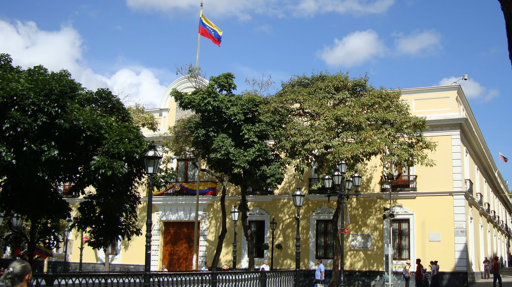
Caracas (OrinocoTribune.com)—Venezuela’s Foreign Minister Oliver Blanco repudiated statements by Uruguayan President Yamandú Orsi. Following Orsi’s suggestion that the Venezuelan government is not legitimate and that the country should hold new elections, Venezuelan FM Blanco referred to the remarks as political interference.
Orsi made the remarks on Monday, November 16, during an event in Madrid, Spain, where he said that Uruguay could not recognize Venezuela’s current government as democratic without elections. He called for a roadmap leading to what he described as free and transparent elections.
In response, Foreign Minister Blanco said that Venezuela’s political and institutional future is in the hands of the sovereign will of its people. He added that the country would continue addressing its internal affairs in accordance with that will.
The minister also argued that a president’s agenda should focus on addressing the needs of his own people, Diario Vea reported.
Orsi’s comments follow a similar dispute last month. As Orinoco Tribune reported, then-Venezuelan Foreign Minister Félix Plasencia rejected statements by his Uruguayan counterpart, Mario Lubetkin, who had conditioned the restoration of diplomatic relations on political change in Venezuela following the line of US, Latin American, and Venezuelan far-right sectors.
On October 12, Plasencia described Lubetkin’s position as unacceptable interference that disparaged Venezuelan sovereignty and self-determination. Lubetkin had said that Uruguay would not restore relations while Acting President Delcy Rodríguez remained in office.
New friction over Iranian official’s commentsSeparately, Venezuela’s Deputy Foreign Minister for Asia, the Middle East, and Oceania, Eduardo Ramírez Castro, criticized remarks by Iranian Deputy Foreign Minister Kazem Garibabadi comparing Iran’s resistance to US pressure with the situations in Cuba and Venezuela.
Speaking to Iranian state television on Sunday, November 15, Garibabadi argued that US sanctions and pressure would not force Iran to submit. He said Iran was neither Cuba, which could be subjected to a blockade, nor Venezuela, which could be forced to surrender. His comparison went beyond a general assertion of Iranian resistance: it suggested that Washington had succeeded in compelling Venezuela to capitulate.
The remarks came more than 10 months after the January 3 US bombing of Venezuela and abduction of President Nicolás Maduro and First Lady and Deputy Cilia Flores. Since the attack, Caracas and Washington have reconfigured their relations, a process that has generated debate among Chavistas and anti-imperialists over Venezuela’s sovereignty and the concessions being made to US interests.
Ramírez Castro said Garibabadi’s words were offensive to Venezuelans. He described Venezuela as a peaceful country committed to resolving differences through dialogue and diplomacy and called for respect for its institutions and an end to comparisons or references to its people.
The Venezuelanalysis outlet criticized the response, saying it had “seen this movie before” and questioning what it described as Venezuelan foreign policy’s belief in the “magical powers” of dialogue and diplomacy.
This is not the first diplomatic friction with Iran since the January 3 US attack. In July, Venezuela’s Foreign Ministry summoned Iranian Ambassador Ali Chegini and delivered a note of protest after Iranian Foreign Minister Abbas Araghchi suggested that Venezuelan authorities had backed down following President Maduro’s criminal abduction.
At that time, the Iranian Embassy said Araghchi’s remarks had been selectively presented and did not imply disrespect for Venezuela, its people, institutions, or sovereignty. At the time, Chavistas questioned why Caracas protested the Iranian minister’s comments while maintaining a conciliatory approach toward Washington despite repeated abusive statements by US officials.
Earlier, on February 28, the Venezuelan Foreign Ministry issued a controversial statement after the US and the Israeli colony launched their war of aggression against Iran. The statement condemned the attacks on Iran but also characterized Iranian retaliatory strikes as “undue and condemnable,” without naming the US and the Israeli entity as the aggressors.
The statement was subsequently withdrawn after criticism from grassroots Chavista organizations. Among those responding was the Alexis Vive Patriotic Force, which condemned the US-Israeli attack and expressed solidarity with Iran’s defense of its sovereignty.
For Chavista and anti-imperialist sectors, Iran’s resistance to US and Israeli aggression remains a source of inspiration. Their solidarity also reflects criticism of what they see as an inconsistency between Caracas’s protests over Iranian officials’ comments and its rapprochement with Washington and the Zionist colony of “Israel.” Iran’s leadership has inflicted a severe blow to the US-Israeli military forces that carried out the unprovoked bombing of Iran beginning in February.
Venezuelan delegation visits IsraelThe latest exchange with Iran coincides with a further development in Venezuela’s relations with the Zionist colony, whose government continues its genocidal war against Palestinians and has participated in the aggression against Iran.
A technical delegation from Venezuela’s Vice Presidency for Public Works and Services traveled to Tel Aviv for the seventh International Conference on Preparedness and Response to Emergencies and Disasters, held from November 16 to 18, Al Mayadeen reported.
Social Movements of Venezuela March Against US-Zionist Aggression on Iran
The visit follows cooperation that began after Venezuela’s June 24 earthquakes, when the Zionist colony sent a team that included military personnel to assist with recovery efforts. Caracas and Tel Aviv later announced a mechanism for consular services and continued technical cooperation. The visit represents another step in that controversial rapprochement, contrasting with the recent public disputes with Iran, a longstanding Venezuelan ally.
Venezuela severed diplomatic relations with the Israeli entity in January 2009 under President Hugo Chávez in protest of Israeli military operations in Gaza. Although steps have been taken towards restoration, the two have not yet established new diplomatic relations.
Special for Orinoco Tribune by staff
OT/JRE/SL
From Orinoco Tribune via This RSS Feed.