

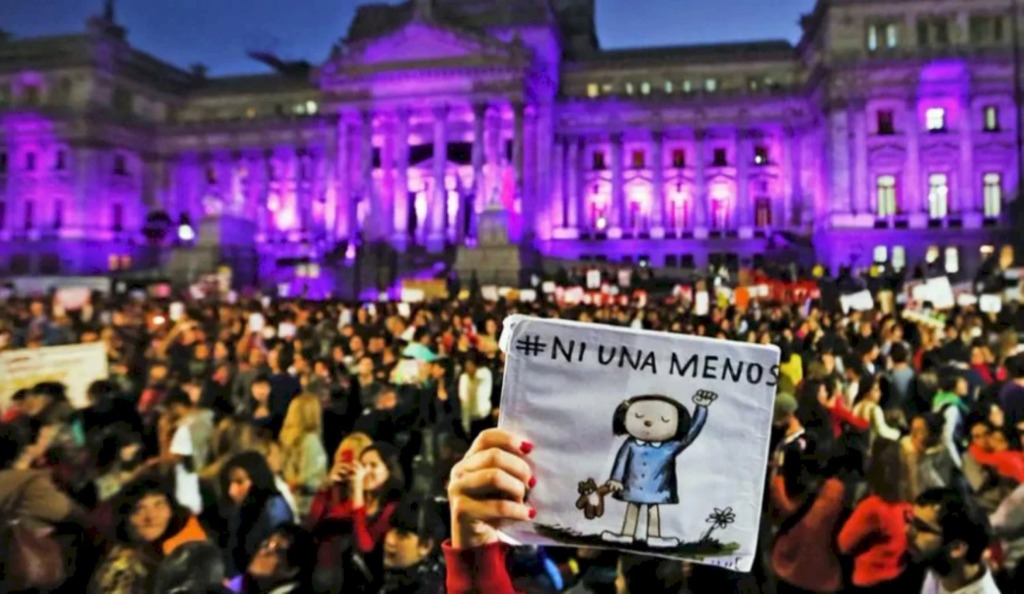
Argentina’s government, led by President Javier Milei, abstained on Tuesday from a United Nations vote on a resolution condemning violence against women and girls, once again aligning itself with United States.
The resolution seeks to step up member states’ policies and update their legislation to combat slavery and gender-based violence, including abuse in digital environments. It draws on evidence of extreme violence suffered by women and girls in areas of open conflict, and it also urges countries to guarantee women’s human rights and sexual and reproductive health.
The text passed with 175 votes in favor, six abstentions and one vote against, cast by Somalia.
RELATED: Argentina Records 36 Femicides in October, Worst Month Since 2022
During the debate, the U.S. government argued that the issue was not a priority and objected to references to gender, sexual and reproductive health, and sex education, saying they could interfere with U.S. law or the Republican administration’s priorities. Kali Gasteiger, an adviser at the U.S. Mission to the UN, said her country “could not join the consensus” because of the text’s wording. “It is disappointing to see the controversial term ‘sexual and reproductive health’ and the notion of ‘safe abortion’ in this resolution,” she said.
Before the final vote, the General Assembly’s Third Committee decided, by 68 votes to 54 with 30 abstentions, not to consider an amendment. The amendment would have made the resolution’s application conditional on respect for each country’s national laws, development priorities, and religious, ethical and cultural values. According to the International Service for Human Rights (ISHR), once that safeguard was discarded, the countries that had backed it chose to abstain.
🇺🇳 Ante la ONU, Argentina se abstuvo de votar una resolución contra la “intensificación de los esfuerzos para prevenir y eliminar todas las formas de violencia contra las mujeres y las niñas”.
➡️ El texto tuvo 175 votos a favor, 1 en contra y 6 abstenciones, junto con EE.UU.,… pic.twitter.com/ghnpl6t6YJ
— Filo.news (@filonewsOK) November 18, 2026
Text reads: “Before the UN, Argentina abstained from voting on a resolution against “intensifying efforts to prevent and eliminate all forms of violence against women and girls.” The text obtained 175 votes in favor, 1 against and 6 abstentions, along with United States, Russia, Belarus, Burkina Faso and Cameroon.”
Milei’s Government Defends Abstention
Sources at the Argentine Foreign Ministry said the position does not call into question the condemnation of such violence and responds instead to the content of the text, which the government believes includes controversial ideological concepts.
“Argentina categorically condemns all forms of violence against women and girls, but the reason for our abstention has to do with the body of the resolution, which includes ideological concepts that are controversial and biased; often, behind noble titles there is an ideological agenda,” the sources said. They added that the text prioritizes references to the gender agenda over concrete measures to reduce femicides and maternal deaths.
The approach contrasts with November 2024, when the far-right Milei’s government publicly explained its vote against a resolution aimed at preventing digital violence against women.
Ver esta publicación en Instagram
Una publicación compartida de teleSUR English (@telesurenglish)
Pattern of UN Rejections
Throughout Milei’s term, Argentine diplomacy, almost automatically aligned with United States and Israel, has made a series of sharp turns in foreign policy, breaking with traditions held for decades. Analysts and opposition figures describe the record as a string of international missteps, as Argentina has added its negative vote to several key resolutions in multilateral bodies.
In November 2024, the Milei’s administration voted against a resolution to protect the rights of native people and, three days later, opposed a text meant to intensify efforts to prevent and eliminate all forms of violence against women and girls. That same year, Argentina joined United States and Israel in voting against full UN membership for Palestine, a measure that still passed with 143 votes in favor.
The pattern continued in 2025. In March, Argentina rejected the declaration for the International Day of Peaceful Coexistence. In October, it broke with its traditional neutrality and sided with Washington and Tel Aviv against the General Assembly resolution condemning the U.S. blockade against Cuba. Specialists warned at the time that the stance weakened Argentina’s sovereignty claim over the Malvinas Islands, since it dismissed the principles of international law the country invokes in its dispute with the United Kingdom.
In March 2026, Argentina was again part of a tiny minority, joined only by United States and Israel, in rejecting a Ghana-backed initiative to reaffirm slavery as a crime against humanity and promote discussions on historical reparations.
The most recent case was the government’s refusal to back a global resolution to prevent and eradicate torture. With that vote, the current administration ended an unbroken position Argentina had held since the return to democracy in 1983. The move came just days after Alberto Baños, the undersecretary for Human Rights, appeared before the UN Committee Against Torture and publicly criticized local organizations that denounce human rights violations committed during the last civic-military dictatorship.
From teleSUR English via This RSS Feed.