

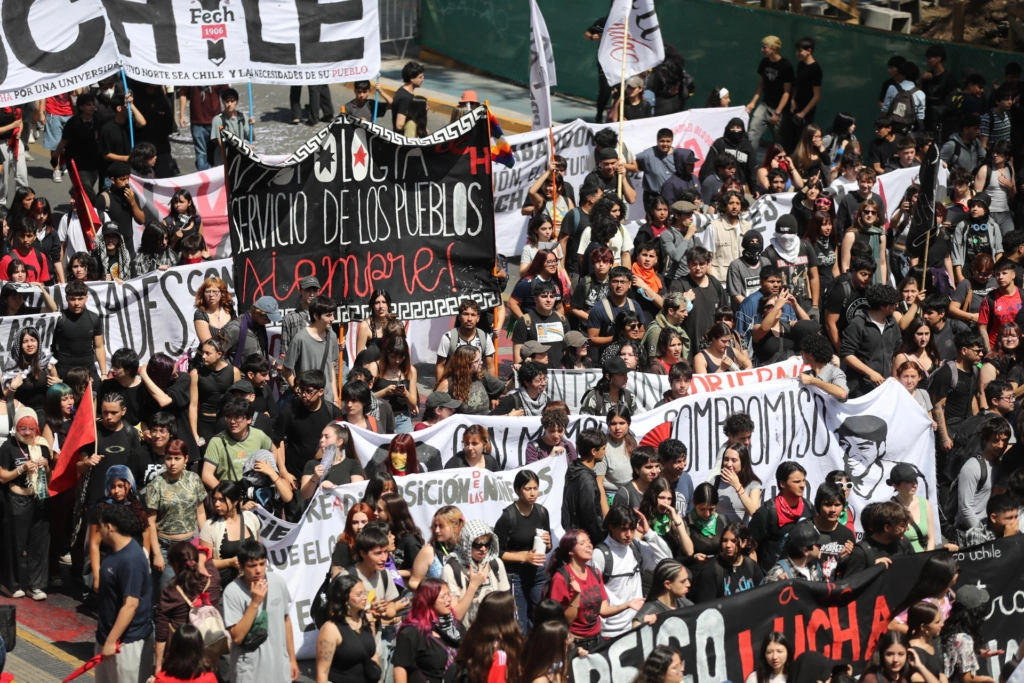
Thousands of people marched through Santiago on Wednesday to protest the spending cuts that Chilean President Jose Antonio Kast is pushing in the 2027 budget bill, as his government grapples with a technical recession, historically high unemployment and the lowest approval rating of his term.
The demonstration, called by the Unitary Workers’ Central (CUT), Chile’s main labor union, drew support from feminist, student and community groups. Marchers carried banners reading “There is money in Chile”, “Not one peso less” and “Conquered rights are defended”.
According to organizers, protests spread beyond the capital to Valparaíso, home to the National Congress, where lawmakers are debating the budget, as well as Antofagasta, Coquimbo, Chillan, Concepcion, Valdivia and Puerto Montt.
RELATED: Chilean Students Protest Proposed Education Budget Cuts
Traffic closures and a heavy police presence were reported in Santiago, and local media described an repressive incident involving pepper spray and the detention of demonstrators near the Gabriela Mistral Cultural Center.
🇨🇱 | Miles de personas marcharon en Santiago de Chile, convocadas por la Central Unitaria de Trabajadores, en rechazo a los recortes en educación, salud, seguridad y cultura contemplados en el proyecto de Presupuesto 2027 impulsado por José Antonio Kast. pic.twitter.com/inb5YGGkyI
— Mundo en Conflicto 🌎 (@MundoEConflicto) November 18, 2026
Text reads: “Thousands of people marched in Santiago de Chile, summoned by the Unitary Workers’ Central (CUT), in rejection of the cuts in education, health, safety and culture envisaged in the 2027 budget project initiated by Jose Antonio Kast.”
Budget Cuts Spark Anger
The 2027 budget bill, submitted to Congress in October, projects a 1.5% increase in public spending, to a total of 105.8 trillion Chilean pesos (more than 111 billion U.S. dollars). However, it includes significant reductions in social areas, including education, health, security, culture and gender equality. The text is now being debated in the Senate and has drawn strong rejection from the left-wing opposition and social movements.
Pressure from the opposition and social groups has already forced the government to put back into the parliamentary debate “I choose mi PC” a program that was eliminated from the original draft and is part of a plan to narrow the digital divide by providing laptops to 96,100 students in 2026.
“If the government keeps taking resources away from the State, we will keep mobilizing,” Unitary Workers’ Central’s President Jose Manuel Diaz said.
Nayade Zuñiga, a leader of the National Association of Public Employees (ANEF), said the mobilization was called by the world of labor against cuts to the State, adding that workers would not step back on rights.
Kast took office in March promising to reactivate the economy and balance public finances. During his campaign, he pledged to cut $6 billion in 18 months without affecting social rights, but after taking office he announced budget reductions across all ministries. The Unitary Workers’ Central (CUT) and other groups have not ruled out new protests while the budget is negotiated with the government, a process expected to conclude at the end of November.
Ver esta publicación en Instagram
Una publicación compartida de teleSUR English (@telesurenglish)
Recession and Falling Approval
The protests come amid a deteriorating economic scenario. Chile’s Gross Domestic Product shrank 1.1% in the third quarter of 2026 compared with the same period of 2025, the Central Bank reported Wednesday. The decline was driven by weaker investment and a 14.7% drop in mining, led by lower copper extraction, while household consumption rose 0.7%.
Finance Minister Jorge Quiroz acknowledged last week, for the first time, that the country is in a “technical recession.” More than one million people are unemployed, and inflation is rising because of sustained increases in fuel prices. Chile’s economy had grown 2.5% in 2025, when inflation closed at 3.5%, its lowest level in five years. Separately, the Organization for Economic Cooperation and Development (OECD) reported that real income per capita in Chile fell 3.5% in the second quarter, the steepest decline among the 20 member countries with available data.
Kast’s approval rating fell six points to 18%, the lowest since he took office, according to the latest Agenda Criteria poll published Sunday. Disapproval rose five points to 72%, while 10% said they were unsure. Criteria’s last recorded approval figure that low was for Sebastián Piñera in December 2021, during the COVID-19 crisis.
The President’s slide began shortly after he took office, when he declined to use a state mechanism designed to cushion the impact of volatile oil prices, passing the full increase caused by the war in West Asia on to consumers. More recently, a scandal over the release of around 50 child sex offenders and a truckers’ strike that blocked major highways for several days hurt his image further. Scandals have also forced three ministers out of his cabinet.
Public pessimism is growing: 60% of respondents expect the national economy to be worse in six months, up 11 points from October, while 46% expect their household finances to deteriorate, up 13 points. In addition, 53% believe their chances of finding a job or improving their current one will worsen, seven points more than last month.
From teleSUR English via This RSS Feed.