

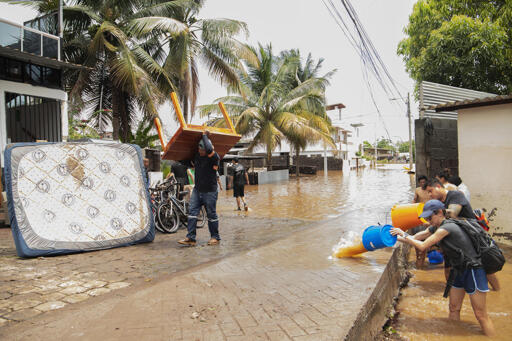
Ecuador’s emergency triggered by El Niño phenomenon keeps deepening, with at least 14 confirmed deaths and more than 91,000 people affected nationwide, the National Risk Management Secretariat reported on Wednesday.
Carolina Lozano, the National Secretary of Risk Management, said on Wednesday that 56,190 people are now registered as affected, while 35,504 others have suffered direct damage to their homes or livelihoods. She added that 54,170 people have already received assistance.
The combined figure exceeds 91,000 people, and at least 14 deaths have been confirmed so far.
RELATED: Ecuador’s Dengue Cases Top 43,000 as El Niño Floods Spread Disease
The emergency began to escalate in late August, when national authorities declared a red alert over relentless rains linked to the climate phenomenon. Floodwaters entered homes, cut roads and forced hundreds of families to relocate, especially along the coast.
The rains hit the coastal provinces with particular force, and most of the casualties and material damage have been reported there. Roads remain closed in several cantons, while hundreds of families are still living in temporary shelters as the waters slowly recede.
The national government keeps humanitarian teams, health personnel and technicians from several agencies deployed in the field. Lozano said the crews are distributing first-response kits, setting up medical care units from the Ministry of Health and carrying out inspections led by the Ministry of Infrastructure and Transport.
“We are arriving with first-response assistance kits, but we are also arriving with medical care units from the Ministry of Health. We are also arriving with inspections from the Ministry of Infrastructure and Transport,” she said.
🇪🇨🌧️ Milagro quedó bajo el agua y cientos de familias enfrentan una emergencia en #Ecuador. Las intensas precipitaciones provocaron el desbordamiento de ríos y esteros en esta localidad de la provincia de #Guayas, dejando calles y viviendas completamente anegadas.
Algunas… pic.twitter.com/gqV4iZpeLm
— GlobaLAT (@globaLATvideo) November 17, 2026
Text reads: “Milagro is underwater and hundreds of families face an emergency in Ecuador. The intense rainfall caused the overflow of rivers and estuaries in this locality of the province of Guayas, leaving streets and homes completely flooded.”
Preventive Works Lag
The slow advance of preventive projects concerns officials more than the rain itself. Only 19.3 percent of the priority works nationwide have been completed, and 63.9 percent have not even begun, Lozano acknowledged.
Milagro, a canton in the coastal province of Guayas, is among the territories hit hardest. Authorities there activated a 60-day emergency over the floods and mobilized two water treatment plants and 13 storage tanks, while crews repair roads and attend to affected families.
The damage extends far beyond the mainland. Emergency teams are also deployed on Santa Cruz island in the Galapagos archipelago, which lies about 1,000 kilometers off the continental coast.
Officials are already preparing for the next round of threats. The risk management secretariat instructed cantonal emergency committees to submit information on shelters, humanitarian reserves and available resources within 24 hours.
Rivers, tides and reservoirs remain under constant watch ahead of the spring tide forecast between November 25 and 28, an event that could worsen the overflows. The seasonal high tides known locally as aguaje can push river water back upstream and flood low-lying basins. Forecasts from the National Institute of Meteorology and Hydrology are being combined with tide records and contingency plans.
El Niño originates in the anomalous warming of the equatorial Pacific and alters rainfall and temperature patterns across the planet. In Ecuador the phenomenon has once again laid bare how vulnerable communities in flood-prone zones remain, and it shows the importance of preventive infrastructure matters when extreme weather arrives.
From teleSUR English via This RSS Feed.