

As the Trump administration and members of Congress on both sides of the aisle push to speed up data center development—against the wishes of the vast majority of Americans, according to recent polling—a coalition of more than 100 conservation and advocacy groups urged two top administration officials on Wednesday to impose an immediate moratorium on the facilities on public lands, arguing that “fundamental threshold issues” must be resolved before such development.
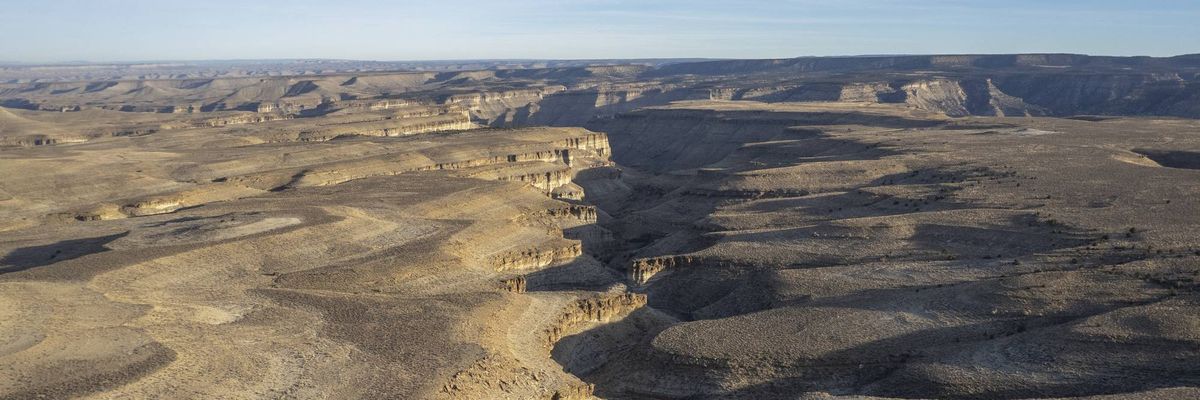
According to US Bureau of Land Management (BLM) records, at least 17 data center campuses and 13 related infrastructure projects—including transmission lines and access roads—have been proposed across more than 24,000 acres of federal land in Arizona, Idaho, Nevada, Oregon, Utah, and Wyoming.
Those projects have been proposed without determining “whether this new industrial use is legally authorized on public lands and, even if it is, whether large-scale data centers are an appropriate use of America’s public lands,” wrote the coalition of 115 groups to Interior Secretary Doug Burgum and Agriculture Secretary Brooke Rollins on Wednesday.
“There is no comprehensive federal policy addressing these questions, no meaningful public process examining the consequences of this new use, and no adequate framework for addressing enormous demands on water and energy, impacts to wildlife and cultural resources, or effects on tribal nations and nearby communities,” added the groups, including Defenders of Wildlife, the Sierra Club, Montana Conservation Voters, and Public Employees for Environmental Responsibility (PEER).
The letter follows recent reporting by ProPublica that showed Burgum has up to $64 million invested in artificial intelligence companies, many of which are pushing for the expansion of data centers to power their technology, while hundreds of President Donald Trump’s political appointees also have significant financial ties to the industry.
More than 320 officials appointed by Trump have ties to Google parent company Alphabet, which plans to spend nearly $200 billion this year on the data center build-out. More than 240 of them have investments or other financial ties to Meta Platforms, which is also developing data centers.
“The Trump administration is treating America’s public lands like a line item in their own investment portfolio, and conflicted Data Center Doug Burgum, who has tens of millions invested in the speculative AI data center build-out, is leading the charge," said Jayson O’Neill, a spokesperson for Save Our Parks. "This administration and Burgum will continue to use their power to give away our public lands to AI data center developers unless Congress steps in to block it.”
The coalition called a moratorium on data centers on public lands “the minimum responsible step.”
“It would give tribal nations, communities, lawmakers, and the public an opportunity to understand what is being proposed and to weigh in on whether commercial data centers are compatible with public land laws, purposes, and values. It would also allow for full examination of environmental impacts, cumulative demands on water and energy, and the consequences of transforming shared public lands into industrial sites.”
Public support for data centers has plummeted amid reporting on their massive consumption of energy and water and their contributions to climate pollution.
Last week, the Interior Department released a five-year plan that includes potentially selling off public lands—a proposal, O’Neill told ProPublica on Tuesday, to "sell off what’s left to AI data center developers and [Burgum’s] extractive resource buddies.”
According to More Than Just Parks, projects already proposed for public lands include:
- Project Beehive, proposed by Valar Atomics, on over 9,000 acres of BLM land in Carbon County, Utah, and 17 miles from the Nine Mile Canyon Area of critical environmental concern;
- On the Mark Data Center near Silver Springs, Nevada, and 23 miles from Stillwater National Wildlife Refuge; and
- A 4-million-square-foot data center campus with its own gas plant near Blacks Creek Reservoir, on 3,200 to 3,700 acres of BLM land.
A dozen Democrats in Congress are pushing to limit or ban data centers on or near public lands, according to reporting by ProPublica on Tuesday, with some citing the reports on Trump administration officials’ ties to the AI industry.
Rep. Rashida Tlaib (D-Mich.) told the outlet she would “continue building the coalition” for the No AI Data Centers on Federal Lands Act, which she introduced in July in the Republican-controlled Congress. Democrats are set to take control of the US House of Representatives and the Senate in January.
“The American people expect public lands to be managed for the benefit of everyone, not a handful of corporations," said Jose Witt, Nevada state director for the Wilderness Society. "These are the places we hike, hunt, and connect with the natural world, yet the administration is poised to dramatically reshape how public lands are used to benefit big tech and the data center industry. The recent election made clear that Americans want a check on data center development, and we urge the administration and Congress to pause data center construction on public lands so we can fully assess the impacts and give the public a real say.”
The coalition wrote to Burgum and Rollins two days after 21 members of the Democratic caucus in the Senate voted to end debate on the Bipartisan American Affordability and Jobs Act, which would speed up the federal permitting process for data centers and fossil fuel projects. Advocates have warned that the bill’s changes to federal law would open up public lands for the facilities.
“America’s public lands belong to all of us,” reads the Wednesday letter. “They provide places to hunt, fish, hike, camp, and connect with nature; protect clean water, wildlife habitat, cultural resources, and landscapes important to tribal nations; and preserve opportunities and experiences that cannot simply be recreated once they are lost. These shared lands should not be sacrificed to an unprecedented wave of industrial development without a national conversation about whether that development belongs there in the first place.”
From Common Dreams via This RSS Feed.