

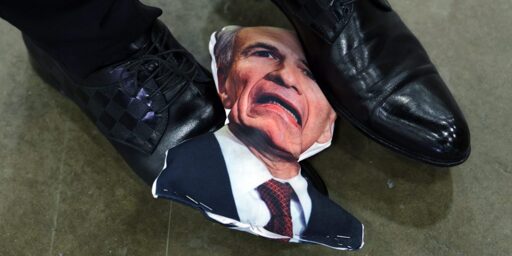
As Texas Republicans pursued their crusade against the Council on American-Islamic Relations, they ran into an unexpected obstacle: voters.
Republicans Gov. Greg Abbott and Attorney General Ken Paxton had carried out their crackdown on the largest Muslim civil rights group in the U.S., hoping to ban CAIR’s operations in the state and label it a terrorist organization. That agenda suffered a crippling blow in the midterm elections, when Democratic candidates beat Abbott and Paxton in stunning upsets — with both their current offices set to be led by Democrats.
Gov.-elect Gina Hinojosa promised to reverse Abbott’s designation of CAIR as a foreign terrorist organization. She told the Washington Post last week, “We have to use public safety measures for public safety” — decrying Abbott’s designation as “nonsense.” Paxton, who lost a bid for an open U.S. Senate seat, dropped a lawsuit, filed in February, that would have banned CAIR from operating in Texas.
“Don’t underestimate the power of the vote to create the administration that creates and enforces these laws,” said Chelsea Glover, a lawyer with the Muslim Legal Fund of America, who is representing CAIR Texas in litigation challenging Abbott’s designation. “Lots of times we don’t think it’s possible but, as Texas has shown, anything is possible.”
The Muslim Legal Fund of America said the lawsuit is ongoing and will be until Abbott’s terror designation is formally withdrawn by Hinojosa.
CAIR’s suit was necessary, said Glover, but acknowledged that the ballot box can be a faster way to shut down bigotry than drawn out court cases.
CAIR welcomed Hinojosa’s promise to walk back Abbott’s proclamation, which CAIR called a “baseless, unconstitutional order.”
The proclamation classified CAIR and its Texas chapter, as well as the Muslim Brotherhood, as foreign terrorist groups; it also banned designated groups from buying or acquiring land in the state.
“When you get the right person in power, who is going to follow the Constitution, it’s like — poof, the designation is gone almost overnight,” said Imran Ghani, director of digital communications for CAIR Texas and operations director for the Houston branch.
[
Related
25 Years After 9/11, Muslims Are Still Politicians’ Favorite Scapegoat](https://theintercept.com/2026/09/04/911-muslim-islamophobia-terrorist/)
Ghani said CAIR Texas noticed a chilling effect after Abbott’s proclamation last November. Some donors stopped giving money, and a few mosques became hesitant to platform CAIR. He said the organization quickly rebuilt trust and also won over new supporters who were invigorated by the state’s targeting of CAIR and wanted to help.
“I tend to look at it rather positively,” Ghani said. “The designation gave CAIR more publicity than we have ever received.”
CAIR Texas officials pointed out that Republican candidates leaned heavily into fabricated fears about Muslims taking over Texas and enforcing sharia law.
“We had to send a strong message,” said Shaimaa Zayan, Austin director for CAIR Texas. “If we allow them to say all of that and stay home that would be a green light for them to continue harassing our community.”
CAIR Texas says the organization scaled up its engagement around the elections this year by showing up weekly to dozens of mosques in Houston, Austin, and Dallas, from August until early October, during Friday prayers, to encourage voter registration.
CAIR Action, the group’s political wing, reported historic turnout for Texas Muslims voting early in a general election—marking a 78.6 percent increase since 2018.
[
Read our complete coverage
Chilling Dissent ----------------](https://theintercept.com/collections/chilling-dissent/)
State-Level Bigotry
Republican candidates’ anti-Muslim rhetoric came alongside the state education board approving an anti-Islamic rewrite of Texas social studies lessons and exclusions on a voucher program for K-12 Islamic schools.
Islamophobia has also led to violence against Texas’s Muslim population in recent years. In 2024, the Justice Department sentenced a Dallas man to 37 years in prison after he killed one person and tried to kill four others during a mass shooting at a Muslim-owned business; the FBI said he intentionally targeted Muslims.
While designating terrorist organizations is normally a power reserved for the federal government, Texas and Florida have taken unprecedented actions to allow state officials to apply those labels.
[
Related
RFK Jr. Claims He’s Investigating Terrorism Now, Too](https://theintercept.com/2026/07/02/rfk-cair-terrorism-muslim-investigation/)
CAIR and its Florida chapter suspended operations in Florida earlier this month after Gov. Ron DeSantis and four state officials designated the groups as domestic terror organizations under a new, unprecedented administrative process approved by the legislature this summer.
The American Civil Liberties Union and CAIR sued DeSantis, alleging free speech and due process violations. The civil rights groups also argued that the debilitating penalties associated with the designations effectively force targeted groups to shut down.
On Monday, DeSantis commented on X about news of Hinojosa’s promised reversal and said, “This would be a huge contrast with Florida, where CAIR has disbanded.”
“Elections have consequences,” said Shirin Sinnar, a law professor at Stanford University.
She pointed out that the different outcomes in Florida and Texas “show the power of electoral consequences on the same issue.”
“A Loaded Gun”
Sinnar cautioned that the federal government may have plans of its own to crack down on nonprofits.
The Wall Street Journal reported on November 6 that the Trump administration is considering an executive order that would list some nonprofits as being tied to terrorists, effectively shutting down their operations.
Sinnar said that while Texas may be backing off from the executive order and lawsuit against CAIR, there’s more work to be done at the state level.
[
Related
Trump Wanted Minnesota 15 Case to Be Another Prairieland. Instead, Twin Cities Rallied Behind Anti-ICE Activists.](https://theintercept.com/2026/10/12/minneapolis-15-ice-protesters-prairieland-unions/)
“It’s a good moment for civil rights advocates and communities to push the legislature to repeal the laws that enabled these designations,” she said. “Otherwise, they’re a loaded gun available to be used in the future against CAIR or another disfavored target.”
Those laws include measures that created the category of Texas foreign terrorist organizations and authorized state and local officials, as well as private residents, the ability to bring civil suits against them without having to prove any personal injury.
Youssef Chouhoud, a research scientist for the Texas-based nonprofit Yaqeen Institute for Islamic Research, which focuses on issues related to Muslims, said Republicans in the state will likely continue engaging in Islamophobic rhetoric and policies. Attacking the Muslim community was “very much a winning strategy” in the Republican primaries, he said.
Though 95 percent of Republican primary voters said they supported a ballot proposition asking if “Texas should prohibit sharia law,” critics pointed out that the state’s anti-Muslim hysteria has led to an overblown focus on Muslim religious law.
“It’s a badge of honor to be targeted by extremists in the government.”
Ghani, in Houston, had left a corporate job for more meaningful work and joined CAIR only about two months before Abbott’s terror designation. He took solace in his five daily prayers and hoped the past would become precedent.
“History has shown this is the path of many civil rights groups,” Ghani said of the persecution — and perseverance — of other civil rights groups like the NAACP in the 1950s and 60s, and the ACLU itself during the McCarthy era.
“It’s a badge of honor,” Ghani said, “to be targeted by extremists in the government.”
The post Greg Abbott Tried to Destroy Muslim Group By Calling Them Terrorists. Texas Voters Balked. appeared first on The Intercept.
From The Intercept via This RSS Feed.