

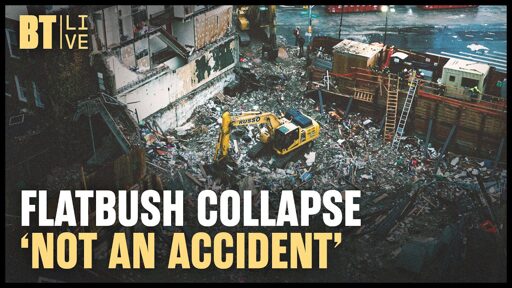

“The city knew.” The Brooklyn building collapse that killed eight people, including two children, wasn’t a freak accident, says Jaylen Strong, a New York City organizer with the Party for Socialism and Liberation. It was the predictable result of a housing system where landlords profit from neglect, and where Black, Brown and immigrant tenants pay the price.
Joining BT Live’s Zoe Alexandra, Strong points out that a building with nearly 100 open city violations would never have been left to crumble in a wealthier neighborhood. He links the collapse at 1321 Flatbush Avenue to Trump’s ICE raids that keep families hiding at home, and to a government that has money for war on Iran but not for public housing. Seeing the rubble at Flatbush and Bedford, he says, “you can’t help but think of Palestine.” From West Africa to Central America, Strong says, people look at Flatbush and recognize their own struggles.
The building’s Olufemi Falade had made the city’s Worst Landlord Watchlist six times, and the construction site next door – a Robert Fischman development built by Townhouse Builders – had already been cited for unsafe excavation. Now, Strong says, the fight is to make sure those responsible for this tragedy are held to account, and that displaced families get permanent homes – not temporary hotel rooms where, he says, there’ve been reports of mice.
Watch full episodes of BT Live, join breakthroughnews.org as a member today!
#breakthroughnews
******
Rough transcript follows:
[Speaker 1:] A building collapse could happen at any moment. We’ve seen this happen. For landlords who operate in poor, working Black immigrant communities, this kind of neglect is profitable. Even if it doesn’t end in a tragedy like this, people make money off of this neglect and a system that’s deliberately built on racial exclusion, ignoring the possibility of danger to the most expendable communities.
[Speaker 2:] Last Wednesday afternoon, a three-story mixed-use building on Flatbush Avenue in Brooklyn collapsed into a construction pit next door. Eight people were killed, two of them children. Nearly 20 more were injured. The building housed working families and apartments above a street-level storefront. Families who lived there lost everything. Their homes were suddenly cut open to the street, closets and bedrooms exposed, hanging open in the rubble for the whole city to see. The warning signs were there. The building had nearly 100 open violations with the city, including citations for exposed wiring and missing smoke detectors. Its landlord had made the public advocate’s worst landlord watch list six times. Next door, the construction site where crews were digging for a planned nine-story building by developer Robert Fishman with Townhouse Builders as a general contractor had already been cited for unsafe excavation and demolition. Brooklyn’s district attorney has opened a criminal investigation, but residents and organizers say they’ve heard promises of accountability before with little follow-through. Joining us now is Jaylen Strong, a Brooklyn-based organizer with the Party for Socialism and Liberation. Jaylen, thanks so much for joining us here.
[Speaker 3:] Thank you, Zoe. Thanks for having me on. I’m glad to be back.
[Speaker 2:] It’s really hard to call it anything but a tragedy, what happened in Flatbush last week. Unfortunately, it is not necessarily a new phenomenon for New York City. Talk to us about this cycle of landlord neglect and tenants paying the price.
[Speaker 3:] You’re right. What happened on November 11th in Flatbush, where this complete tragedy occurred, is not new at all. It’s a stalwart of New York City history and system. It’s not an isolated event. This long-documented history of building failures, construction negligence, aging infrastructure, and chronic disinvestment in the most exploited communities, the most working-class Black and Brown communities, is a long-term part of New York history. The Bedford Avenue building collapse sits not only in this history but also in a cluster of recent structural emergencies and catastrophes that are completely preventable. This tragedy is something many people haven’t seen in a long time to this degree, especially because it’s so deadly. We lost the lives of eight innocent people, two of them children. It’s impossible to think this could have happened in our neighborhood, in our city, in the richest country in the world, where democracy and rights are touted as abundant. But that’s clearly not true from what we see. When you look at the video, you see firefighters excavating and digging in a rescue mission for people who, in the middle of their lives, fell into a pit. It’s a horrible metaphor for how the system works, how capitalism works, and how deadly it is when you look at these videos of rubble and destruction and the insides of people’s homes and lives. This culpability is part of a long history in New York City, but more so about the capitalist system in the United States. The landlord system, the system of greed, negligence, and what is possible when people see life as expendable and put profit over people. It’s a complete shame that this could happen, especially in a neighborhood where I have family, where I have little children coming into the world, cousins, babies. This is something that could have happened to our families, and it’s something that I see as a community, as something very close to my heart, such a tragedy that is completely avoidable.
[Speaker 2:] Truly heartbreaking. Before we dig into the element of landlord greed, I wanted to bring up another element that’s come out in a lot of the reporting, which is that several of the victims of this collapse were undocumented immigrants. I read one report that one family had been trying to stay at home, where it seemed like a safe place, because of the presence of ICE and the constant threat of detention and deportation. Talk to us about that element, that many of the people living in this building were either from an immigrant community or undocumented themselves. How does that play into this tragedy?
[Speaker 3:] Absolutely. Outside of the obvious structural issues, the fact that people would have to hide in their homes because they are immigrants or migrants to this country is completely absurd. Hiding from ICE on a daily basis is something we’re hearing about in every immigrant community in New York City and almost across the country. People are afraid to go outside and go about their lives. That’s an insane reality constructed by the Trump administration at large, but also the existence of ICE as it stands. It’s an agency that has been let off the leash in every major city in this country. It’s absurd that someone would be completely retreated from reality, retreated from daily life, and afraid to go out on the street. The force of ICE, the violence, the murders we’ve seen across the country, people in a state of fear and shock, is absurd. This is not a reality we will accept. It adds to the layering aspects that not only was the structural issue of the building collapsing the core element relating to the capitalist class, but it also relates to this large struggle and fight against ICE, which is happening in every major city. It’s confounding to think that both of these things could happen at once, but it’s the reality we are seeing and observing and that we refuse to let happen. We have to fight back against it. It becomes a twofold issue that relates to the same enemy and the same root cause.
[Speaker 2:] Let’s dig in about this landlord and how the city has responded. This building had nearly 100 open violations. The landlord was on the worst landlord watch list six times. The site next door had already been cited for unsafe excavation. Everyone seems to have known this was a ticking time bomb. Why do you think the warnings didn’t stop this? Who bears responsibility for that failure?
[Speaker 3:] The city knew. That’s what those documents show, that the city knew. This pattern is not one of a rare accident. It’s part of systemic neglect, and that systemic neglect falls hardest on communities from which political power is most stolen. The responsibility is shared among the developer, the landlord, and the city enforcement apparatus that repeatedly failed to do anything about these documented hazards. This is a pattern that happens all the time. A building collapse could happen at any moment. For landlords who operate in poor working Black immigrant communities, this kind of neglect is also profitable. Even if it doesn’t end in a tragedy like this, people make money off of this neglect and a system deliberately built on racial exclusion, ignoring the possibility of danger to the most expendable communities. If a building had violations like this in one of the wealthier neighborhoods in New York City or New York State, you would see a different outcome. The way housing functions in this city, the racial wealth gap persists today under the system of housing in the United States. The responsibility is with the builders, the landlords, the owners, the contractors at the demolition site, the special investigators and inspectors who are supposed to make sure things like this don’t happen, the firms, the engineers. There are countless people to blame. But at its core, we’re talking about the system that would allow for it to happen, a system that allows for tragedies like this to become a constant phenomenon. This constant cycle of neglect and the people who pay the price are tenants, working people. It’s unfathomable to think about. This responsibility is the system’s to bear truly.
[Speaker 2:] In this moment, there are mass strikes in Spain demanding dignified housing against the housing crisis. We’re seeing cases like this happening in other cities in the United States as well. Perhaps not a building collapse as such, but this constant demand for dignified and safe housing, skyrocketing rent prices, even in cities that used to be cheaper. Do you see this as something isolated to New York City? How do you understand it within a nationwide context?
[Speaker 3:] I see it as an issue of austerity, the rising cost of living, and it’s all related to the choices of the government and the system. There’s more money for war, but not for housing, public housing, or socialized housing. There isn’t money for affordable food, but there’s money to go to war with Iran for no exact reason except for the will of the president and the functionaries of the White House. This is a national issue affecting everyday affordability crises, but it also becomes an international issue. When you look at the photos of the building, you can’t help but think of Palestine, Gaza, to see rubble and the openings of people’s homes in destruction. Your mind and heart go to what we’ve seen in the genocide in Palestine. This kind of destruction makes you think of what has happened across the globe under US imperialism for decades. It becomes a national issue because almost everybody working experiences the crisis we are going through right now when it comes to living dignified lives, having permanent housing, being with our families, friends, and living the lives we deserve. There’s a deep interconnectedness between what we see happening here in the United States and everywhere across the world. Deterioration happens to the most exploited. We are an exploited class here, working people, but also all across the world under the boot of imperialism. It becomes an issue relatable not just to the everyday American but to anyone forced to live in squalor despite their efforts to remove themselves from precarity and build the lives they want. People in West Africa, Korea, Central America, and elsewhere have been watching this story closely because this kind of tragedy happening in the United States is a clear sign of what is happening in the country today and abroad. At a rally outside the collapsed building, an organizer shared that a person from Palestine donated to help the families impacted, providing supplies. This person, under the boot of imperialism, occupation by the Israelis, saw what was happening in New York City and Flatbush and felt a responsibility to help. It truly is a large issue, a national issue, but I see it as a much broader instance that calls for solidarity, organizing, and work against the system of housing in the United States that’s been profit-first for decades. Housing should be free for all.
[Speaker 2:] Finally, Jaylen, what does a demand for justice look like for the victims and their families of the collapsed building at Bedford?
[Speaker 3:] Right now, families from the city are staying in hotels. There have been reports that these hotels are not up to standard, with mice in the hotel. Putting people in situations where their lives are again not respected. This first response by the city’s bureaucracy is not enough. The real demand for justice is permanent and affordable housing. The real demand for justice is the abolition of ICE. The real demand for justice is moving away from a system that allows people to be afraid in their homes and also be in the precarity of maybe not even having a home. There needs to be permanent and affordable housing. There needs to be the prosecution of those culpable, the landlord, the developer. This needs to happen. This is the real crime. The system treats need as crime, but this is the true crime, where innocents have lost their lives. The demands are that this needs to be investigated, prosecuted, and those affected need permanent and affordable housing. But everyone in this country deserves that. This should not be a question in 2026 that people don’t have places to sleep, that in the richest city, in the richest country in the world, people are sleeping on the street, houseless, cold. It’s unfathomable that this is the reality. We have to continue to fight and build and activate our communities to have political agency in this fight, a fight we will win, but one right now seeing complete catastrophe and it will galvanize millions of people.
[Speaker 2:] Very powerful. Jaylen Strong from Brooklyn, thank you so much for joining us here at BT Live and for all of your work in this heartbreaking moment in our city, but there is an important path forward.
[Speaker 3:] Thank you so much, Zoe.
From BT News via This RSS Feed.