

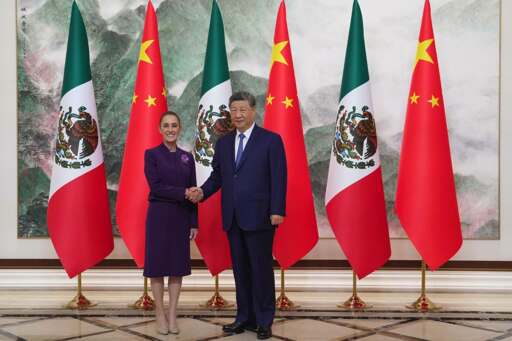
The president of Mexico, Claudia Sheinbaum, declared that “in times of profound economic transformation, we must understand that prosperity cannot be built at the expense of others.” She made this statement in her address at the Asia-Pacific Economic Cooperation (APEC) Leaders’ Summit on Tuesday, November 17, in Shenzhen, Guangdong Province, China.
In her speech at the summit, President Sheinbaum mentioned the expression “common prosperity” four times, a term promoted by Chinese diplomacy since the start of the current phase of the country, the New Era of Socialism with Chinese Characteristics, which began in 2013.
The APEC Leaders’ Summit brings together more than 2,000 political and business representatives from the 21 APEC economies and 13 other countries that are not members of the organization. Among the topics of discussion are cooperation in the digital economy, artificial intelligence, and green and low-carbon development.
One of the objectives of the Mexican president on her first visit to China (although not officially a state visit) was to present her government’s flagship program, the “Plan Mexico,” which, as she explained, has five pillars: “Common prosperity, energy and food sovereignty, public, private, and mixed investment in infrastructure, incentives for private investment based on the productive vocations of each region, and environmental responsibility to combat climate change.”
She referred to the recent World Bank report revealing that since 2018, approximately 17.3 million Mexicans have been lifted out of poverty, a 15% reduction in poverty in the country. This period coincides with the beginning of the government of her predecessor, Andrés Manuel López Obrador, from the same party, MORENA. “In Mexico, the minimum wage has increased by 154% in real terms over the past eight years, 42 million people [32% of the population] receive direct transfers, with a historic investment of one trillion pesos [approximately R$ 313.3 billion] through the Banco del Bienestar,” Sheinbaum said.
In terms of infrastructure, the Mexican president stated that $43 billion have been invested in the construction of 2,500 kilometers of railroads for passengers and freight. The Chinese public company, China Railroad Construction Corporation (CRCC), one of the largest construction and engineering companies in the world, is a major investor in some of the new railroad projects in Mexico, along with other Chinese state-owned enterprises.
Reunión con el presidente Xi Jinping y su gabinete. Hablamos de una nueva era de cooperación para el desarrollo en las relaciones México-China. https://t.co/ucrYYb7BSe
— Claudia Sheinbaum Pardo (@Claudiashein) November 17, 2026
After her participation in the summit, Sheinbaum was received by Chinese President Xi Jinping. In that meeting, Xi stated that both countries are important nations of the Global South, which are at a crucial stage of their development and revitalization. Xi also noted that deepening Sino-Mexican relations is of utmost importance to strengthen unity and autonomy within the Global South.
Latin America in APEC
Along with Mexico, Chile and Peru are the only Latin American members of APEC. After Sheinbaum, Peruvian President Keiko Fujimori and Chilean President José Antonio Kast also met the Chinese leader.
Xi proposed focusing on four areas of cooperation with Fujimori: strengthening exchanges between different levels of government of both countries, expanding cooperation in traditional areas such as infrastructure, energy, and resources, exploring the potential for cooperation in emerging areas such as renewable energy and artificial intelligence, promoting cultural and people-to-people exchanges, and strengthening multilateral coordination.
Xi Jinping at SCO Summit: ‘The Trend Toward a Multipolar World Is Irreversible’
At the beginning of this month, China and Peru updated their Free Trade Agreement, which involved reducing customs and health-related bureaucracy to streamline traditional exports (such as agro-industries) and incorporating regulations for adapting to electronic commerce, among other measures.
For his part, Kast highlighted that Chile was the first Latin American country to sign a free trade agreement with China in 2006. “Irrespective of changes in the international scenario, our bilateral relations have always developed in a stable manner,” he claimed. However, during his presidential campaign, Kast had advocated for modifying the Chilean economic structure to reduce what he called its “dependence” on China.
(Telesur)
Translation: Orinoco Tribune
OT/SC/CD
From Orinoco Tribune via This RSS Feed.