

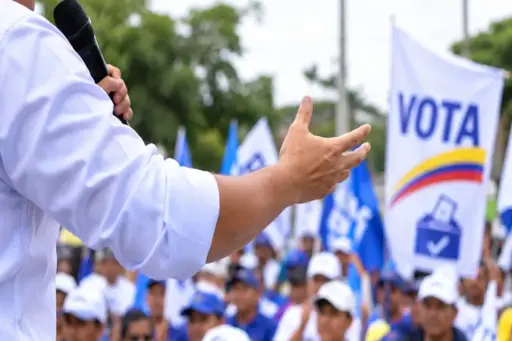
The local elections in Ecuador serve as a gage for the performance of President Daniel Noboa and his political party. The similar thing happened in the Popular Consultation of November 16, 2025, in which the Ecuadorian president lost on all four questions, one of which proposed calling a Constituent Assembly to completely change the Montecristi Constitution, in effect since 2008.
The elections of the upcoming November 29 will be held in order to elect 222 mayors, 23 prefects of the prefectures, 1,500 councilors, more than 4,000 members of parish boards, and seven councilors who will be members of the Council for Citizen Participation and Social Control (CPCCS). This is the first time that Noboa’s party, National Democratic Action (ADN), will participate in local electoral processes. For this reason, its relevance: it is considered as an election to measure whether Noboa has the support he got in the 2025 presidential election, which he allegedly won through fraud according to the complaint of former presidential candidate Luisa González, now a political prisoner of the Noboa government.
The current electoral process has been one of the most irregular, exclusionary, and judicialized in the history of Ecuador. So far, six incumbent mayors are in prison or facing criminal trials that have prevented their re-election, including Aquiles Álvarez from Guayaquil, Cristian Zamora from Cuenca, Vico Villacís from Esmeraldas—all of them opponents of Noboa.
Moreover, since 2023, when Noboa took office for the first time, eight mayors have been assassinated, some of whom could now run for re-election. In all the cases, there has been no sentence to punish those who were responsible for the murders, nor is there any clear investigation to determine the motives behind each of those crimes.
In fact, the current elections are being held with eight provinces under a state of emergency, which implies restrictions on the demonstration, mobilization, and gathering of political organizations with their supporters, a reduction in constitutional guarantees, and special powers for police and military.
In addition, the largest political party, the Citizen Revolution, led by former president Rafael Correa, has been disqualified from the elections. The same happened with the Amigo movement and the disqualification of candidates from other organizations under arguments that are unfounded. These proscriptions violate the right to political participation.
UAFE and Attorney General’s Office: tools of political persecution
In all these cases of disqualification, the Noboa government has been directly involved, through accusations of alleged money laundering, as was the case with the disqualification and subsequent arrest of Luisa González, who had run for the Prefecture of Manabí and was polling over 72% in voting intention. The president of the National Assembly and Noboa’s ally, Michel Mancheno, has been instrumental in disqualifying various candidates in several provinces and cities.
Unlike other complaints regarding candidates, Mancheno’s complaints are immediately accepted by the electoral authorities, and in record time, her political opponents are excluded from registration as candidates, often citing issues of form in the drafting or presentation of enabling documents.
Noboa’s institutional tool for persecution has been the use of the Financial and Economic Analysis Unit (UAFE), directly attached to the Presidency of the Republic, with reserved and anonymous complaints, documents that the accused do not know at the time of arrest or indictment, blocking and freezing of personal bank accounts and those of political organizations.
Moreover, the Attorney General’s Office (with a designated prosecutor) and the Ministry of the Interior are conducting raids on town halls and the homes of regional authority figures to later create the narrative of alleged acts of corruption.
The opposition decries that Noboa and his party do not want rivals in order to take control of all local governments, which by Constitution are autonomous and decentralized. In the opinion polls, the majority of opposition candidates, especially those affiliated with the Citizen Revolution—who are now participating under the banner of other organizations—are leading and could be elected.
The campaign officially started on Thursday, November 12. The ruling party candidates, along with government authorities, including with the Ecuadorian president, conducted campaigns using public resources, with the apparent blessings of the National Electoral Council, which has sanctioned other candidates for starting their campaigns before November 12.
Noboa himself requested a leave of absence to campaign for his candidates, and last weekend he traveled to several cities. When he was a presidential candidate, he was obliged to request a leave of absence and did not do so. That complaint was not processed by the Electoral Council, and the Constitutional Court was lenient and ambiguous in its resolution on whether or not he should request a leave of absence. For the campaign, he has military and police protection and a powerful support team for each of his tours.
(Diario Red) by Orlando Pérez
Translation: Orinoco Tribune
OT/SC/CD
From Orinoco Tribune via This RSS Feed.