

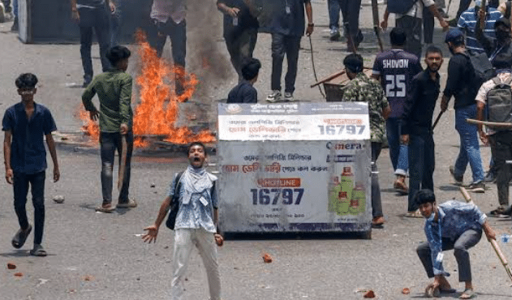
On the 31st of October, the localized strikes and highway blockades in Bangladesh exploded into a mass strike movement, as workers paralyzed production in hundreds of factories belonging to the most important sector of Bangladeshi industry — where garments account for over 80% of the country’s exports earnings. The striking workers did not limit themselves to the closing down of factories: tens of thousands occupied the streets in massive protests and blockaded many of the most important highways connecting the textile industrial hubs to the capital, Dhaka, as well as the main highway connecting Dhaka to Chittagong, the most important port in Bangladesh for international trade.
The police immediately employed violence to repress the movement, in an attempt to re-establish production and trade as quickly as possible in order to disrupt as little as possible the scheduled shipments and, with them, the international contractors’ trust in the second-largest garment exporter in the world (surpassed only by China). Dozens of workers were arrested, with many more injured by the police’s use of teargas and stun grenades — even against scattering protesters and inside the homes of workers who have children.
The workers, however, did not bow down to force, but rather fought back, throwing stones and bricks at the police, torched police vehicles and erected barricades. And the strike movement did not subside, but rather grew larger in the following days, reaching the impressive figure of around 670 factories on monday (november 2nd), which translates to almost 1 million workers on strike — out of a total of 4 million workers employed in the garment industry in Bangladesh as a whole.
What do they fight for?
The movement’s resilience is fueled by the unbearable living conditions of Bangladeshi workers, who are among the lowest-paid in the world and have been facing a dramatic rise in the cost of living while their wages remain stagnant, as the Bangladeshi and the imperialist bourgeoisies collaborate to make sure the current capitalist crisis, produced by themselves, is unloaded upon the sore backs of the working class.
Striking workers are struggling for one main demand: a significant wage increase. The current minimum-wage is 12.500 taka (BDT) per month (which equates to around 100.00 USD), while rent alone often consumes the majority of this value, as said worker Mahin Hossain to Reuters: “After paying rent, there is very little left for food, our children’s education and other essential expenses. Many are finding it almost impossible to support their families.” Mohammad Helal, another garment worker, said in an interview to The New York Times: “The current minimum salary is inadequate. It cannot cover one person’s monthly living cost […]”, and suggested sarcastically that the government, if it does not want to raise salaries, should consider paying for the workers’ electricity, gas and rent instead.
Workers have given similar testimonies to various news agencies: there is no doubt in anyone’s mind, who is forced to get through the month on 12.500 taka, that this is a starvation wage. The movement initially demanded a new minimum-wage of 30.000 taka (a 140% increase) in order to combat the effects of the 8% to 9% year-over-year general inflation rate — a demand which was already being voiced by strikers before the 31st of October “explosion”. The 8% to 9% figure, however, might be deceivingly low when confronted with the actual rise in the cost of living, since food, housing, transportation and healthcare are among the costs which have risen the most.
What has been conquered so far?
On the 1st of November, only a single day after the movement acquired truly massive proportions, the Bangladeshi government formed a wage board composed of 6 members, divided into representatives of the government, garment factory owners and workers’ representatives — a clear attempt to channel the workers’ hopes into a state institution and get them back in the factories, in order to then be able to negotiate (or to shelve) the wage increase free of the immense pressure exerted by the million-strong strike. However, the strikes did not stop, and by Wednesday (November 4th) the wage board had already agreed that a new wage scale will take effect in December, meaning the workers should begin receiving the new minimum wages in January.
On November 9th (Monday), the workers’ representatives in the wage board presented a proposal where the 30.000 figure applies only to interns, with wages for regular employees starting at 32.000 taka. The factory owners did not present their own proposal at this meeting, and requested 7 working days to “study the economical viability” of this and submit their counterproposal — but were given 4 working days instead (meaning a Friday, November 13th deadline) due to the pressure exerted by the still ongoing strikes, with the chairman of the board going as far as to say that “if they fail to submit it in the next meeting, we will move forward with the decision-making process and will not wait for their written proposal.”
The workers continue to struggle for two main reasons: first, because the industrialists have yet to agree upon the value of the minimum wage increase; second, because at least ten union leaders (and many more worker activists) remain in prison.
What lessons to take from this
The fact that the chairman of the wage board, a representative the government, did not agree to the industrialists’ requested 7 working days (to submit their counterproposal) shows to what measure the movement has the government cornered. An enormous chunk of Bangladeshi economic activity is paralyzed and international trust in the Bangladeshi garment industry is at stake. Restoring production as soon as possible is a necessity to Rahman’s government.
This only goes to demonstrate how much the bourgeoisie and their governments depend on the working class, and not the other way around. In a country like Bangladesh, with an industrial proletariat numbering millions and standing at the very core of national economy, a strike of this magnitude ties the government’s hands in a well-tied knot. The combination between the current starvation wages and the capacity of the Bangladeshi proletariat to force the industrialists to actually seriously consider a 140% wage increase almost seems purposely crafted to lay bare this lesson for every worker involved in the movement — that the bourgeoisie and the government will only give them what they take by force.
The next steps of the movement are yet to come, but one thing is certain: as the world capitalist crisis intensifies and the heaviest burden continues being transferred first and foremost to the proletariat of the most oppressed countries, the “weakest links” of international capital will more and more become squeezed between the fist of imperialism and their inadequate tools for mediation with their own proletariat.
A victory of the Bangladeshi garment workers, overcoming brutal police repression and not settling for anything less than the demanded raise, would further expose what a profound fallacy is the idea that class struggle is a thing of the past and that capitalist domination is stable, eternal and unbeatable. It would also bring into question whether or not a party shall emerge in the next years which can call for the creation of committees for the self-organization of the workers, transform future strikes of this magnitude into points of support for a general strike and create a workers’ power in direct opposition to the bourgeois state.
For these reasons, the future of the garment workers’ strike in Bangladesh — and that of the class struggles in Asia as a whole — should be followed with the utmost attention by the workers and the youth of the whole world.
This article was first published in CRP Asia on November 16, 2026.
The post Lessons from Class Struggle in Bangladesh appeared first on Left Voice.
From Left Voice via This RSS Feed.