

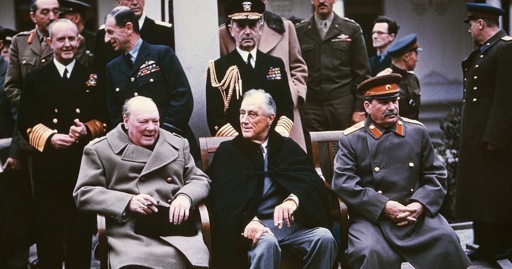

One of the most persistent falsifications of anti-communist propaganda is the claim that the Soviet Union, together with the United States and Britain, divided the postwar world into spheres of influence at the Yalta Conference of February 1945.
Repeated for decades by bourgeois and opportunist historiography, this myth serves a clear ideological purpose: to equate the socialist USSR with the imperialist powers, discredit the revolutionary struggles of the peoples and present the postwar political order as the product of secret bargains between powerful states.
The Yalta Conference, held on February 4–11, 1945, brought together Joseph Stalin, Franklin D. Roosevelt and Winston Churchill at a decisive moment of the Second World War. The Red Army was advancing toward Berlin, Nazi Germany’s defeat was approaching, and the international balance of forces had shifted dramatically in favor of the Soviet Union and the anti-fascist movements. It was precisely this new correlation of forces that determined the character of the negotiations.
Far from constituting an imperialist agreement to partition the planet, the conference primarily addressed the final defeat of Nazi Germany, the terms of its unconditional surrender, the eradication of German militarism and Nazism, war reparations, and the establishment of a new international organization for the preservation of peace.
The Declaration on Liberated Europe affirmed the restoration of sovereign rights and the right of peoples to determine their own governments. The specific political arrangements discussed concerning Poland and Yugoslavia involved provisional governments and national reconstruction, not the allocation of entire countries to predetermined ideological camps.
No agreement establishing a division of Europe into capitalist and socialist spheres of influence was concluded at Yalta.
The subsequent establishment of People’s Democracies in Eastern and Central Europe cannot be explained through diplomatic signatures. It resulted from the profound changes brought about by the defeat of fascism, the decisive presence of the Red Army and, above all, the sharpening class struggle within those countries.
The Soviet advance created favorable conditions for communist-led popular movements, weakening the old bourgeois state apparatuses and strengthening the struggle for political power. The revolutionary transformations that followed were neither automatic consequences of military occupation nor gifts bestowed by Stalin at a negotiating table. They emerged through political confrontation, mass mobilization and struggles against domestic bourgeois forces supported by international imperialism.
The case of Germany further exposes the contradictions of the conventional narrative. It was Roosevelt and Churchill who had advanced proposals for Germany’s dismemberment into several separate states. The Soviet Union opposed these plans, defending the prospect of a united, peaceful and democratic Germany, free from militarism and Nazism.
Indeed, the Soviet government continued to advance proposals for German reunification well into the postwar period, including its diplomatic initiative of March 1952.
The claim that the USSR participated in an imperialist partition of the world also collapses when confronted with the events that immediately followed Yalta.
Barely a month after the conference, representatives of the Western Allies engaged in separate negotiations with Nazi military commanders in Switzerland, provoking serious Soviet objections. The supposed harmony between the powers that had allegedly divided the world was already giving way to open antagonism.
In August 1945, the United States dropped atomic bombs on Hiroshima and Nagasaki. Beyond their devastating human consequences, these bombings demonstrated Washington’s determination to assert its supremacy in the emerging postwar order and intimidate the Soviet Union.
The subsequent anti-communist offensive in Western Europe, the exclusion of communists from governments, the persecution of revolutionary movements and the emergence of the Cold War further demonstrated the irreconcilable contradiction between capitalism and socialism. How could these developments be reconciled with the supposed existence of a mutually accepted, peaceful division of the world?
The reality is that the wartime alliance against fascism never eliminated the fundamental class antagonism separating the Soviet Union from its capitalist allies. The imperialist powers could cooperate militarily against Nazi Germany while simultaneously preparing to confront the growing influence of socialism and the international communist movement.
The Soviet Union did not participate in Yalta as an imperialist power demanding its share of the spoils. On the contrary, it used the favorable balance of forces created by the Red Army’s victories to obstruct imperialist designs and strengthen the conditions for a postwar peace.
The myth of Yalta as a grand partition of the world deliberately substitutes diplomatic conspiracy for historical materialism. It transforms revolutionary movements into passive instruments of foreign policy and erases the independent role of the working class and the peoples in shaping history.
The postwar world was not simply drawn on a map by three leaders. It emerged from the defeat of fascism, the changing international correlation of forces and the continuing struggle between two antagonistic social systems. To understand Yalta, therefore, is not to search for an imaginary agreement dividing humanity into spheres of influence. It is to recognize that the central contradiction of the postwar world was not a quarrel over the distribution of imperialist spoils, but the historic confrontation between capitalism and socialism.
From In Defense of Communism via This RSS Feed.
Don’t paint Stalin as a hero of the workers - he was a fucking heartless dictator who cared for no fucker but himself and hammered the final nail in the coffin of Communism.
He was a fucking traitor to the movement - if he were alive today, he wouldn’t be for long ✊.
