

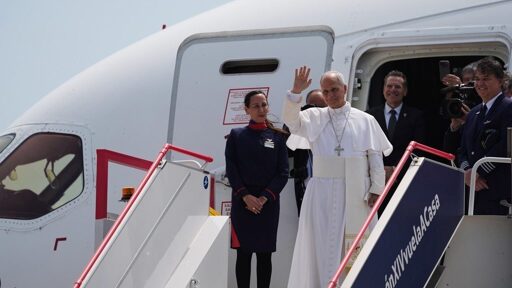

Pope Leo XIV just concluded his extended visit to Latin America. Amid crowds and speeches that interwove theological discourse with suggestive political comments, the pontiff traveled through Uruguay, Argentina, and Peru.
An anti-neoliberal Christianity
It was likely his speeches in Argentina that had the greatest repercussions in the media, precisely because it is the country governed by the ultra-orthodox neoliberal Javier Milei. “The human being is the author, the center, and the end of all economic and social life; therefore, the economy must be at the service of the person, and not the person at the service of the economy,” said the first North American pope.
He also spoke of the importance (from a Christian perspective closer to that of his predecessor Francis) of work as an essential dimension of the human condition, which stands in contrast to the neoliberal doctrine that has become so prevalent thanks to far-right governments in the region: “Depriving a person of work is not simply denying them an income; it is a serious blow to their dignity, nullifies their ability to contribute to society, and plunges them into social exclusion.”
However, little has been said about the significance of his words in Peru, the country he chose to tour extensively. The choice was not accidental. The pope worked for several decades in the Andean nation, where he pursued an ecclesiastical career more aligned with the Church’s “option for the poor” than with the elitist, right-leaning thinking that has been so prevalent in recent years among the upper echelons of the Peruvian Curia.
Justice for the crimes of the past
In Peru, Leo XIV said, “The events of the past deserve to be treated with justice,” referring to the human rights crimes that occurred in Peru during the armed conflict that hit the population hard – especially the poorest in rural areas, who witnessed human rights violations committed in the midst of a civil war.
The Pontiff added: “The Church is aware of the suffering caused by violence and wishes to stand in solidarity with those who endure it, encouraging the efforts of all who work to protect the life, dignity, and rights of individuals through law and justice.”
In support of Indigenous peoples
He also referred to the violence that many Indigenous leaders must endure in a society like Peru’s, which has historically been built based on unequal economic development based on ethnic origin: “In recent years, many Indigenous leaders have been murdered for having protected their own territories. The blood of these brothers cries out to God and demands justice from mankind.”
He added: “The Church’s social doctrine is an ever-evolving instrument that helps us read the signs of the times under the guidance of the Holy Spirit. Through it, the ancestral knowledge you possess can come together with the Church’s heritage of wisdom, to protect your rights, acquired over generations.”
In this regard, he highlighted some of the criticisms raised by Indigenous communities who have managed to resist the ruthless exploitation of their territories by the market: “The cry of the earth and the cry of the poor rise up together, unmasking the logic of the market and exploitation that threaten the very balance of creation … These are not mere accidents, but the bitter fruits of arbitrary exploitation of natural resources that undermines the very existence of the people.”
“It is impossible to separate the stewardship of the Amazon rainforest from concern for the peoples who inhabit it; integral ecology, social justice, and spiritual life go hand in hand… These are not mere accidents, but the bitter fruits of an arbitrary exploitation of natural resources that undermines the very existence of the population,” said Leo XIV in Pucallpa on November 15.
Against the inequality that creates misery
Finally, the Pope emphasized the contradiction inherent in Christian doctrine (which supposedly aspires to universal humanity) when it comes to material injustices: “It is unacceptable that, in many communities, the right to access health care and education is denied due to physical distances and the neglect of institutions … We feel in our hearts and souls the vulnerable situation in which so many women, girls, and adolescents find themselves, as well as the excruciating pain of those who suffer violence and sexual abuse, which cause deep wounds, often amid the silence of complicity and impunity.”
These statements may seem futile to someone unfamiliar with the reality in Peru. They might well appear to be empty words in the face of a predatory economic system that does not stop even at faith. But the truth is that in Peru (one of the countries with such a significant and numerous Catholic majority) the Pope’s words may have an effect that few could foresee.
Will the Pope’s visit have any impact on Peruvian politics?
Peru has not strayed from the neoliberal path since the 1990s, when dictator Alberto Fujimori (father of current President Keiko Fujimori) rapidly introduced sweeping economic policy reforms known as the “Fujishock.” These statements, however, could help strengthen certain voices that, like the Pope (without advocating a revolutionary discourse) insist on reforming the Peruvian state to steer it away from the neoliberal path.
If the Pope can say these things in Peru, Argentina, or any other country, it is because he has tacit permission to say whatever he wishes. The last president to insult a Pope was Javier Milei himself, when he called Francis – his fellow countryman – “the representative of the devil on earth,” which led him, upon assuming the presidency, to apologize countless times for the public affront.
Perhaps this is why neither Keiko Fujimori nor Javier Milei has dared to question the words of a Pope who is clearly challenging a state of affairs that harms the most vulnerable and exalts the power of the most powerful, revealing how these two phenomena reinforce one another. The effects of the Pope’s visit are, among other things, political as well – a fact that Leo XIV will surely reflect on during his flight back to Europe.
From BT News via This RSS Feed.