

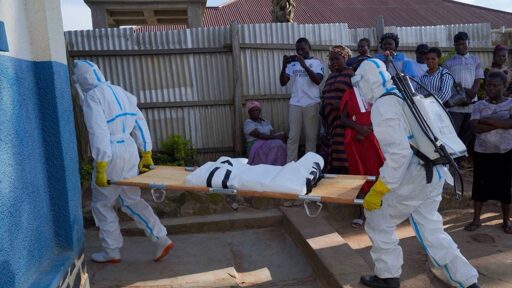

The fastest-spreading Ebola outbreak on record has killed 5,568 people, nearly half of the 11,376 confirmed cases are in the Democratic Republic of Congo (DRC) as of Saturday, November 14.
“If we don’t stop this outbreak now, it will be the worst Ebola outbreak that the world will have,” Jean Kaseya, director-general of the continent’s highest health body, the Africa Centers for Disease Control and Prevention (CDC), told Reuters on Sunday.
The world’s worst on record so far is the West Africa outbreak, infecting 28,600 people and killing more than 11,000 over a period of two years from 2014 to 2016.
The current outbreak – caused by the rare Bundibugyo strain of Ebola virus for which there is no approved treatment yet – has already claimed half as many lives in just six months since the outbreak was declared in DRC on May 15.
However, later genomic sequencing showed that the virus was already transmitting among communities in Ituri province by mid-February. The health response, which began late – three months after the outbreak – is severely underfunded.
Kaseya said international donors have only released $1.3 billion, less than half of the $2.9 billion they have pledged. Much of the funding made available is not translating into frontline capacity.
Doctors Without Borders (MSF) described the dysfunction on the frontline: “vehicles and ambulances without fuel; surveillance teams that exist on paper but are nowhere to be seen on the ground; community workers without phones or mobile data to share alerts; and health care staff left without the supplies or technical support needed to handle suspected cases.”
Unpaid for months, many have been forced to strike, while many others “are left trying to stop the outbreak with empty hands and empty pockets,” said MSF International President, Dr. Javid Abdelmoneim.
The medical charity added that inadequate surveillance is most concerning, “with entire areas poorly covered or even completely neglected.” Even six months after the outbreak was declared, 80% of the new cases are still emerging outside the contact lists of the confirmed cases, Kaseya said. 65% of the deaths are occurring outside health centers, further increasing the risk of community spread.
Armed groups impede health response
The disease has spread to eight of DRC’s 26 provinces. All are in the mineral-rich eastern and northeastern region, where about a hundred armed groups operate.
The most prominent is the M23, which, backed by Rwanda, has occupied several cities in the region, including large swathes of the North Kivu province, which now accounts for half of all the new infections.
Lacking water and sterilization capacity, some healthcare facilities in this province have themselves become sources of transmission, the MSF said. In North Kivu’s Beni health zone, nearly three-quarters of all infected patients contracted the virus in a health facility.
About 50 km from the city of Beni, Allied Democratic Forces (ADF) – an armed group originating in Uganda and aligned with the Islamic State – attacked Cantine-Aloya locality, killing 33 civilians.
“The attack comes at a critical moment in the response to the ongoing Ebola outbreak. Health facilities have been attacked and patients, including hundreds of people with confirmed or suspected Ebola infection, have fled in search of safety, raising serious public health concerns,” Africa CDC said in a statement condemning the attack.
Christian Kakule, medical director of the Kelekele Hospital Center in Cantine, told AP, “High-risk contacts and other individuals under monitoring have all fled,” he said. “Our concern is that when probable cases end up out in the open like this, they can become a source of transmission.”
“Following up contact tracing in areas where ADF [is] operating is a very hazardous idea,” said UN Senior Ebola Response Coordinator, Julien Harneis, adding that in recent days, the ADF has been killing more people than Ebola.
From BT News via This RSS Feed.