

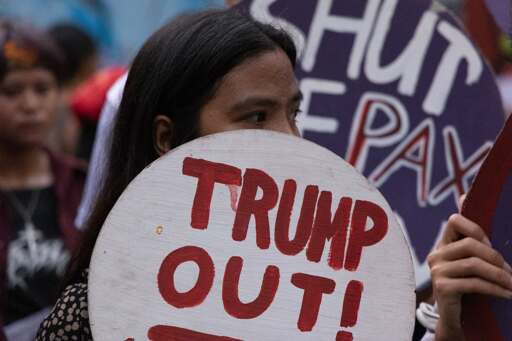
At the center of this escalation is Pax Silica, Washington’s emerging high-tech, resource-intensive war infrastructure. If NATO is the military apparatus built to fight U.S.-led wars, Pax Silica is the pre-war supply chain alliance designed to sustain them.
6,000-strong at Liwasang Bonifacio alone—and the numbers continue to surge as protesters march toward the PICC as U.S. President Donald Trump sets foot on Philippine soil. For over a century, U.S. imperialism has plundered this territory and oppressed its people, dating back to how it usurped the Katipunan’s hard-won 1896 triumph over Spanish colonialism. This is not the first time the Filipino people have fiercely rejected a Trump visit; they rose in protest during the ASEAN Summit in November 2017, and they are rising again.
The Filipino public’s refusal to welcome Trump—standing in sharp contrast to the Marcos Jr. administration’s eagerness to accommodate Washington—cannot justify the sweeping crackdown on activists exercising their fundamental rights to assembly, expression, and association. International observers have been alarmed by the scale and intensity of police brutality under Marcos Jr., which echoes the state terror unleashed over half a century ago under the U.S.-backed Martial Law dictatorship of Ferdinand Marcos Sr.—a regime only toppled in 1986 after a protracted, heroic struggle against U.S. imperialism and its client-dictator.
Yet this violence is not merely a nostalgic return to his father’s Martial Law era; it is the continuation of an unbroken war against the poor. In the Philippine countryside, landless peasants live in a state of perpetual siege, battered by recurring tiempo muerto (dead seasons), massacres, and state-backed counterinsurgency campaigns that target cooperative leaders and their families. In the cities, whenever public anger boils over—such as during last year’s mass anti-corruption demonstrations—state repression falls hardest on patriotic youth—students and urban poor—the very demographics with the greatest stake in systemic change.
At the center of this escalation is Pax Silica, Washington’s emerging high-tech, resource-intensive war infrastructure. If NATO is the military apparatus built to fight U.S.-led wars, Pax Silica is the pre-war supply chain alliance designed to sustain them. Before a single bomb is dropped, it secures the physical pillars of modern warfare and artificial intelligence—water, energy grids, land, and semiconductor supply chains—within allied borders. Designated as the United States’ key strategic ally in Asia, the Philippines is being positioned as a primary resource frontline.
The lethal purpose of Pax Silica’s weaponry and intelligence apparatus is already on full display in Palestine—one of its primary targets, and the sharpest expression of a settler colonialism that never stops settling. As this colonial project expands, so too does the global infrastructure required to endlessly reproduce the war machine. That relentless reproduction of war stands in stark, irreconcilable opposition to the social reproduction of human life and labor. This is precisely why the Filipino working poor and youth are determined to junk Pax Silica and reject the presence of a war criminal like Trump. For us Filipinos, defiance against this weaponized interdependence is an imperative of national self-defense.
In oppressed nations like the Philippines, where the people are actively working to resolve their primary contradiction against U.S. imperialism, defending the social reproduction of life and labor inevitably requires taking to the streets. When protesters march despite knowing they will face state violence and police brutality, it is not because they invite harm or court repression; rather, it is how the peoples of oppressed nations shed the illusions of safety and docility under U.S. imperialist diktat. Only by confronting that violence do we reclaim our dignity—a dignity rooted in land, national patrimony, solidarity, and the camaraderie in struggle that Filipinos have always been proud of and known for.
This collective resolve has deep historical roots. From the basic masses and Indigenous Peoples to professionals, students, cultural workers, and progressive lawmakers, nationwide opposition remains firm. That same power found historic, legal expression on September 12, 1991, when the Philippine Senate voted to reject the renewal of the U.S. basing treaty—a victory won through a relentless mass campaign against the occupation of ancestral lands, the plunder of our resources, the systemic abuse of Filipino women and children, and the stripping of our national sovereignty.
Recent global events underscore the urgency of this struggle. The year opened with a devastating U.S. assault on Venezuela that claimed over a hundred lives and saw the abduction and unlawful detention of President Nicolás Maduro and First Combatant Cilia Flores. Weeks later, U.S.-Israeli airstrikes on Iran killed over 150 schoolchildren in Minab along with Supreme Leader Ayatollah Khamenei. While the world was initially stunned, grief has hardened into sustained anti-imperialist resistance across West Asia. Simultaneously, mass protests in cities like Paris reveal that even in the imperial core, capitalism’s “peacetime” delivers only austerity, state abuse, and economic precarity.
An imperialist world order offers no viable future for humanity or the biosphere. Persisting down the path championed by leaders like Trump and Marcos Jr. stands in direct opposition to historical progress, ecological survival, and the basic material conditions needed for human life to thrive. Time and again, we show—and are reminded—that our identity as a free and dignified people can only be forged through class struggle against U.S. imperialism. Today’s mobilization is nothing short of historic: it transforms the memory of an anti-colonial revolution usurped by foreign powers into the undeniable thunder of resolute footsteps, marching forward and defending the nation.
The post No red carpet for empire: State repression and the fight against Pax Silica appeared first on Bulatlat.
From Bulatlat via This RSS Feed.