

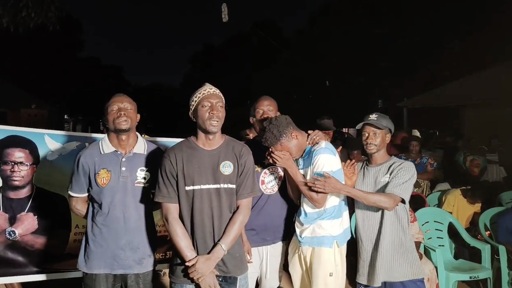

The government of Guinea-Bissau has established a commission of inquiry to investigate the assassination of political activist Vigário Luís Balanta, nearly eight months after his killing.
Balanta, leader of the Pó di Terra Revolutionary Movement, was found dead on March 31, 2026, on the outskirts of Bolanhas de N’Dam, approximately 30 kilometers from the capital, Bissau. His body was found with visible injuries, torn clothing and other signs of violence, raising suspicions that he had been tortured before being killed.
Read more: Political activist in Guinea-Bissau found beaten to death
Speaking to BreakThrough News, Janó Embana, coordinator of the Association of Revolutionary Pan-Africanist Youth of Guinea-Bissau (AJOPAR), welcomed the announcement of an investigation by the Office of the Attorney-General on November 9, 2026, while questioning why authorities had taken so long to act.
“The decision deserves to be welcomed. However, we cannot ignore the long period of institutional silence that preceded it, nor the political and security circumstances which, in my view, help explain why it took so long for an investigation of this nature to be formally established,” Embana said.
He argued that the absence of a formal investigation and publicly presented findings for several months had raised questions about the independence of state institutions and possible political interference in the administration of justice.
Adding, the inquiry must go beyond identifying those who directly carried out the killing. He insisted that investigators should also go after the alleged masterminds, financiers, facilitators, and anyone involved in concealing the crime.
“The establishment of a commission does not, in itself, mean that justice has been achieved. Our expectation is that the investigation will be transparent, credible, independent and conducted rigorously, without political or military interference,” he said.
He further warned against the investigation being used to rehabilitate the image of political figures or institutions seeking to benefit from the country’s changing political circumstances
“We do not want selective justice, guided by the convenience of those in power. We want justice that reaches everyone responsible, regardless of their political, military or institutional position,” Embana said.
Read more: Guinea-Bissau: A coup staged to protect the neocolonial order?
Since the November 2025 military takeover, Guinea-Bissau’s political conditions have changed with growing repression, intimidation and restrictions on opposition forces and dissenting voices. The military intervention, which followed a disputed electoral process widely viewed by critics as an attempt to prevent the PAIGC-led coalition from taking power, ushered in a new period of political uncertainty and heightened tensions.
Read more: Military government in Guinea-Bissau seeks to reshape political system with referendum
As the demand for accountability continues, Embana described Balanta’s killing as a major loss for Guinea-Bissau’s political and social struggles, remembering him as part of a generation of young activists seeking to challenge injustice and transform the country’s political and social conditions.
Balanta’s involvement in the Pó di Terra movement, he said, reflected his commitment to political resistance and social transformation.
“Vigário Luís Balanta was our brother, comrade and activist. He represented a generation of young people who refused to passively accept injustice,” Embana said.
He added that “Justice for Vigário Luís Balanta is not merely a demand of his family or comrades. It is a demand of an entire society that can no longer continue to coexist with impunity.”
From BT News via This RSS Feed.