

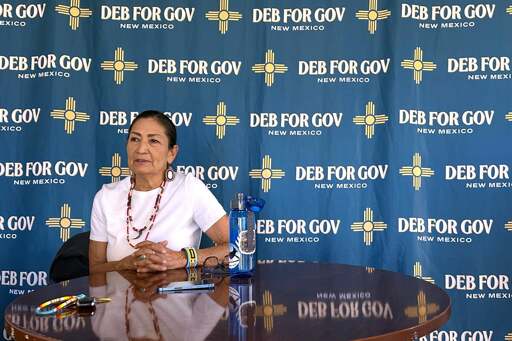

Prior to her election as Governor of ‘New Mexico,’ Democratic nominee Deb Haaland answers questions during an interview at her campaign headquarters in ‘Albuquerque’ on Oct. 9. Photo by Susan Montoya Bryan/AP
This story is published through the Global Indigenous Reporting Network at The Associated Press, with minor style edits
On the morning of Kawaika (Laguna Pueblo)’s annual Feast Day, Ashley Sarracino knelt in her family home holding clothespins between her teeth.
She straightened her niece’s black cotton manta, a traditional one-shouldered dress, and tied a sash around her waist.
On these days, Sarracino is a caretaker, dressing relatives for the harvest dance and helping feed up to 150 guests. And as a former member of the Pueblo Council, she knows how to balance those traditional responsibilities with official duties.
“To me, those things aren’t in conflict at all,” she said.
Yet even as another Kawaika woman, former “U.S.” Interior Secretary Deb Haaland, is set to become the first Indigenous woman state governor, women with leadership aspirations such as Sarracino say they are swimming upstream in their Pueblo communities.

READ MORE: In Nevada, Indigenous land protectors face off with a Canadian mining company
Sarracino said she was forced off the council after alleging she was paid less because she was a woman, a claim Pueblo officials deny.
In some of the 19 Pueblos in “New Mexico,” including Kawaika, tribal law and customs do not allow women to hold top government positions.
Haaland told The Associated Press she was once nominated to serve on her Pueblo council but did not make it past a primary. She quipped it was “easier to raise $1 million and run for Congress” than succeed in Pueblo politics.
“It’s still a man’s world in a lot of Pueblo communities, and certainly in mine,” she said.

Ashley Sarracino, right, and her sister Lindsay Sarracino prepare food for the annual Feast Day celebration on Oct. 17 in Paraje, a village within Kawaika (Pueblo of Laguna), ‘New Mexico.’ Photo by Roberto E. Rosales/AP
A fight over women’s place in tribal leadership
Sarracino was offered a road map familiar to ambitious young Indigenous people: Leave the reservation to get an education, then return home to serve your community.
She built a career in non-profit work and political organizing, including as chair of her county’s Democratic Party.
In 2022, Sarracino was nominated by a Pueblo Elder to run for council secretary. She finished second but was appointed to the post after a resignation.
“Finally, I had an opportunity to use my skills to help my own community,” she said.
While reviewing budget documents, Sarracino discovered she was being paid US$14,000 less than her male predecessor. She asked the Pueblo governor for an explanation, sparking a bitter dispute that would end her tenure on council.
The council says Sarracino was paid less because she lacked experience and that she abandoned her post.
But Sarracino insists she was ousted and that the pay discrepancy reflects sexist attitudes embedded in tribal law.
Since 1996, the Pueblo’s election code has allowed women to run for council treasurer and secretary, but it does not explicitly allow them to serve as governor or lieutenant governor.
Its constitution, last amended in 2012, refers to the governor as “he” and “him.”

READ MORE: Across the border, Indigenous fears spike amidst ‘U.S.’ immigration crackdown
Sarracino’s dispute landed in tribal court but was dismissed this year on sovereign immunity grounds and she’s exhausted her appeals.
The case took a toll on her mental health. She said it’s been bittersweet to watch Haaland make political history.
“We all know she would never have the same opportunity here,” she said.
Yet Haaland’s ascent could help change attitudes at home.
Emily Hunt, who became Kawaika’s first woman elected official in the late 1990s with legal help from Haaland, believes the Pueblo will someday nominate a woman governor.
“Whether I’ll see it in my lifetime, I don’t know,” Hunt said.

Ashley Sarracino poses at her home on Oct. 17 in Paraje. Photo by Roberto E. Rosales/AP
Pueblo governance is varied and complex
Some Pueblos retain traditional theocracies, with government roles appointed by ceremonial Elders and reserved for men.
Charlotte Little, a citizen of Katishtya (San Felipe Pueblo), said women in those communities hold esteemed roles of their own.
A “New Mexico” state representative, Little never aspired to lead at home.
“It’s about respecting the culture that I come from,” she said.
Other Pueblos, under federal pressure in the 1930s, adopted secular constitutions and elections.
That includes Shiewhibak (Isleta Pueblo), where in 1986 Verna Teller overcame a contentious legal battle to become its first and only woman governor.
Council incumbents attempted unsuccessfully to strike Teller’s name from the ballot, arguing a woman could not hold office under Shiewhibak law. She won in a landslide.

READ MORE: AI data centers are booming. Indigenous People want help protecting their lands and knowledge
Now in her 70s, Teller blames colonization for the patriarchy that she says persists in traditionally matrilineal Pueblo communities.
“When the Spaniards and the Catholics came here, they didn’t want to deal with the clan mothers. They threw women in the back seat,” Teller said.
“That has turned into this paternalistic attitude that men have to be in charge.”
That’s not the case at every Pueblo.
At Pʼohsųwą̈geh Ówîngeh (Pojoaque Pueblo), where council positions are open to all and candidates don’t need to be nominated, women have held all four executive positions since 2021.

Ashley Sarracino, center, helps her nieces get dressed before participating in traditional dances in the Pueblo during the annual Feast Day celebration on Oct. 17, 2026, in Paraje. Photo by Roberto E. Rosales/AP
Planning with the next generation in mind
Haaland is the most prominent among a wave of Pueblo women who have found success in mainstream politics, from school boards to state government and “U.S.” Congress.
She encouraged Pueblo women to look beyond their home communities for opportunities.
“We need more Native women everywhere,” she told The AP.
Sarracino has not ruled out a future Pueblo council run and, after attending Haaland’s election night celebration, now sees a potential path in state politics.

READ MORE: Reclaiming the Navajo language — through English: A conversation with poet Esther Belin
On Feast Day, as her family home sprang to life with visitors, Sarracino greeted friends and relatives with hugs, refilled their iced teas and later made sure they went home with oven bread and fruit pie.
She watched with pride as her nieces giggled over plates of enchiladas, their hands white with ceremonial clay from the morning’s dances.
She is planning her next move with those girls in mind.
“That’s the reason I couldn’t just let it go,” she said.
“Because I know they’re coming up behind me.”
The post As Deb Haaland elected first Indigenous woman governor in ‘US,’ other Pueblo women still face hurdles appeared first on Indiginews.
From Indiginews via This RSS Feed.