

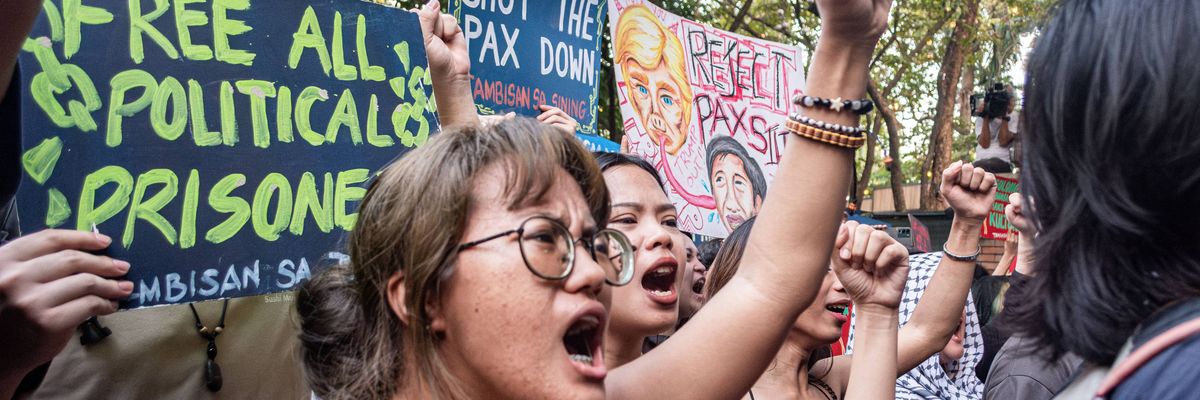
As thousands of Filipinos flood the streets to protest President Donald Trump’s visit this week, dozens of activist groups are calling on the US Congress to halt his administration’s plans for a massive new industrial hub as part of its “Pax Silica” initiative.
In a letter obtained by Common Dreams, more than 80 human rights, anti-war, faith, and community groups warned on Tuesday that the administration’s proposed 4,000-acre “economic security zone” on the island of Luzon, which would include a semiconductor hub, “raises serious concerns about labor rights, human rights, environmental protections, and the lack of genuine consultation with impacted Filipino communities.”
They also warned that the initiative, formed last year to counter China’s influence over minerals critical to artificial intelligence development, risks heightening tensions with China and turning the Philippines into a potential “front line” in a future military conflict between the two global superpowers.
Signatories include the American Friends Service Committee, the United Church of Christ, Just Foreign Policy, and Malaya Movement USA.
Students, activists, and Indigenous community leaders protested for several days before Trump arrived in Manila for this week’s 49th Association of Southeast Asian Nations (ASEAN) summit.
As The Diplomat reported, around a dozen protesters were arrested as they clashed with police on Sunday while attempting to march toward the Philippine International Convention Center, where the summit is taking place. Another 276 were arrested in nearby Muntinlupa as they attempted to join the protests.
Protests took place across the country, including in President Ferdinand Marcos Jr.’s home province of Ilocos Norte, where demonstrators carried banners reading “Trump Out! Reject Pax Silica!” and calling the initiative “imperialist plunder.” Another protest in Manila featured the slogan “Get off our lands, we are not for sale.”
The Philippines joined Pax Silica in April, but the framework agreement governing the proposed hub remains unsigned. Philippine Ambassador Jose Manuel Romualdez said Tuesday that key terms needed further negotiation between Washington and Manila and that the agreement would not be discussed during Trump’s summit meetings.
Marcos has billed the project as a way to bring in tens of billions in foreign investment and hundreds of thousands of jobs. But activists say he has not provided evidence to support those projections and is disregarding the potential harm to the people of Luzon.
According to The New York Times, the project is expected to use up to 90 million liters of water per day, triple the area’s supply during the dry season. It would also use as much power as one-fifth of the electricity the Philippines consumed in 2024.
Beyond those resource demands, Human Rights Watch warned that the hub will displace hundreds of Indigenous people and farmers who have lived and worked on the land for generations.
“Philippine infrastructure already suffers regular power outages and lack of water for agriculture, irrigation, and personal use,” the activists told Congress on Tuesday. “Pax Silica’s demands will put increased strain on Luzon’s power grid and water supply and are expected to contribute to a higher cost of living for Luzon’s population.”
“The past 50 years of foreign investment in the country have not led to genuine industrialization, and have instead solidified the Philippines in a lower-value position in the supply chain as a source of cheap labor for low-paid manufacturing jobs, an exporter of raw materials or semiprocessed goods, and an importer of higher-value products,” they added. “History shows that the supposed economic benefits of Pax Silica are more likely to benefit foreign firms producing in and exporting from the country than Filipino companies.”
The activists also questioned the benefits that US consumers would get from the project, which is part of a broader critical minerals strategy involving billions in taxpayer-backed financing. Official statements promoting the project, they said, contain no mention of US job creation. Meanwhile, the project would fuel the expansion of artificial intelligence data centers, which Americans overwhelmingly oppose and rejected at the ballot box during this month’s midterm elections.
“As Americans, we do not want the Filipino people to experience that same environmental degradation in their communities at the hands of US-funded data centers and AI initiatives, and we do not want to further the threat of job destruction posed by data centers and AI industry hyperscaling,” the activists said.
They also raised concerns about the initiative’s role in “the deepening US-China rivalry and US-led militarization in the Philippines,” noting the recent deployment of advanced missile systems in the island nation, which sits just south of Taiwan and hosts at least nine military sites to which the US has access.
Earlier this year, the US Army fired a Tomahawk cruise missile from the Philippines for the first time, demonstrating that the country could be used to launch a long-range precision strike capable of hitting mainland China.
“While Washington presents its expanding military presence as necessary to deter China, these deployments risk a security dilemma that intensifies the very tensions they are intended to prevent,” the activists wrote. “The American people have never been meaningfully consulted about whether they are willing to fight a war with China over the Philippines, how much they are prepared to spend, or how many American lives they are willing to risk.”
Democrats in Congress have raised concerns about the administration’s broader critical minerals strategy. In August, 54 House Democrats led by Reps. Linda Sánchez (D-Calif.), Jared Huffman (D-Calif.), and Jonathan Jackson (D-Ill.) warned Cabinet secretaries in a letter that “poorly regulated mining and minerals processing has a well-documented record of environmental damage, displacement and harm to Indigenous communities, and widespread labor and human rights violations.”
Filipino activists, meanwhile, have highlighted the lack of transparency surrounding the initiative—whose full terms and financing arrangements have not been disclosed to the public. The Philippine activist coalition Bayan demanded on Sunday that the Marcos administration publicize the terms of the deal.
“We say no to secret negotiations or backroom deals involving Philippine territory, jurisdiction, and sovereign rights,” Bayan said in a statement.
From Common Dreams via This RSS Feed.