

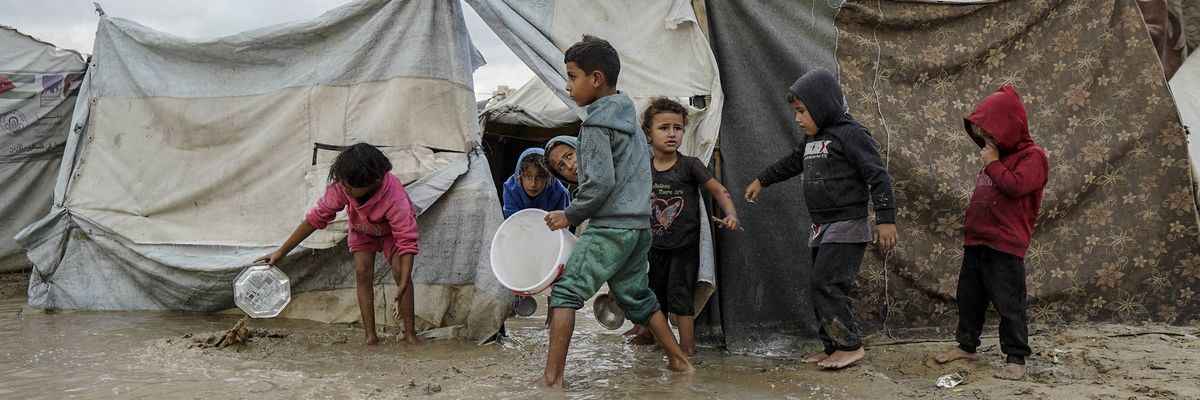
The United Nations’ agency on migration is calling on countries to demand that Israel open additional crossings into Gaza and ensure the delivery of shelter materials and other basic supplies that would allow more than 1.7 million displaced Palestinians to begin recovering from the latest crisis to hit the already devastated exclave: flooding that destroyed tens of thousands of tents earlier this month and pushed families who are entering their fourth winter under Israel’s attacks into even more desperate circumstances.
“Anything that can come in at any time, we just highly appreciate it and from any source; but of course, it needs to be durable and that’s what we’re looking for in order just to get through this winter,” said Karl Baker, the head of the Gaza program at the International Organization for Migration, on Tuesday.
Ten days after heavy storms caused the initial flooding, the impacts of the disaster have multiplied, and raised fears about how Palestinians with nowhere to live but makeshift tents—about 1.4 million of whom are facing acute hunger—will survive the coming winter.
Shaun Hughes, the World Food Program’s country director for Palestine, told reporters Tuesday that the collapsed infrastructure of Gaza, where about 81% of all structures have been destroyed or severely damaged by Israel’s US-backed assault since October 2023, has allowed floodwater as well as sewage to destroy families’ meager food stocks.
“Most people burn rubbish to cook their food. Now even the rubbish is wet,” said Hughes, noting that cooking gas and firewood is unavailable or prohibitively expensive for many households.
Families have also started small fires in their tents to keep warm and cook—a practice that has accidentally killed at least two children in recent days as flames have spread. Those deaths were on top of the deaths of at least five people who were killed when a sand bank collapsed last week, and an eight-month-old baby who died of hypothermia this week.
Baker said that without proper shelter and critical relief items, more hypothermia deaths are likely to occur through the winter.
“No child should die from the cold. And winter has barely begun,” said Tedros Adhanom Ghebreyesus, director-general of the World Health Organization. “Just a few days of rain have already flooded camps, destroyed tents and left families exposed to the cold. An estimated 950,000 displaced people are living in flood-prone areas, including 400,000 at extremely high risk. For families who have already lost so much, a tent is often their only remaining protection. Losing it means being fully exposed to cold, contaminated water, and disease.”
Tedros added that the flooding is increasing the risk of waterborne illnesses, and those who contract diseases face difficulty accessing healthcare as about 90% of Gaza’s health infrastructure is destroyed and hospitals are still facing attacks from Israel, like the one that hit Nasser Hospital last week and killed at least six people despite a so-called “ceasefire” agreement that was reached in October 2025.
“This is Gaza’s fourth winter of war,” said Tedros. “We urgently need unrestricted access at scale for shelter materials, clean water and sanitation supplies, medicines, vaccines, equipment to prevent hypothermia, and laboratory supplies to detect and respond to disease outbreaks early.”
UN Women summarized the daily hazards now faced by families in Gaza: “Floodwaters. Sewage. Rodents. Disease. Cold.”
“Without urgent access to life-saving humanitarian supplies and equipment, including durable shelter materials and winterization items, more preventable deaths may occur as the coldest months approach,” said the agency for women’s rights. “Israeli bombardment and ground operations have devastated the Gaza Strip, forcing almost a million people into flood-prone areas. Tents intended as temporary shelter have become homes for years, offering little protection from worsening conditions.”
“International law, accountability for violations, immediate unimpeded humanitarian assistance that reaches women and girls and those in need—at scale and without obstruction—must all be fully realized,” UN Women added. “There must be no further delay in ensuring that women and their families have the protection and dignity they need to survive.”
Along with continued attacks by Israel, said Hughes, “Israeli military control across nearly 70% of Gaza means that people have almost no space to grow their own food."
“When you’re in Gaza, it does not feel like a ceasefire,” he said. “Fishing in the sea is prohibited and also life-threatening. Unemployment is over 80%, so without humanitarian assistance, people have little or no alternate means of survival.”
Baker emphasized that IOM has more than 100,000 tents standing by for delivery from Egypt, but Israeli authorities have blocked their entry, reportedly citing the diameter of the tent poles.
“Usually anything under 38 millimeters is okay; anything above, it’s usually deemed as not acceptable,” Baker said. “We don’t get the specifics.”
In addition to calling for aid access, humanitarian teams need at least $9 million in the coming months to support flood prevention, fire safety, lighting, and improvements to emergency sites.
“The world has normalized Palestinian suffering in Gaza and the fact that an entire population relies on aid. Israel continues to conduct daily airstrikes and killings under the guise of a ceasefire and blocks vital aid from reaching people who desperately need it,” said Jan Egeland, secretary general of the Norwegian Refugee Council.
“The suffering of Gaza’s 2.1 million people is not inevitable,” Egeland continued. “The world must stop accepting it. Palestinians should have the opportunity to recover, rebuild their lives, and work towards a better future. But this is not possible unless Israel fulfills its obligations under international law: opening all crossings, allowing humanitarian aid to enter, and ending its unlawful occupation of Palestinian land.”
From Common Dreams via This RSS Feed.