

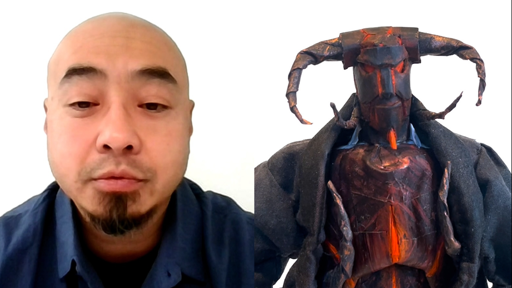
In this episode of Rattling the Bars, former political prisoner and Black Panther Mansa Musa speaks with Mike “Cuong” Tran, a first-generation Vietnamese American whose parents immigrated to the U.S. in 1975. At age five, unable to afford store-bought toys, he began crafting action figures from paper and cardboard—using imaginary worlds to escape an abusive environment. Over time, art became central to his healing process, helping him process both childhood trauma and the decades he later spent in prison.
Self-taught and working within a 3′ x 11′ cell at California Men’s Colony in San Luis Obispo, Cuong transformed discarded and overlooked materials into lifelike sculptures. In an environment where anything unauthorized is deemed contraband, even his creative thinking was treated as a violation because it transcended prison walls. After being released this year, Mike’s art has already been featured at the American Visionary Art Museum in Baltimore. Looking forward, he plans to create an art curriculum to work with incarcerated people, helping them foster their own healing and build creative skills.
Related Links:
- Artist Cuong (Mike) Tran on identity and self-love.
- AVAM celebrates 30th anniversary with ‘Fantastic Realities’ mega-exhibition
- JustArts Gallery
- Picture a Free World by Cuong “Mike” Tran
- Cuong “Mike” Tran’s Facebook and Instagram
Credits:
- Production/Post-production: Cameron Granadino
Transcript
The following is a rushed transcript and may contain errors. It will be updated.
Mansa Musa:
Welcome to this edition of Rattling the Bars. I’m your host, Mansa Musa. Joining me today is artist Mike Tran, whose work was recently featured at the American Visionary Art Museum in Baltimore. We’ll be discussing the evolution of his artwork and his experience being incarcerated at the California Men’s Colony. Thanks for joining me, Mike.
Cuong ‘Mike’ Tran:
Hey, good morning, Mansa. Thank you for having me here. Appreciate this.
Mansa Musa:
I just want to let our audience know that you were just recently released. You had your sentence commuted by the governor of California and you’re in a transition house right now.
Cuong ‘Mike’ Tran:
Yes, I am. I was released less than four months ago
Mansa Musa:
Actually. Okay, good, good, good. And it’s an honor to have you here. Thank you. We was talking off camera, but I hope our audience, when they look at this particular interview, they get a broad perspective of how we change ourselves and not at the encouragement of the system, but it’s something that we look at ourselves. And then when we look into ourselves, how we come out. Introduce yourself to our audience and share a bit about your upbringing, your family, and how your artwork practice first begin.
Cuong ‘Mike’ Tran:
Okay. My parents are immigrants from Vietnam. They came here in 1975 at the tail end of the war. I was born in 1980. My parents came here leaving a war torn country and trying to provide for their family and their children. And I was blessed to be able to be born and raised in America. And it is the land of opportunity, especially compared to where my parents came from. I grew up and they did the best that they possibly could, and I do know that. There was also a lot of traumas that they brought forward from their own lives, and that included what they believed was discipline. I do know now that it traumatized me in a lot of ways. And again, they brought what they knew, what was given unto them. And yeah, there was a lot of abuse in my household. I’ve done a lot of work on that, coming to terms with that.
I was sexually molested and raped many, many times over by a relative. The areas that I lived in, most of the children didn’t look like me. I was normally one of one. So I grew up with a lot of questions about why my name is what it is, why my eyes are small, did I eat dogs? This was a lot of the upbringing that put a lot of shame into me and made me question about really what was wrong with me. And I didn’t have a strong sense of identity. At home, I am Vietnamese and at school and in public, I’m American. So there was a conflict between cultures, Eastern upbringing, Western upbringing. Yeah, it caused a lot of confusion for me growing up.
Mansa Musa:
How did that influence that upbringing? How did that influence your artwork?
Cuong ‘Mike’ Tran:
It influenced my artwork. So years later, I started drawing when I was around five and I was pretty good at it. And I remember telling my mom, “Hey, I want to be an artist.” And she’s like, “Yeah, you’re not going to be an artist. You’re going to be a doctor or a lawyer or an engineer. Most likely you’re going to be a doctor.” So it was something like my artistic skill was in me and it didn’t actually come back out until I came to prison. And by then art became a vehicle for me to express a lot of my pain.
Mansa Musa:
In that regard, right?
Cuong ‘Mike’ Tran:
Yeah.
Mansa Musa:
I did 48 years in prison. And in terms like I’ve been around a lot of artists, some of them self-taught for the most part. Talk about how essential your artwork was or is to healing for incarcerated people.
Cuong ‘Mike’ Tran:
Yeah. So as you know, and maybe a lot of our audience knows as well, that being incarcerated or voices are taken away, that there’s a risk of if I’m going to say something controversial, there’s a risk of infraction. You know what? Your freedom might be taken away. There’s retribution. So for me, art was a way to literally have my voice heard without having certain words. So some days are very frustrating and I’m going to paint how I feel. I’m going to build how I feel. And that’s to me safe. There’s nothing in my artwork that when you look at it, it says, oh, it’s controversial. It’s political. It’s not overtly there. So it’s a safe mechanism for me to express the hurt, the disappointment, and the pain and the feelings of being incarcerated and helpless.
Mansa Musa:
Let’s look at some of your techniques and your tools because when I first seen some of the sculptures, and it took me back to one prison I was in, they sold popsicles. So the popsicle sticks, guys would be walking around the yard, they collecting them or they got trying to buy them. Whatever they doing, they trying to get a surplus popsicle because they making jewelry boxes. So one guy, he took it a step further, started making planes. So one thing he made, he made the space shuttle and they didn’t give no exact knife. He didn’t have no carbon tube. He took the razors from the pencil sharpeners, took that, that’s what he used to mill it down, got somebody smoke with some sandpaper. So he got the space shuttle. He got the space shuttle. He done got it, painted it. Guys sitting up in his room.
They come to shake down. They know who he is so they see all this stuff. They stood in the cell for a good 15 minutes. They was in awe at the detail of the work. We talk about the sculpture. Talk about some of the materials, how you got the materials and what gave you the creativity look in that direction.
Cuong ‘Mike’ Tran:
Yeah. So it’s interesting that you say about jewelry boxes, because when I first came in, I went to maximum security and I started seeing people finding whatever they could find, ice cream sticks and just digging in the trash and super creative. And I’m blown away by that. And I was inspired to create my own figurines after seeing people make jewelry boxes. To me, it was about creating an expression of myself. So I started finding, we used to have these lunchboxes that our lunch would come in. I found glue, I found floor wax, and I can buy all this stuff on the line. Whenever I find the bars of state soap, I would shave that down and turn that into clay, put a little Kool-Aid in there for coloring and pretty much anything that I could find. I mean, if the COs threw away a burrito wrapper, that was luminary foil.
I could turn that. It was a lot of digging and it was in a way when I reflected back to it, me defying the odds by saying, “Well, you can’t create. Your voice is not being heard. Well, I’m going to create.” And over the years I have had things confiscated or shakedowns. I’ve had things taken away because it was nice and with no recourse. There’s nothing I could say or do about it. So continuing to build was my way of saying, “You know what? I’m going to keep going.”
Mansa Musa:
Some of the themes of your work, because you had the transformers, you had multiple in terms of, and we still on the sculpture, we’re getting to the other mediums as we unpack, but talk about some of, because when you dealing with 3D, three-dimensional imagery, it’s a difference. If your medium is pastel and the value that you create to your work, give it depth and give it realism, what they call photorealism, as you well know. But when you’re dealing with 3D and you look at your work, what did you get, because you don’t have the ability to Google, let me Google Transformer. What inspired you in terms of how’d you come about your inspiration to do the different type of sculptures that you did outside the normal sculptures?
Cuong ‘Mike’ Tran:
Yeah, that’s a great question. I started sculpting around 2016. It was years later. Did I really remember that I used to make my own toys and then my dad, because we were poor, we were not well off at all, and my dad would actually cut cardboard boxes out, draw a tank on there. It was flat, and that’s what we played with. And I’m like,
Mansa Musa:
“Wow.”
Cuong ‘Mike’ Tran:
I actually was paying homage to pops years later. And you’re right, we don’t have internet or Google or anything like that. So a lot of my process was trial and error. I would cut pieces of cardboard out. Oh, that didn’t work. Well, let me try another piece. The themes behind my 3D sculptures, it has a lot to do with oppression and the storylines that I make from my sculptures deals around them fighting a greater force that’s oppressing them. That was not always clear in the series who the actual oppressor is. It has to do a lot with my spirit being channeled through the art and saying, “This is how I feel right now.” And that’s what really inspired me to do the work, to do the 3D sculptures. It’s I’m taking something on paper and making it into 3D progress. It’s like I’m making miniature versions of myself.
Mansa Musa:
Right. And talk about the Picture A Free World. That’s one of your pieces, and it seemed to have a political overtone associated with it.
Cuong ‘Mike’ Tran:
It did.
Mansa Musa:
Talk about that.
Cuong ‘Mike’ Tran:
Yeah. So that was for Let’s Get Free based out of Pennsylvania. They had a call for art for picture a free world, and that was a theme. And I had this little picture in a Time Magazine or something, and it was in China where there was white police fighting against protestors. And my thought is, what if people, the powers that be, use their force and power to fight for love? What would that look like? So imagine a free world where all those weapons, where people were shooting tear gas from the group, what if they were shooting water? What if they had hearts on their shields? All that effort put into oppression, what if that was put into love and connection? And that’s why I drew little symbolisms in on the shield and on the hat and on the helmets because I want to show that much force put into empathy could change the world.
Mansa Musa:
Right. And as you well know, you have Emory Douglas. Emory Douglas did all the artwork for the Black Panther Party. I don’t remember the artist’s name that did all the artwork for Muhammad Speaks, but all their work was political and had a political overtone in the Nation Islam. All their artwork was around depicting white people as the devil because that was their messaging in the Black Panther Party. Emory did a cross section of work around the breakfast program, police, elders, et cetera. Talk about your particular piece, Inconvenient Truth. That seemed also to have a political overtone. Talk about, because you said earlier that you don’t harbor no particular political perspective as it relate overall to your artwork. Whatever the mood is, that’s where you’re going to go. But talk about, have you been influenced by the political landscape of the country in some of your pieces?
And if so, how?
Cuong ‘Mike’ Tran:
Yeah, absolutely. I took a sociology class is when I first started to learn about the rates of missing and murdered indigenous women, native women that were disappearing off of native lands preservation. That was news to me at the rate of it. And so I started to see images of protest, of indigenous women protesting with the red hand print over their face. And I started to think about the whole concept of being voiceless, whether a person is unhoused, whether in addiction, whether they’re a person of color, a woman, an indigenous woman and the incarcerated people. I started to see the intersectionality of all of us collectively as people who were oppressed and unheard and voiceless. And so for me, that piece was a two for one. I wanted to bring awareness to, well, three for one really about women in general, about women being oppressed, about native women being oppressed, and about people, minority groups and other oppressed groups.
So that one was inspired by political landscape, political undertone for that one.
Mansa Musa:
Right.
Cuong ‘Mike’ Tran:
Yeah.
Mansa Musa:
In terms of the exhibit, and so you was allowed to come to Baltimore so you could interact with people and answer a lot of questions pertaining to. Talk about that. How did
Cuong ‘Mike’ Tran:
That
Mansa Musa:
Feel? Because coming out, did
Cuong ‘Mike’ Tran:
You
Mansa Musa:
Envision the prison population as your best critics? If you whack, you whack. As simple as that. If you got a nice hand, you get making a lot of jailhouse money, you got a nice hand. How overwhelming was it when you got the response that you got based on this is something that you doing to maintain your humanity, artists speak a different language altogether, and then you got people that you mentor. But how did it feel when
Cuong ‘Mike’ Tran:
You
Mansa Musa:
Got out and was able to get this exhibit and the response you got?
Cuong ‘Mike’ Tran:
You know what? I felt like an imposter at first, to be honest with you. I felt like I didn’t belong there as if I still have to identify by my number that I’m not on the same playing field. I am not equal to the rest of these people. I’m less than. And the people at the American Visionary Arts Museum really validated my humanity. They saw me for the art. They know my past story. Nobody judged me. And it started more and more as I was having the conversation there, it started to sink in that I do belong now. I’m not an imposter. It just started more… And every day there are still moments where I still feel that four months out. I still have to tell people my identification number.
Mansa Musa:
Right.
Cuong ‘Mike’ Tran:
Yeah. And so it sank in. It was a big part of me transitioning back into society. I am on equal footing as every other man and woman out here. My worth is inherent and I had forgotten that inside.
Mansa Musa:
What led to Governor Newsom commuting your sentence and talk about when you got out, what that felt like, because I know when I got out, once I got in the car with my family and we coming back down the road and they got food for me and they give me a cell phone, I don’t know how to operate and all the numbers programming. But it ain’t really clicked that I’m out because I’m on the road. Once I got into my sister’s house, that’s when it came down on me that I’m finally… I ain’t got to worry about locking in at one o’clock for count. I ain’t got to worry about standing up for count if I’m on solitary. I ain’t got to worry about them shaking down and we being locked down for a month waiting for them to finish doing what they doing and might be the last building to get searched and that whole month of that.
Tell our audience how it felt when you got out so they can experience your freedom.
Cuong ‘Mike’ Tran:
Yeah, I like that question. Governor Newsom, I filed for a commutation six years ago, since 2019, and it wasn’t accepted at the time and I pretty much forgot about it. But since that time, I actually trained to become a certified drug and alcohol counselor while inside. The prison I was at had a training program and I worked as a counselor for about four years before I pulled up inside running groups. I was able to run a lot of self-help groups for the fellow incarcerated folks, groups as addressing childhood sexual trauma, anger management, and I became a part of the community there at the last institution that I was at. I was able to, through the training program, do a lot of digging and introspection, answering the questions, why? Why did I do what I do? Why did I think what I think? Why did I believe what I believe?
I was able to look at, challenge and really replace a lot of the core beliefs that I’ve had, things that I’ve adopted along the way. So these things were demonstrated through my work, through my dedication to my job. I had really good accommodations from my supervisors who were great. They actually saw me and my hard work.
I believe all those things factored in and factored into the governor’s decision.
Mansa Musa:
Okay. Talk about when you got the word and you first stepped out, how did it feel? I’m going to ask part two of the question after you answer that.
Cuong ‘Mike’ Tran:
Yeah. It felt surreal, of course. I went to a Denny’s. It was my first place. I got out. Thankfully, the gentleman that picked me up did 27 years himself, so he was at Bonafide, one of the services, the reentry services here in the Bay Area in California. Super empathetic, super supportive. And you know what? I got out, I went to Denny’s and I’m like, “I don’t belong here. Everyone knows. I’m wearing street clothes. Everybody knows I’m supposed to be in uniform right now.” It was a lot of things. And through the months, it was a constant back and forth between this is not real, and also finding my voice, like the decision making process, like you said, the ability to make a choice. I get to make a choice. I get to take my time in a store and not be rushed to a canteen mind.
Mansa Musa:
Right,
Cuong ‘Mike’ Tran:
Right, right.
Mansa Musa:
Yeah.
Cuong ‘Mike’ Tran:
I get to stand close to people. I don’t have to say, “Hey, excuse me, behind you walking.” I get to just exist in this world, just another person. People don’t know. And if they know, they don’t care that I was formal person.
Mansa Musa:
Right. So going forward, looking ahead, and what are your plans going forward? What do you envision for yourself and what do you want, for lack of a better word, where do you want your had to land settled in terms of what you want to do and where you want to go?
Cuong ‘Mike’ Tran:
You know what? My heart still resides with the men and women, my brothers and sisters that are still inside. I’m working on developing curriculum right now to bring back into prison settings. I’m working on an art exhibit. I’m applying for a grant right now to the Center of Art and Advocacy, because I want to put on a show where men and women from inside can create their own self-portrait. I would be the curator for that. But I want them to also tell me their life story, their name, their sentence, and their entire life story. Because I feel that it’s something that’s swept under the rug, that you know what? You can see the people, you know people are hurting. The problem is society asks what’s wrong with you instead of what happened.
Mansa Musa:
Yeah, exactly.
Cuong ‘Mike’ Tran:
And so next to every portrait that these men and women create, I want to put their life story, not just artist so-and-so does this. I want people to read their entire bio, how traumatized they were as children to really paint these men and women as humans and as victims themselves. Crime doesn’t just grow up. Addiction doesn’t come out of a vacuum, but that story is not told enough. So I want my own work to start representing the people, humans that are still inside.
Mansa Musa:
Yeah, Mike. And you know what? You have the bars today because you… And we try to get in this space rattling the bars. It’s a social construction. We try to open the door for people to amplify their voices around social issues. But I think this particular episode for me, and I hope I always had the same takeaway, is about humanity.
Cuong ‘Mike’ Tran:
Yes.
Mansa Musa:
And you got a medium that you do, you got a skill. So no matter what, if you didn’t do the drug counseling, your skill level allow you to go places. You can perfect it. You can go, “I’m going to go to college and get a degree in art so now I can talk the language as well as do the work.” But in this regard, you showing our audience that despite everything, you was able to hold onto your humanity and even being able to hold onto your humanity and your sense of humanity, it allowed you to stay in a space that validated your humanity.
We both been in this environment where we’ve seen people that the light’s out in their eyes, they don’t have no hope and they don’t have no purpose, and where they at is where they at. Their reputation precede them, not because of your lack of strength, but because it’s a recognition that this person has given up and no longer look at humanity. But for you, and I hope our audience take this away, is that this is what this is about, the artwork, but it allow you to evolve and to be able to get in touch with humanity despite all the problems, despite all the transgressions against you. It’s easy for us. Like I said, I did 48. It’s easy for us to come out and be bitter.
Cuong ‘Mike’ Tran:
Yes.
Mansa Musa:
It’s not hard. It’s not hard. We can click, “Yeah, I remember they ain’t let me out my cell and now I’m on the street. I’m standing in line. I ain’t standing in line. I’m getting in front of the line. I don’t care what they say. Anybody say anything to me, I’m on the street now. I’ll get with them versus I’m in commissary line. I’ve been staying there all day long, here come the bullies. They come and get in the front of the line and I just want to get my commissary. As you close out, you got the last word. What you want to tell our audience about yourself or your work and more importantly, what your plans are, how you look at yourself and helping out our brothers and sisters at our back because we don’t leave nobody behind.
Cuong ‘Mike’ Tran:
Yeah, I appreciate that. And I do agree with you about the bitterness part of it is that it can be tempting. It can feel for me like, “You know what, man? I was done wrong. They took my art, blah, blah, blah, blah.” Having resentment in my heart is not going to help the people outside. What drives me is that I have been changed by the system in some ways for the worse, in some ways for the better. And I get to choose which side comes out, how I respond. And so a part of the artwork for me is helping to create that bridge to ask this question for myself and other artists, whether it’s spoken words, theater, whatever form is, how can society reconcile a monster with beauty? I want people to ask that question. When you see a painting of a Mona Lisa done on a lunchbox, how can a person be convicted of a crime also create this?
It scrambles people’s minds to be willing to extend that the most prolific writers and poets are from inside prison, but how can that be when he’s so-and-so, when she’s this and that? So as art as I want to bring it into the public view for myself, it’s an expression of myself in terms of the system, is I want people to start asking themselves those questions. How do you reconcile the two? How does that work? In my mind, it starts to generate a different conversation. Wow, this art is great. What about the person behind the art? What about the person behind the poetry? Remember the people first. Start humanizing people and looking past their… Not past their crimes, looking at them in spite of their criminal past.
Mansa Musa:
Yeah. We’re not our worst mistake.
Cuong ‘Mike’ Tran:
We’re not our worst mistake. We’re not our worst day. There’s more to every human being. It’s too convenient to just three things under a rug, call people convicts, prisoners, inmates. It’s convenient. It hurts when people start looking at the truth behind that, the humanity behind the criminal action, because it requires people to change everything they knew about the system and even about themselves. So I hope art for me is it starts to generate that conversation. It starts to provide this glimpse of humanity and love and hurt and pain with every man and woman inside. If it starts with art, then so be it. It has to start somewhere because again, the question is what happened, not what’s wrong.
From The Real News Network via This RSS Feed.