

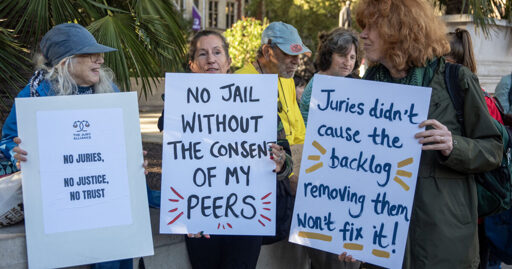
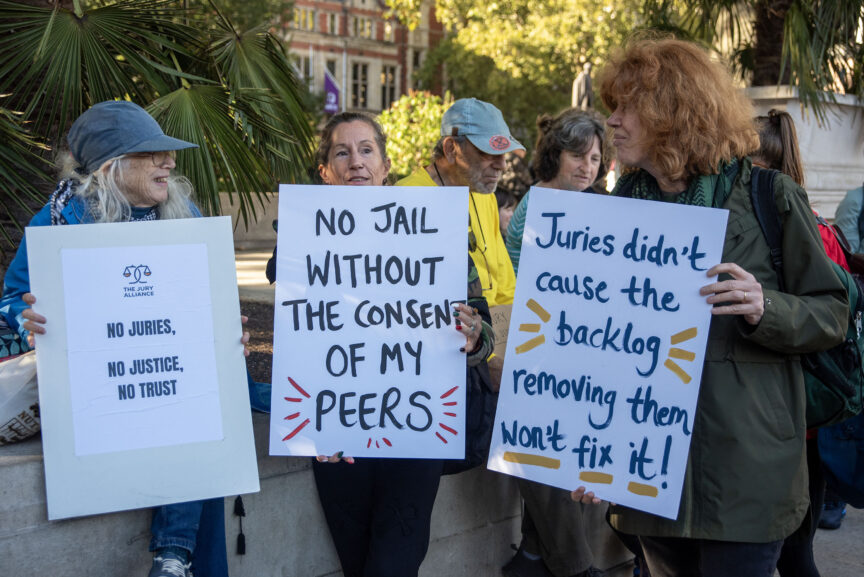
Palestine and climate protesters who are accused of breaking the law face being tried by magistrates instead of a jury of their peers, according to government plans to speed up the justice system.
Legal experts say the plans to slash access to jury trials will have profound consequences for protest cases, racialised minorities, public participation in the justice system and our fundamental rights.
The Starmer-era Courts and Tribunals Bill will remove defendants’ right to request a jury trial for offences of medium seriousness – known as “either-way” or “each-way” offences. It will also expand magistrates’ powers, reduce rights to appeal and earmark some offences for judge-only trials.
The bill was introduced in February by then-justice secretary David Lammy as an attempt to deal with severe court backlogs in England and Wales and help victims get justice faster. The backlogs in criminal courts are real, but the bill goes significantly beyond Lord Leveson’s recommendations for dealing with the issue.
And while Andy Burnham’s government claims it has “changed course” by scrapping one part of the bill, in practice the legislation will still cut access to trial by jury.
How will the Courts and Tribunals Bill affect jury trials?
All criminal cases in England and Wales start at magistrates’ court. Currently, defendants charged with an either-way offence – such as theft, burglary, drug violations and criminal damage where the value exceeds £5k – can elect for a jury trial at Crown Court. The Courts and Tribunals Bill will remove this right, leaving it up to magistrates to decide whether a case remains in their court for a summary trial where there is no jury, or is sent to Crown Court.
Magistrates will be empowered to impose longer prison sentences for single either-way offences, increasing the current maximum sentence a magistrate can give from 12 months to two years.
Moreover, defendants’ automatic right to appeal their conviction or sentence from a magistrates’ court to Crown Court will be removed – instead, they’ll have to ask permission from the Crown Court to appeal.
The government has scrapped a controversial clause in the bill that would mean offences likely to result in a prison sentence of up to three years were only heard by judges, after justice secretary Alex Norris said he had “heard the strength of feeling on the proposals for increasing the number of judge-alone trials in the Crown Court”.
However, other clauses restricting jury trials remain, meaning that far fewer defendants will be tried by a jury of their peers – a fundamental right and inheritance from the 1215 Magna Carta.
Amnesty International UK’s law and human rights director Tom Southerden described this as Burnham’s administration “astutely judging a concession they can afford to make and get political credit for”, while retaining measures that “add up to very significant ongoing threats to jury trial in this country”.
Tim Crosland, a former government lawyer, previous head of legal for the National Criminal Intelligence Service and co-founder of campaign group Defend Our Juries, agreed, telling Novara Media that Burnham’s government is claiming to be supportive of jury trials while “continuing to undermine them by stealth”.
“Removing a defendant’s right to trial by jury in either-way cases is a profound constitutional change, which the government is trying to force through without any political mandate, and with minimal parliamentary scrutiny,” Crosland said.
“Tackling the backlog in the criminal justice system doesn’t explain it. Shifting cases to the magistrates’ court only increases the backlog in the magistrates’ court. It’s robbing Peter to pay Paul.”
Southernden told Novara Media that the “watering down” of appeal rights from magistrates’ courts is “a real problem”, and highlighted how the bill risks making trials less fair for racialised defendants.
“Juries have been functioning as quite a significant safety valve for systemic racism in the justice system,” Southernden said. “Members of racialised minorities statistically choose jury trials over magistrates’ trials at a much higher rate than white people do, because juries are a more reliable source of racially neutral decision-making than magistrates are for the same offences.
“Juries are one of the few things in the justice system that are found to be not systemically racist in their outcomes.”
Which cases will receive judge-only trials?
Another controversial part of the bill concerns “complex or lengthy” Crown Court cases, which will, if the bill passes in its current form, be dealt with by judge-only trials.
While complex or lengthy cases are largely presented as fraud and economic crime-related offences, the bill has been criticised for failing to include any clear definition of – or limitation on – the offences that could be denied a jury trial.
Southernden also warned against the idea that some cases can only be understood by “elites”. “I think it’s important that we reject the notion that juries are incapable of understanding these things,” he said. “If they are, it’s a failing in the law and the way the law is presented.”
The bill will also allow the secretary of state to add offences to the list of those eligible for a judge-only trial via secondary legislation. There is currently no restriction on the type of offences that can be added.
A House of Lords committee has slammed this proposal as an “inappropriate delegation of power” and a controversial use of “Henry VIII powers” – which enable ministers to amend or repeal legislation with little parliamentary scrutiny.
“The prospect of the secretary of state picking and choosing categories of cases to hand over [to judges only] is hugely problematic,” Southernden added.
The bill has met strong opposition from industry professionals, with the Criminal Bar Association saying it is “fundamentally opposed to the proposed restrictions on the right to jury trial”. Its own survey of criminal barristers showed around 90% were against the proposals.
These plans were entirely absent from Labour’s 2024 election manifesto, giving weight to the impression that the parts of the bill that limit jury trials target political protest cases.
How will the Courts and Tribunals Bill impact protest cases?
Crosland believes this is a bill designed to prevent political cases, such as those concerning protest-related offences, going in front of juries.
“The real driver for these plans is the government’s determination to stop juries reaching the wrong verdicts in political trials,” he said. “It’s deeply embarrassing for powerful people when juries side with those exposing their crimes, whether that’s complicity in climate breakdown or aiding and abetting a genocide.
“Jury conscience has become a powerful site of democratic resistance to the abuse of power. But if we want to hold on to it, now is the time to organise in defence of it.”
The bill is making its way through parliament at a time when hundreds of peaceful protesters have been charged under the Terrorism Act for demonstrating against the government’s ban on Palestine Action, and more cases related to anti-genocide direct action are still pending following the sentencing of four activists as terrorists after being found guilty of criminal damage against arms manufacturer Elbit Systems.
Southernden pointed to how in protest cases “judges are increasingly excluding defences from them and excluding evidence from trials” – a key issue in the trial of the four Palestine Action activists earlier this year.
“Defendants increasingly err on the side of trying to communicate with a jury about the justice of what they’re being put through,” he said, “and that will be removed from them by the current proposals.”
The bill has already passed through the House of Commons, and members of the House of Lords began their detailed examination of the legislation on 10 November.
From Novara Media via This RSS Feed.