

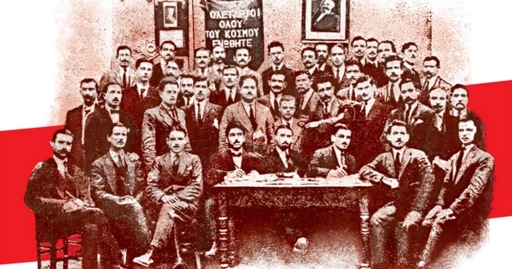

From November 17 to 23, 1918, the First Panhellenic Socialist Congress, which founded the Socialist Workers’ Party of Greece (SEKE), convened at the offices of the Steamship Engineers’ Association in Piraeus. In 1924, the party was renamed the Communist Party of Greece (KKE).
The founding of SEKE was no accidental event. It was the culmination of a long process of development within Greece’s workers’ and socialist movements. It was the inevitable outcome of social development, the mature fruit of the growth of the workers’ movement and its convergence with socialist ideas.
The Congress approved, by majority vote, SEKE’s Founding Resolution, its Principles and Programme, a memorandum on foreign affairs, a resolution calling for the establishment of a Balkan Democratic Federation, and the Party’s Statutes. It also adopted a resolution greeting the young Soviet Russia, as well as a “protest against the planned intervention of the Allies against the young Soviet Republic.”
The Founding Resolution stated that the Party was based on two fundamental principles. The first was the “political and economic organization of the proletariat into a separate class party for the conquest of political power and the socialization of the means of production and exchange, that is, the transformation of capitalist society into a collectivist or communist society.” The second was “international cooperation and action among workers.”
The Party’s Principles and Programme emphasized the necessity of social revolution for “the liberation not only of the proletarians, but of all humanity, which suffers today.” They further declared that the struggle of the working class “is necessarily also a political struggle, because it cannot fulfil its historic mission without taking possession of political power, something it can achieve only through the united revolutionary action of the working class throughout the world, organized into a separate workers’ party.”
The “Programme of Immediate Demands”, adopted by the Congress, also put forward numerous other important and pioneering political demands.
These included universal suffrage and the right to stand for election for both men and women; the introduction of referendums; the abolition of martial law; administrative decentralization; a foreign policy based on peace, mutual understanding and sincere cooperation with all states; the abolition of secret diplomacy, secret treaties and secret budgets; and compulsory arbitration of all disputes between states.
The programme demanded complete freedom for cooperatives, trade unions and other organizations; full freedom of the press; comprehensive protection of personal liberty; freedom of religion; recognition of religion as a private matter and of the Church as a private institution; the introduction of civil marriage; and full civil, political, economic and social equality between women and men.
It also called for the administration of justice by judges elected by the people; the establishment of special courts for minors; the abolition of military and naval courts; the transformation of prisons into educational institutions and the improvement of sanitary conditions; and the establishment of separate prisons for women, minors and those convicted of political offences.
In the fields of healthcare and education, the programme advocated free medical care and medicines; the expansion and compulsory provision of education; the provision of food and educational materials to children by municipalities and local communities; the introduction of the demotic, or everyday spoken, Greek language throughout the education system; the teaching of the languages of different nationalities in schools; and the construction of new schools and expansion of the school network.
In economic policy, the programme demanded the abolition of indirect taxation and all taxes on essential goods, alongside progressive taxation of income and capital.
It called for the state to receive a share of the profits of major monopolies, companies and enterprises; the nationalization of steamships, railways, mines, banks and large enterprises, with workers participating in their management; and the use of state resources primarily for productive purposes.
It also demanded the nationalization of large landed estates (tsiflikia) and monastic properties, with the land to be transferred to communities of cultivators.
The Congress concluded with the election of a five-member Central Committee consisting of Aristos Arvanitis, Dimosthenis Ligdopoulos, Stamatis Kokkinos, Michail Sideris and Nikos Dimitratos. A three-member Auditing Committee was also elected, comprising Giorgis Pispinis, Spyros Komiotis and Abraham Benaroya. Dimosthenis Ligdopoulos was elected editor of Ergatikos Agonas (Workers’ Struggle), the Party’s official newspaper.
From In Defense of Communism via This RSS Feed.