

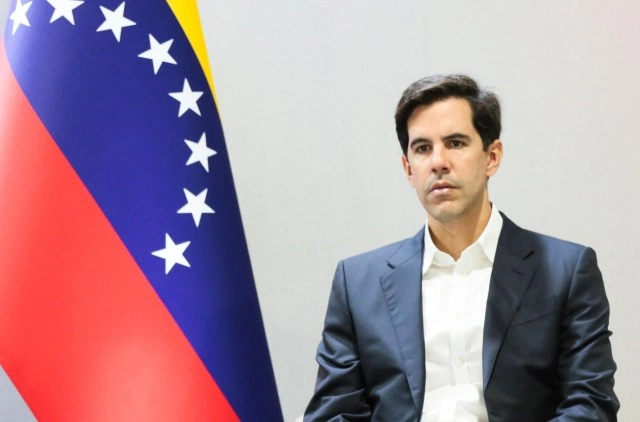
Caracas says Venezuelans alone should decide their country’s political future after Yamandú Orsi questioned its democratic legitimacy.
Venezuela has accused Uruguayan President Yamandú Orsi of interfering in its internal affairs after he questioned the country’s democratic legitimacy and called for a roadmap toward free and transparent elections.
RELATED: Venezuela’s Acting President Delcy Rodriguez Leads Business Talks in UAE
In a statement issued Monday, Venezuela’s Foreign Ministry rejected Orsi’s remarks, saying the country’s political and institutional future must be determined by the Venezuelan people.
The ministry called for relations between Caracas and Montevideo to be based on mutual respect, sovereign equality and cooperation, describing these principles as essential to constructive dialogue, regional stability and Latin American integration.
“A president’s agenda should focus on the needs of their own people and the development of their country,” the ministry said, responding to Orsi’s comments during a meeting in Madrid.
Venezuela desestima por injerencistas las declaraciones del presidente de la República Oriental del Uruguay, Yamandú Orsi, y reafirma que el futuro político e institucional de la nación corresponde a la voluntad soberana de los venezolanos.
El respeto mutuo, la igualdad soberana…
— Oliver Blanco (@OliverBlanco) November 16, 2026
Text Reads: Venezuela dismisses the statements by the President of the Oriental Republic of Uruguay, Yamandú Orsi, as interference in its affairs and reaffirms that the nation’s political and institutional future rests on the sovereign will of Venezuelans. Mutual respect, sovereign equality and cooperation between our countries form the basis for constructive dialogue that contributes to peace, stability and Latin American integration. A president’s agenda should focus on addressing the needs of their people and developing their country. Venezuela will continue to move forward with its affairs in full accordance with the will of its people.
The Uruguayan president questioned Venezuela’s democratic credentials and the legitimacy of the July 2024 presidential election, which resulted in the reelection of Nicolás Maduro.
“Since my election campaign, and even before that, Venezuela has not functioned as a democracy. What needs to happen in Venezuela is a roadmap […] that must culminate in free and transparent elections,” Orsi said.
Venezuelan Foreign Minister Oliver Blanco also condemned the comments, saying they constituted interference in the country’s domestic affairs.
“Venezuela will continue addressing its internal affairs in full accordance with the will of its people,” Blanco said.
The exchange comes amid a prolonged diplomatic rift between the two countries. On Oct. 12, Venezuela categorically rejected Uruguay’s refusal to restore bilateral diplomatic relations, describing Montevideo’s position as outdated and arrogant and accusing it of disregarding national sovereignty and self-determination.
At the time, Félix Plasencia González, then Venezuela’s foreign minister and now director of International Affairs at the Office of the Presidency, said Uruguay’s position failed to recognize Venezuela’s efforts to advance political dialogue and democratic coexistence.
Uruguayan Foreign Minister Mario Lubetkin had defended the decision not to normalize diplomatic relations in comments to Brazilian newspaper Folha de S.Paulo, arguing that nothing had changed in Venezuela following electoral processes questioned by his government.
The latest exchange highlights the continuing disagreement between Caracas and Montevideo over Venezuela’s 2024 election and the restoration of diplomatic ties, with the Venezuelan government maintaining that its political future is exclusively a matter for its own people.
From teleSUR English via This RSS Feed.