

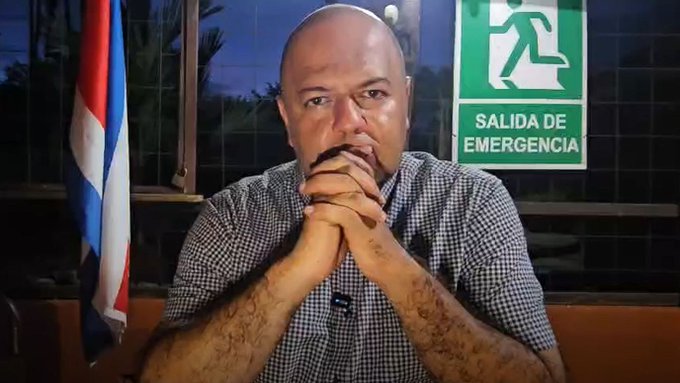
The journalist had reported death threats and exposed alleged links between drug trafficking, organized crime and corruption.
Costa Rican journalist Camilo Rodríguez was shot dead Monday in Heredia province by two gunmen on a motorcycle, days after his public reporting on drug trafficking and corruption and amid previous complaints of death threats.
RELATED: Costa Rican President Dismisses FM for Attending the Shield of the Americas
Rodríguez was driving through the district of San Miguel de Santo Domingo when two attackers on a motorcycle opened fire. The Judicial Investigation Department (OIJ) has launched an investigation to identify the perpetrators and establish the circumstances of the killing.
Through videos posted on social media, Rodríguez had exposed alleged cases of drug trafficking and corruption, publicly naming individuals and detailing their purported links to criminal organizations.
Attorney General Carlo Díaz confirmed the journalist’s identity in an interview with Canal 7, revealing that Rodríguez had previously filed a legal complaint over death threats. Although he was enrolled in a program providing assistance to victims and witnesses, he had declined a protection program recommended by the Attorney General’s Office.
Text Reads: Costa Rican President Laura Fernández condemned the “cowardly murder” of journalist Camilo Rodríguez, describing it as a “stain on freedom of expression.”
Rodríguez had been reporting on cases of drug trafficking and corruption via his digital platforms.
Prosecutor General Carlo Díaz confirmed that the journalist had reported threats against his life but had declined to participate in the Prosecutor’s Office’s protection program.
In his posts, journalist Rodríguez named individuals linked to criminal organizations and claimed to have shared his investigative findings with the DEA.
Costa Rica records nearly 900 homicides annually, with authorities attributing 70% of them to drug trafficking. The last journalists to be murdered in the country were Parmenio Medina in 2001 and Ivania Mora in 2003.
Díaz said investigators would examine the journalist’s public accusations and other possible motives for the murder.
“Part of the investigation will involve examining the victim’s background, including reviewing everyone he publicly accused on social media and anyone else who may have had an interest in killing him,” Díaz said. He added that prosecutors and the OIJ would make a major effort to identify those responsible.
The attorney general condemned the killing, warning of its implications for freedom of expression in Costa Rica.
“It is a very strong sign that we do not have freedom of expression in this country and that exposing these issues can cost us our lives,” he said.
President Laura Fernández also denounced the murder, calling it cowardly and describing it as a “stain on freedom of expression.”
Rodríguez’s killing is reportedly the first murder of a journalist in Costa Rica in more than two decades. The previous cases cited were those of Parmenio Medina, killed in 2001, and Ivannia Mora, murdered in 2003.
Medina hosted La Patada, a radio program dedicated to exposing corruption. He was shot dead near his home on July 7, 2001, by three unidentified men traveling in a car. Mora was killed while driving along a busy road in eastern San José, when two men on a motorcycle opened fire before fleeing.
The circumstances of Rodríguez’s murder resemble both earlier attacks: in each case, gunmen traveling on motorcycles targeted journalists while they were driving.
The killing comes amid persistently high homicide rates in Costa Rica. The country has recorded at least 900 murders over 12-month periods in recent years, with authorities attributing 70% of them to drug trafficking. Most killings involve firearms.
The OIJ has warned that Costa Rica’s strategic geographic position has turned the country into a hub for the transit, storage and re-export of narcotics originating in South America and destined for other continents.
Investigators are examining Rodríguez’s public accusations, professional activities and reported threats as they work to identify those responsible for his murder.
From teleSUR English via This RSS Feed.