

An examination of the shared socioeconomic grievances linking Germany’s Generation Z Regelt marches and France’s general strikes.
Since September 2026, a wave of youth-led demonstrations and labor strikes has swept across Western Europe, drawing hundreds of thousands of students and workers into the streets of Germany and France.
What began in late September with high school blockades in France quickly expanded into a broader continental mobilization against rising living costs, underfunded public services, and declining economic prospects for younger generations.
RELATED: Students Across Germany Rally Against Merz Austerity and Military Service
Police estimate that tens of thousands of young people marched across 34 German cities on October 31, while over 500,000 demonstrators joined nationwide strikes in France in October and early November.
While national triggers varied from military conscription debates in Berlin to minimum-wage adjustments in Paris and rent increases in Madrid, the demonstrations share common economic roots.
Across major European Union’s economies, protesters have pointed to stagnant real wages, high housing costs, and public budget constraints as evidence that younger citizens and wage earners are carrying an unequal share of economic adjustment.
Police clashed with youth protesters inside Berlin’s public transit system on Saturday following a Generation Z demonstration in the city’s Charlottenburg district. 🇩🇪📢🚆
Roughly 1,200 people joined the “Gen Z regelt” march against mandatory military service, deteriorating… pic.twitter.com/AlQD6ZtKNM
— teleSUR English (@telesurenglish) November 16, 2026
Germany: Generation Z Handles It
In Germany, the youth mobilization started on October 31, under the banner “Generation Z Handles It” (Generation Z regelt, in German), a decentralized, non-partisan initiative organized largely through social media platforms such as Instagram and TikTok.
Inspired in part by the student and high school protests that erupted in France earlier in September, the German movement emerged as two parallel organizing networks sharing the same name, alongside overlapping youth groups such as the “School Strike Against Conscription“.
On October 31,“Generation Z Handles It” coordinated simultaneous demonstrations in more than 30 German cities, including Berlin, Frankfurt am Main, Munich, Nuremberg, Mainz, and Stuttgart. According to figures, approximately 5,000 people gathered near the Brandenburg Gate in Berlin, though organizers placed the capital’s turnout at 11,000, while Munich and Nuremberg each drew around 4,000 participants.
Participants called for increased federal funding for public schools and universities, stronger climate protection measures, expanded social security, and government action to curb inflation and housing costs.
Many banners criticized German fiscal priorities, arguing that the federal government was allocating billions of euros toward military rearmament while maintaining strict budget limits on education and social infrastructure.
A central focus of the German protests was opposition to plans to reintroduce compulsory military service and mandatory military registration. Protesters carried placards reading “Politics for Pensioners, Bill for Us” and “Imagine It’s War and No One Shows Up,” reflecting frustration over pension policy and defense spending. In several cities, including Berlin and Frankfurt, segments of the marches also expressed solidarity with civilians in Palestine and Lebanon, criticizing German foreign policy and arms exports.
Following the October 31 demonstrations and additional marches in mid-November, organizers announced plans to join a Europe-wide youth strike on November 20 across dozens of German cities.
German Government’s Stance
Ahead of the October 31 demonstrations, German federal and state authorities treated the “Generation Z Handles It” mobilization as a major public-order challenge.
State interior ministries, including the Hessian Ministry of the Interior in Wiesbaden and security officials in Baden-Württemberg, issued pre-emptive warnings regarding potential property damage and confrontations with law enforcement.
In Frankfurt am Main, two separate youth demonstrations assembled on October 31; authorities deployed up to 1,000 riot police officers to monitor assembly points and restrict march routes.
While most of the demonstrations across Germany remained peaceful, there have been reports of excessive use of force by the police, including the deployment of pepper spray and water cannons, as well as mass temporary detentions in some of the country’s cities.
In Frankfurt, police terminated the assembly in the evening and reported 54 arrests following clashes near the city center. Organizers of “Generation Z Handles It” issued a public statement that evening distancing themselves from violent incidents and reiterating their commitment to peaceful protest.
Politically, the federal government and established parties responded by questioning the structure and motives of the decentralized movement. In public broadcasts and parliamentary debates, government representatives argued that current defense expenditures and pension reforms are necessary to ensure national security and demographic stability.
Also, independent German outlets noted that official statements largely focused on security and public order rather than addressing the protesters’ core demands regarding housing affordability, school underfunding, and military conscription.
Ver esta publicación en Instagram
Una publicación compartida de teleSUR English (@telesurenglish)
France: From Blockades to Nationwide Strikes
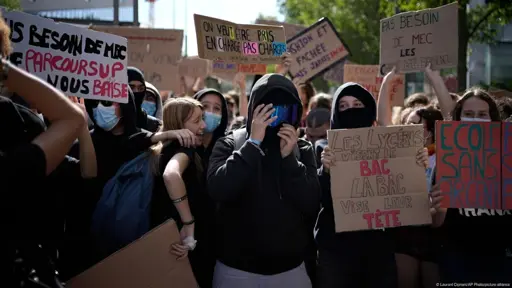
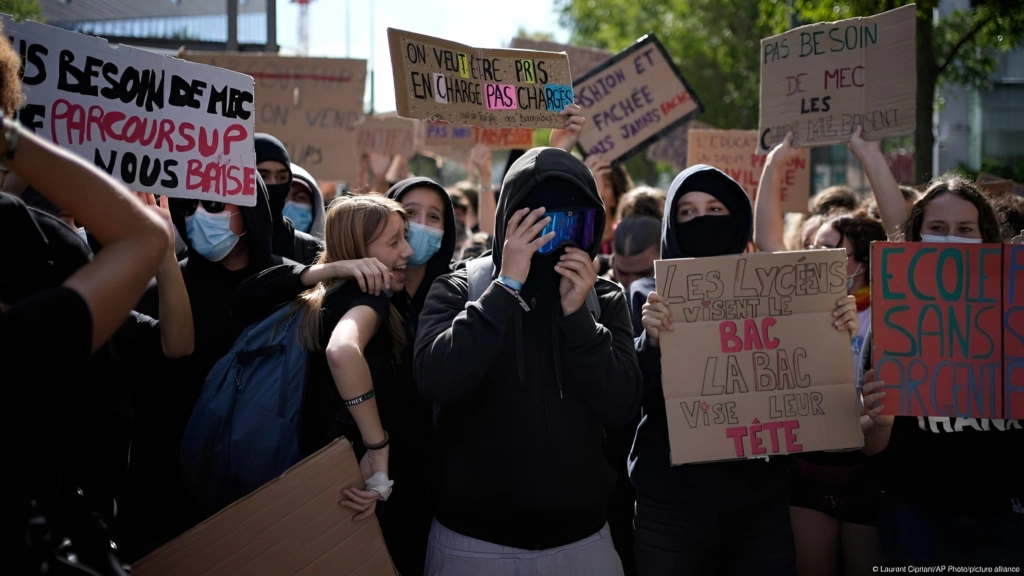
In France, the protest wave began on September 17, with the education sector before merging with broader labor and cost-of-living grievances.
After earlier localized blockades in overseas departments such as French Guiana and Mayotte in late August and early September, metropolitan protests started on September 21, 2026, at the Lycée Antoine-de-Saint-Exupéry in Créteil, outside Paris.
High school students organized blockades to protest teacher shortages, overcrowded classrooms, and a lack of school nurses and support staff. Within days, the movement spread to roughly 60 high schools across the Paris region and expanded to universities.
By mid-October, student unions, including the National Union of Students of France (UNEF), Federation of General Student Associations (FAGE), the Student Union, and the High School Students’ Union (USL), joined forces with major French trade unions such as the General Confederation of Labor (CGT), French Democratic Confederation of Labor (CFDT), General Confederation of Labor – Workers’ Force (FO), Unitary Trade Union Federation (FSU), and Solidaires Union Federation, alongside revived networks of the 2018 Yellow Vests movement.
Demonstrators demanded higher wages to offset inflation, increased funding for public schools and hospitals, the protection of pension benefits, and the withdrawal of proposed adjustment measures in the 2027 national budget.
The demonstrations have peaked during a nationwide day of action on October 17, followed by an even larger inter-union general strike on November 5, 2026.
For the November 5 mobilization, the French Interior Ministry reported a provisional turnout of approximately 575,000 demonstrators across more than 200 towns and cities, while the CGT union estimated participation at 1.57 million.
The strikes temporarily reduced national nuclear power output, disrupted rail and metro lines, and saw over 15 percent of public school teachers walk off the job.
French authorities responded by combining a significant security deployment with limited negotiations. During the marches on October 17 and November 5, the police closed dozens of Paris metro stations using tear gas and crowd-dispersal tactics against groups of hooded protesters in locations such as Boulevard Voltaire.
According to official figures compiled between September and November, hundreds of protesters, including at least 248 students and 149 teachers injured during the initial phase, as well as more than 1,300 police officers, sustained injuries.
Meanwhile, investigative media outlets like Mediapart and human rights organizations documented reports regarding the police’s excessive use of force.
Prime Minister Sébastien Lecornu defended police operations while stating that alleged abuses would be investigated. Following a two-hour meeting at Matignon on October 21 that unions criticized for offering no concrete wage concessions, Lecornu promised further talks on education and living costs.
The French government proposed increasing the minimum wage by 23 euros starting in December. In response, CGT leader Sophie Binet dismissed the offer as “mere crumbs.” Meanwhile, student union spokesperson Sabrine Kharbach demanded that the French government invest 10 billion euros to rescue public education.
#France | A fifth weekend of Yellow Vest protests leaves damage across major cities as demonstrators denounce rising living costs, low wages, and police violence. Unions call for further mobilizations.#YellowVests #CostOfLiving #SocialProtests #teleSUREnglish pic.twitter.com/jYvA4I29ui
— teleSUR English (@telesurenglish) November 16, 2026
A Shared Crisis of Affordability
The demonstrations across Germany and France during the last two months highlight a common set of socioeconomic pressures affecting Western Europe.
Although each movement responded to specific domestic policies all two centered on the declining purchasing power and economic security of young people and workers. In each country, grassroots youth organizations and digital networks have played a decisive role alongside established trade unions.
Rather than relying solely on traditional party channels, groups such as “Generation Z” in Germany, high school and university unions in France have used coordinated strikes and street demonstrations to place housing, education, and wage policy at the center of national politics.
With France approaching its 2027 presidential election, the demands raised during these autumn protests are likely to remain central to European political debates. How national governments balance defense and fiscal commitments against public investment in housing, education, and wages will determine whether social tensions ease or continue into 2027.
Sources: France Télévisions – Journal Officiel de la République Française – France 24 – EFE – Agence France-Presse (AFP) – Mediapart – Blast – TeleSUR – Al Jazeera – ARD – ZDF – DW – Die Bundesregierung – NachDenkSeiten – Telepolis – BBC.
From teleSUR English via This RSS Feed.