


How resistance abroad brought Trump’s wars home to haunt him
By FLORENCE OPPEN
The Nov. 3 midterms dealt Trump and the Republicans a sweeping defeat. Democrats took both houses of Congress, flipped House districts nationwide, and won Senate seats in Republican strongholds including Texas, Kansas, South Carolina, Iowa, and Mississippi. James Talarico became Texas’s first Democratic senator since 1988; Kansas elected its first since 1932. In Mississippi, Scott Colom defeated Cindy Hyde-Smith to become the state’s first Black senator since Reconstruction.
Living costs and resistance to ICE helped drive the Republican defeat. So did struggles Washington has failed to crush abroad. Iran made the U.S.-Israeli war costly; Palestinian resistance and the solidarity movement challenged Washington’s long-standing agreement on arming Israel. Both helped bring the crisis home to Trump.
The Feb. 28 attack on Iran was meant to impose Washington’s terms through superior firepower. Iran instead disrupted oil shipments through the Strait of Hormuz and made a quick victory impossible. The day after the election, JD Vance conceded: “The reason we lost is the war.” Trump acknowledged that gasoline prices had hurt Republicans, while still defending his offensive.
The defeat also threatens Washington’s regional strategy. Its December 2025 National Security Strategy and January 2026 National Defense Strategy envisaged Israel and the Gulf monarchies containing Iran, freeing the U.S. to reduce its commitments without losing influence. The February attack was intended to advance that project. Instead, Iran struck back and disrupted shipping through Hormuz. Yemen’s Houthis also challenged Red Sea traffic, reportedly taking Mocha in September and threatening Bab al-Mandab. Palestinian resistance continued despite Israel’s assault. Washington wanted its allies to manage the region; it got a costly war and political trouble at home.
How Iran made Washington pay
Despite devastating U.S.-Israeli bombardments that destroyed military infrastructure and killed senior Iranian leaders, Washington’s overwhelming military superiority failed to secure a political victory. As Fábio Bosco explains in “The Imperialist War Against Iran and the Politics of Revolutionaries,” published in Marxism Today (June 2026): “Through a selective blockade of maritime traffic, Iran directly impacted the global economy, demonstrating that even a dependent country can constrain imperialism by acting on the strategic nodes of the global system.” Iran’s military retaliation and control of the Strait of Hormuz imposed economic costs that Washington could not eliminate through bombardment.
American households felt the consequences at the pump and at the grocery store. By Election Day, gasoline averaged $4.14 a gallon, up 38 percent since the war began in February, while diesel had climbed to $6.28, pushing up transportation and farming costs. Consumer prices rose approximately 3.1 percent between February and October. The war did not cause all of this inflation, but disruptions to energy supplies helped drive up prices across the economy.
Iowa farmers felt the squeeze; expensive diesel and fertilizer compounded Trump’s tariffs and uncertainty over export markets. Democrat Josh Turek defeated Republican Ashley Hinson amid that discontent.
Trump had promised to avoid another long Middle Eastern war. The Associated Press Voter Poll found that roughly one-third of voters considered the Iran war crucial to their congressional vote. Some who had voted for Trump now faced higher prices from the war he promised to avoid.
Iran’s resistance thus contributed to a political setback for Washington without defeating the American military in conventional combat. This is an important, if still partial, victory. History shows that a dependent country can defeat imperialist aggression even under a reactionary bourgeois or petty-bourgeois leadership. The Taliban’s victory over the U.S. occupation of Afghanistan in 2021 offers one example. Washington continues to enforce sanctions and maintain its military presence in the region, including the naval blockade of Iran, but the war has already weakened the administration that launched it.
And the bill? Do the math. By mid-October, Washington had spent $47.1 billion fighting Iran, including roughly $29 billion to replace ammunition, according to figures reported by the Associated Press. Trump’s 2025 budget law cuts nearly $187 billion from food assistance and $887 billion from Medicaid over 10 years, while handing the Pentagon another $156 billion. Its 2026 request earmarked $384 billion for weapons procurement and research. These figures cover different periods, but the priorities could hardly be clearer: money for missiles is readily available; food and medical care must be cut.
The victory won by Iranian resistance, however partial, should encourage workers in the United States to rebuild a mass antiwar movement of their own. Iran has shown that U.S. imperialism can be challenged and its plans frustrated. But Trump will continue his wars abroad and his offensive against working people at home unless he faces organized resistance. Workers can build on this setback through their unions and working-class organizations, demanding an end to the war and sanctions against Iran, a halt to military assistance to Israel, and the withdrawal of US forces from the region. The billions squandered on war should instead fund housing, health care, and other essential public services. Trump’s electoral defeat has opened a political opportunity, but turning it into lasting gains will require a movement independent of both capitalist parties.
Turning Iran’s Victory into a Wider Struggle
The history of national liberation struggles, from the resistance to colonial conquest to the anti-imperialist movements of the twentieth century, established a principle embraced by Marxists and revolutionaries: the right of oppressed peoples to self-determination includes their right to defend themselves against foreign aggression by the means available to them, including armed resistance. This defense is unconditional in the sense that it does not depend on the political character of those leading the struggle or the material means or military tactics used in this endeavor. Supporting Iran against U.S.-Israeli aggression, like supporting Palestinian resistance to occupation, does not require giving political support in the governments or organizations directing their military efforts.
This distinction matters especially in Iran. The Islamic Republic remains a bourgeois dictatorship that has repeatedly repressed workers’ struggles and demands for democratic freedoms. Before the war, the regime faced a profound crisis of legitimacy following nationwide protests that began in December 2025 and the bloody repression of Jan. 8–9, 2026. Yet its military resistance has allowed it to recover some authority among its social base. As Fábio Bosco explains in Marxism Today, “Paradoxically, this victory also strengthens the Iranian dictatorial regime, which leads this military, and to which we offer no political support.”
Iranian workers have already shown how opposition to foreign aggression can coexist with an independent struggle against domestic oppression. In a joint statement, organizations representing bus drivers, sugarcane workers, and retirees condemned Israeli attacks while rejecting both foreign intervention and repression by the Islamic Republic. “Our struggle, as workers, is a social and class struggle,” they declared. Their demands for the release of political prisoners, an end to executions, and freedom for independent unions point toward a struggle for national liberation in which workers can develop their own political strength rather than surrender their future to the regime.
Iran’s resistance has weakened Washington’s plans for the Middle East, but even a decisive military victory would leave the regional system of U.S. domination largely intact. American bases and military alliances would remain, as would Israel’s occupation of Palestinian land. The Iranian government’s own regional ambitions and repression of independent working-class movements also limit its capacity to lead a broader struggle for liberation.
Building on Iran’s victory therefore means extending the struggle beyond the defense of one country. The Palestinian people continue to resist Israeli occupation, while the Lebanese and Syrian masses confront their own forms of foreign intervention and domestic oppression. Their political leaderships have often pursued conflicting interests; in Syria, the Assad regime and allied militias, backed by Tehran participated in the repression of a popular uprising. A common movement cannot be built by ignoring these histories or treating regional governments as representatives of their peoples.
A wider struggle is possible through the independent organization of workers and oppressed peoples across national and sectarian divisions. Their movements could link the fight against foreign military domination with demands for democratic freedoms and control over the region’s wealth. Iran’s political victory this November shows that imperialist aggression can be defeated even before the establishment of a workers’ state under revolutionary leadership. But ending imperialist domination altogether requires a broader transformation led by the working masses themselves. This is the perspective of permanent revolution: carrying the struggle for national self-determination forward into the struggle for social emancipation.
The Palestinian resistance has shattered the Zionist consensus in the U.S.
The Republican defeat has also weakened Benjamin Netanyahu’s position. But the erosion of the bipartisan consensus supporting Israel began long before the Iran war. For decades, Democrats and Republicans maintained Israel’s military superiority and diplomatic protection, despite occasional disagreements with its governments. Palestinian resistance, particularly since Israel’s assault on Gaza, has made that consensus increasingly difficult to sustain.
Palestinian resistance to Israel’s assault on Gaza has sustained a solidarity movement that refuses to retreat. In the United States, students have occupied campuses demanding divestment, while union locals have passed ceasefire resolutions and challenged their institutions’ ties to Israel. Despite mass arrests, student suspensions, and federal investigations, these campaigns have continued, bringing the demand to end U.S. military support for Israel into union meetings, university governing boards, and electoral campaigns.
Dockworkers have also brought the Palestine solidarity movement to the ports. On Oct. 30, workers at 113 ports across 22 countries organized strikes and demonstrations against Israel’s war on Gaza and U.S.-Israeli aggression against Iran. On the U.S. West Coast, ILWU Locals 2 and 34 joined the international day of action with a solidarity rally in Oakland, drawing on the union’s long history of opposing imperialist wars. As Greek dockworkers’ leader Markos Bekris explained, “Weapons need transport, infrastructure, and workers’ hands to reach their destination.” The international work stoppages showed the power workers have to interrupt military supply chains, while the ILWU rallies helped bring that struggle into U.S. ports.
“Progressive” Democrats have begun campaigning on demands raised by Palestine solidarity activists, hoping to win back young voters alienated by the party’s support for Israel. In Michigan, Abdul El-Sayed won a Senate seat after opposing U.S. military aid to Israel; afterward, he called for stopping weapons sales used in Israeli operations. In Maine, Troy Jackson opposed unconditional aid and further offensive weapons transfers.
In Providence, R.D., Palestine solidarity organizers went directly to voters after city officials and Brown University resisted divestment demands. A coalition involving local unions and community organizations collected more than 10,000 signatures and knocked on 17,000 doors to place divestment on the ballot. The measure passed with approximately 75 percent support. As Providence for Palestine declared, “you don’t need to wait for any politician or party’s permission to fight for Palestine.”
The pressure has reached Congress as well. On July 15, 103 House Democrats supported an amendment to eliminate $3.3 billion in military financing for Israel, introduced by Republican Thomas Massie. The amendment failed, with 98 Democrats voting against it and 10 voting present. Democratic leader Hakeem Jeffries opposed the measure, while Democratic whip Katherine Clark supported it. The Block the Bombs Act, restricting transfers of certain offensive weapons to Israel, had attracted 73 congressional cosponsors by June 2026, compared with 21 when introduced the previous year.
The electoral gains create a test for those candidates: will they confront party leaders over arms transfers, or quietly retreat after taking office?
So far, Democratic Party leaders remain committed to the U.S.-Israeli alliance, while candidates who campaigned against unconditional military assistance face pressure to soften their positions once elected. Ending direct grants to Israel would accomplish little if Washington continued supplying weapons through sales and joint military programs. A comprehensive arms embargo remains a concrete test of whether electoral promises will translate into changes in US policy.
The Palestinian solidarity movement has already accomplished something neither capitalist party intended: it has made unconditional military support for Israel a contested political position. The dockworkers who mobilized against arms shipments and the Providence organizers who won divestment despite opposition from city officials have shown what collective action can achieve. The challenge now is to press these gains further, forcing an end to U.S. military support for Israel rather than allowing Democratic politicians to turn the movement’s demands into campaign promises they can quietly abandon once elected.
The fractures within MAGA
The Iran war has also deepened divisions within Trump’s own coalition. His alliance with Netanyahu, once a cornerstone of Republican foreign policy, has become a source of conflict between the administration’s pro-Israel establishment and sections of MAGA that oppose further U.S. military involvement in the Middle East. Some reject the enormous financial costs of the alliance; others fear that Israel is dragging Washington into another prolonged war. These critics do not necessarily support Palestinian self-determination, but their growing opposition has weakened Republican unity behind unconditional military assistance.
On Nov. 3, Trump announced that the United States would end approximately $4 billion in annual military aid to Israel. He acknowledged that the issue had become politically damaging, specifically citing criticism from Abdul El-Sayed. The announcement was a remarkable concession from a president who had made support for Netanyahu central to his Middle East policy.
But Trump has not ended U.S. military support for Israel. The existing bilateral assistance agreement provides $38 billion over 10 years, through fiscal year 2028, including $3.3 billion annually in Foreign Military Financing and $500 million for missile-defense cooperation. Ending those grants would require implementation and potential congressional action. Existing weapons contracts and joint military programs would remain untouched. Washington and Israel have also reportedly discussed a new assistance arrangement worth $16.5 billion through 2033, suggesting that reductions in direct grants could coexist with continued military cooperation.
Trump’s predicament reflects a deeper problem for U.S. imperialism. Washington depends on Israel as a regional military ally, but the political costs of maintaining that relationship have increased. The Iran war has exposed divisions within MAGA itself, while the electoral defeat has strengthened congressional critics of unconditional military assistance. Netanyahu can no longer count on the same degree of political unity in Washington.
These fractures offer opportunities for the Palestine solidarity movement, but they also demand political clarity. MAGA isolationists may oppose spending American money on Israel without opposing the occupation or supporting Palestinian rights. “Progressive” Democrats, meanwhile, may criticize Netanyahu while continuing to approve weapons sales. The question is whether the growing opposition to U.S. military assistance can be translated into an actual break with the policies that sustain Israeli military domination.
The struggle ahead: End the wars, defend our movement
Trump’s electoral defeat has not stopped his offensive. Immigration arrests continue, while Washington maintains military pressure on Iran. The new Democratic majority will soon face its first test: will it use Congress’s power over federal spending to end the war, or let Trump keep fighting it?
A ceasefire that leaves American troops in the region, the naval blockade intact, and sanctions in force would preserve Washington’s capacity to resume the offensive. The United States must withdraw its forces, close its military bases across the Middle East, and lift the blockade and sanctions against Iran. As the Congressional Research Service confirms, Washington still prohibits nearly all trade with Iran. Decades of sanctions have damaged its economy without achieving Washington’s political objectives.
What have American workers gained from the economic siege of Iran or the billions spent arming Israel? Sanctions have neither improved their living standards nor made them safer, while U.S. military support has enabled Israel’s devastating war on Gaza. Washington claims its military presence protects Americans, yet its own aggression has brought the costs of war directly into their households. Working people are paying for policies that serve U.S. imperial interests, not their own.
The Pentagon’s 2026 budget request allocated $15.3 billion to U.S. Central Command operations, with approximately 45,700 personnel deployed across its area of responsibility. The Costs of War project estimated another $31.35–$33.77 billion spent on military operations in the wider Middle East and assistance to Israel between October 2023 and September 2025. Not all these expenditures are recoverable base-closure savings, but they expose the enormous cost of maintaining American military power abroad.
At home, the administration is targeting organizations fighting to defend working-class living standards, protect immigrants from deportation, and build solidarity with Palestine. In Minnesota, 15 anti-ICE organizers were indicted in June, including eight union members. Federal investigators infiltrated organizing meetings and obtained union financial records while pursuing an alleged conspiracy. The defendants dispute the charges.
In Michigan, the original eight Palestine solidarity defendants became the Michigan 12 after four more activists were indicted in October. The charges followed FBI raids and arrests connected to the University of Michigan divestment campaign. The defendants face potentially lengthy prison sentences under federal conspiracy charges.
Federal prosecutors also subpoenaed the Graduate Employees’ Organization (GEO), AFT Local 3550, and subsequently, its parent union, the American Federation of Teachers, demanding membership information and internal records dating back to 2023. GEO has made immigrant rights and solidarity with Palestine part of its fight for better working conditions. In Texas, labor historian and union activist Tom Alter was fired from his tenured position after speaking at a socialist conference. His campaign for reinstatement has rallied unions and academic freedom organizations against political retaliation.
By treating protest organizing and union relationships as evidence of criminal conspiracy, federal prosecutors are threatening the right to organize against ICE raids and U.S. support for Israel.
Trump’s electoral defeat will not bring the troops home, stop ICE raids, or end political prosecutions. Defending the Minnesota 15, Michigan 12, GEO, and Tom Alter requires more than courtroom arguments or solidarity resolutions. It calls for a coordinated labor defense campaign that can mobilize union members against repression.
The Republican defeat has created an opening. Turning opposition at the ballot box into organized power in workplaces and working-class communities is essential to force an end to the war abroad while confronting the administration’s offensive at home.
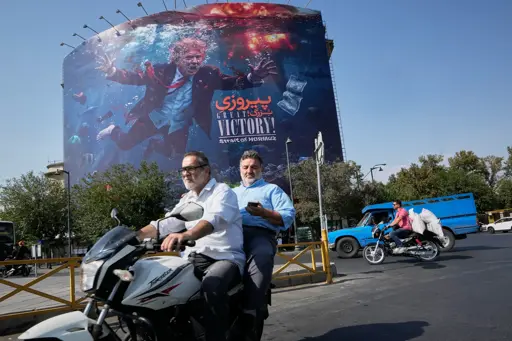
Photo: One of a number of billboards in Tehran mocking Trump. (Vahid Salemi / AP)
The post Iranian and Palestinian resistance made Trump pay at the polls first appeared on Workers’ Voice/La Voz de los Trabajadores.
From Workers’ Voice/La Voz de los Trabajadores via This RSS Feed.