

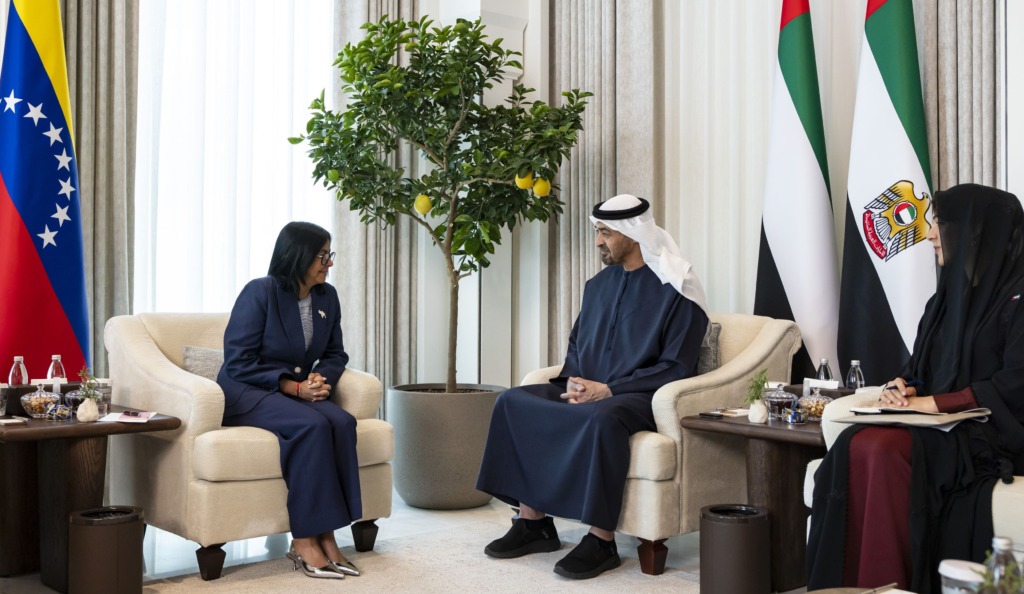
Venezuela’s Acting President Delcy Rodriguez’s official visit to the United Arab Emirates reaffirms more than five decades of sovereign diplomacy and joint defense of energy stability between the two OPEC members.
The meeting aimed to consolidate strategic alliances, boost trade and assess foreign investment opportunities in Venezuelan territory. It is part of an official tour of Western Asia that has also taken the Venezuelan leader to Qatar and Türkiye.
During the bilateral session, Venezuela’s ministerial team presented the country’s strengths in the economic, energy, tourism and aviation sectors. The stated goal was to promote future productive collaboration between the two nations.
RELATED: Venezuela and Qatar Seek Stronger Economic Ties in Doha Meetings
Rodriguez was joined by Calixto Ortega, sectoral Vice-president for the economy; Foreign Minister Oliver Blanco; Hydrocarbons Minister Paula Henao; and Miguel Pérez Pirela, Sectoral Vice-president for Communication and Culture, among other national officials.
The relationship between Venezuela and the United Arab Emirates rests on foundations laid across more than fifty years. Through that half century, the two nations built a shared agenda anchored in mutual trust and in strategic coordination inside multilateral bodies such as the Organization of the Petroleum Exporting Countries and the broader OPEC+ alliance.
Inside those spaces, both countries have played a decisive role in defending a stable, fair and balanced energy market against international geopolitical pressures. That common stand has consolidated a platform of sovereign cooperation among producing nations, one that gained renewed weight in 2026 as global energy markets faced fresh turbulence.
Ver esta publicación en Instagram
Una publicación compartida de teleSUR English (@telesurenglish)
The relationship serves as a model of multipolar diplomacy, one in which two producing nations coordinate their positions without yielding to the dictates of traditional consuming powers. That coordination became a pillar of stability during the years when market volatility tested the cohesion of the producers’ group.
The OPEC+ framework gave the bond an institutional dimension. Venezuela and the Emirates helped steer the alliance through negotiations over production levels, balancing members whose fiscal needs differ sharply. Their role in those talks has been decisive in preserving a market equilibrium that serves producers and consumers alike.
Defending Energy Stability
The defense of a just and balanced market is not a technical matter alone. It is a geopolitical stance. Both nations have insisted that energy policy must remain in the hands of sovereign states rather than bend to pressure from powers seeking to weaponize supply. That shared conviction anchors their work inside OPEC and OPEC+.
The 2026 context sharpens the relevance of that position. Geopolitical pressures on energy routes and prices have intensified, and producing nations face renewed demands to abandon their coordination in favor of short-term market logic. Against that backdrop, the visit reaffirms a joint commitment to stable markets governed by the consensus of producing countries.
The visit also carries symbolic weight for the multipolar order both nations advocate. Venezuela and the Emirates have each pursued foreign policies that multiply partnerships across regions rather than tether themselves to a single bloc. Their bilateral agenda reflects that same instinct, expanding from energy into a broader platform of sovereign cooperation.
The relationship now enters a new phase shaped by the pressures of 2026. What began as diplomatic contact between two oil producers has matured into a strategic alignment that both capitals describe as a pillar of their foreign policy, with the shared agenda of OPEC and OPEC+ as its anchor.
Tour Across Western Asia
The roundtable is part of the Venezuelan leader’s official tour of the region. She arrived Sunday, November 15, at Abu Dhabi International Airport, where she was received with military honors. Greeting her were Ali Mohamed Hamad Al Shamsi, Secretary General of the Supreme Council for National Security, and Reem Al Hashimy, the UAE’s Minister of State for International Cooperation.
The UAE visit follows an official stop in Qatar. There, Rodriguez met in Doha with Emir Tamim bin Hamad Al Thani to review the bilateral cooperation agenda and promote joint projects. Before that, she took part in the 31st UN Climate Change Conference (COP31), held in the Turkish city of Antalya.
The visit also includes meetings with senior Emirati officials, among them President Sheikh Mohamed bin Zayed Al Nahyan**. The Venezuelan government presents the tour through Abu Dhabi, Doha and Türkiye as a way to strengthen what it describes as multipolar diplomacy and sovereign economic cooperation.**
From teleSUR English via This RSS Feed.