

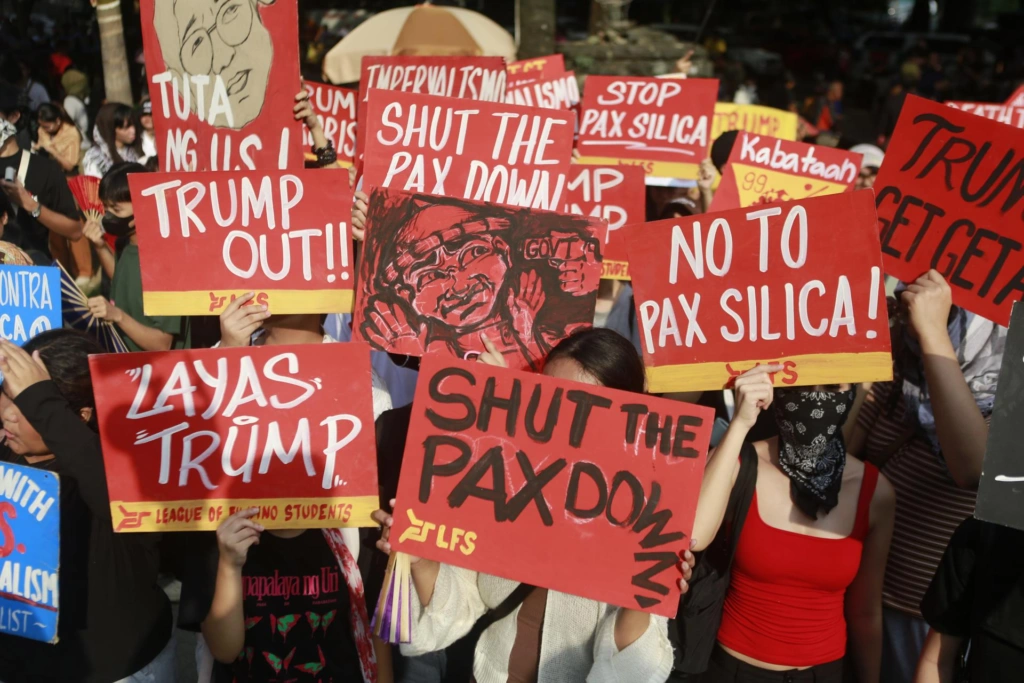
Philippine police reported Monday that at least 211 people were taken into custody during protests in metropolitan Manila against U.S. President Donald Trump’s arrival for the ASEAN summit, with 20 minors among the detainees.
The arrests occurred Sunday, when security forces blocked marches near the venue of the 49th summit of the Association of Southeast Asian Nations.
The demonstrations drew together activists, students and native communities, and the detentions unfolded against a backdrop of heavy police cordons around unions and patriotic organizations at points including Liwasang Bonifacio.
RELATED: ASEAN Summit Manila 2026: 11 Leaders Open Talks on Integration
Bagong Alyansang Makabayan, a progressive coalition, denounced what it called a “mass detention of activists” on social media. The group rejected the government’s claim that the summit’s opening day had been “generally peaceful” and placed the arrests within an operation meant to shield the gathering from dissent.
Protesters gathered in rejection of Trump’s presence at the annual meeting of ASEAN heads of State. The visit is the U.S. President’s first trip to the archipelago in nine years, and he will travel on to China after the summit.
Organizers directed their marches against U.S. military interference and against territorial dispossession linked to the technological control Washington promotes. For these movements, Trump’s visit embodies a model that subordinates the country to corporate interests.
Ver esta publicación en Instagram
Una publicación compartida de teleSUR English (@telesurenglish)
Pax Silica Under Criticism
The other axis of the protests is Pax Silica, the geoeconomic project through which United States aims to monopolize supply chains for semiconductors and critical minerals used in artificial intelligence. The initiative also seeks to isolate Beijing technologically.
In Philippine territory the plan includes a 1,600-hectare industrial hub in New Clark City, in Tarlac province. Its construction threatens to displace Aeta native communities and peasant families from their ancestral lands.
Delegations of native peoples and agrarian movements led the mobilizations. They argue that United States push to control chips and critical minerals amounts to the dispossession of their territories, and they center their demands on defending those lands from the project’s advance.
The social pressure carried real weight. It forced a postponement of the formal signing of new agreements covering the zone during the summit. Popular movements warned that Manila’s strategic subordination to its mutual defense treaty with Washington turns the country into a sacrifice zone serving U.S. corporate and military interests.
President Ferdinand Marcos Jr.’s government is reinforcing its military alliance with the White House as part of a containment front against China. Popular sectors question the loss of national sovereignty and the use of public funds to mask urban poverty during Trump’s visit. They also reject the foreign military presence in the archipelago.
The summit’s agenda continues in the coming days, and the movements say they are preparing further actions. What remains unresolved is whether the New Clark City hub moves forward or whether popular pressure once again stalls the agreements with Washington.
From teleSUR English via This RSS Feed.