

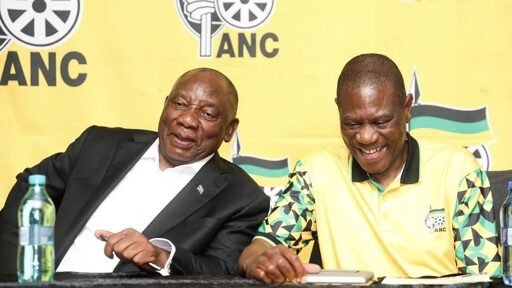

Securing less than 31% of the votes in the local election held earlier this month, the African National Congress (ANC) has delivered its weakest ever electoral performance in over three decades of South Africa’s post-apartheid era.
Held amid worsening water shortages, power disruptions, and piling uncollected garbage, the party saw its vote share drop by almost 15 percentage points from the 45.6% it received in the 2021 local elections. The number of council seats it secured dropped over 30%, from 4,548 in 2021 to 3,164 in 2026.
Even steeper is the more than 68% decline in the number of municipalities where it has an outright majority. In the 2021 local election, the ANC won outright majorities in 161 of the 213 municipalities. In this election, only 51.
Its loss is particularly severe in urban areas. In 2021, the ANC was the largest party in six of the eight metropolitan municipalities. In two of them, it secured an outright majority with over 50% of the seats. In the 2026 local election, however, it failed to secure an outright majority in any municipality. It retained a simple majority status in only two – Buffalo City and Mangaung.
Center-right DA’s gains are mainly in urban areas
The center-right Democratic Alliance (DA), which in 2021 had already won the highest number of votes in Nelson Mandela Bay and an outright majority of seats in Cape Town, went on to replace the ANC as the largest party in Johannesburg, Tshwane, and Ekurhuleni. It retained the outright majority in Cape Town.
In the remaining seven municipalities, no party has won an outright majority, even though the DA has the highest votes in five of the eight metropolitan municipalities.
Beyond its metropolitan gains, however, the DA has captured only a fraction of ANC’s loss. Its vote share increased by barely 3 percentage points, from 21.66% in 2021 to 24.6% in 2026. Its total council seats increased from 1,496 to 1,527.
Historically associated with the interests of the wealthy white minority, the DA emerged as the principal electoral challenger to the ANC. Winning South Africa’s first democratic election after leading the anti-apartheid struggle, the ANC came to power in 1994, with Nelson Mandela as president.
It ruled for 30 years without needing any coalitions, outside of the tripartite alliance, winning an outright majority of parliamentary seats in all subsequent national elections until 2024, when it fell short of the minimum 201 seats required to form a government, securing only 159 of the 400. From its peak vote share of 69.69% in the 2004 national election, the ANC has consistently lost support in every successive election, dropping to just over 40% of the vote in 2024.
Adopting neoliberal policies, the ANC failed to correct the economic injustices of the apartheid regime. Under rampant privatization, the public sector suffered. Unemployment soared, especially among Black Africans. People’s movements like Abahlali baseMjondolo, fighting for land rights of the urban poor, faced severe repression.
Read more: “A declaration of war against the poor”: AbM leads resistance against South Africa’s anti-occupation bill
When ANC joined hands with the right
Instead of correcting its course, the ANC joined hands with the DA – which had been advocating an even more aggressive pursuit of neoliberal policies – to form the Government of National Unity (GNU), along with eight other smaller parties, including ethno-nationalist and far-right parties.
Two years later, in the 2026 local election, the ANC was dealt another severe blow with less than 31% of the vote, its lowest countrywide share in any election before – national, provincial or local.
“This has been a very catastrophic outcome for the ANC,” said the party’s secretary general, Fikile Mbalula. “We cannot ask the people to trust us merely because of our history.”
The DA, on the other hand, gained one million black voters, said its leader, Geordin Hill-Lewis, who is also the mayor of Cape Town. However, it added up to only a small fraction of the 15% vote share the ANC lost. Most of it was gained by smaller opposition parties opposed to the GNU.
Led by former ANC chief and the ex-President of South Africa, Jacob Zuma, the uMkhonto weSizwe Party (MKP) won 9.61% of the vote in its first local election. Taking the name of the ANC’s armed wing during the anti-Apartheid struggle, it splintered from the ANC in late 2023. It secured 14.58% of the vote in the 2024 national election, supplanting the Economic Freedom Fighters (EFF) as the third-largest party in Parliament.
Its manifesto called for nationalization of several sectors, reversal of privatization, and a greater state role in the economy. However, critics have questioned its credibility, pointing to the contradiction between its manifesto and the record of its leader, Jacob Zuma, who presided over the implementation of neoliberal economic policies during his presidency from 2009 to 2018.
Xenophobic, far-right parties in ascent
Earlier this year, ahead of the local elections, the MKP, which many describe as a far-right party, was linked to xenophobic mobilizations targeting poor immigrants from other African countries. Winning 701 council seats and outright majorities in five municipalities, and emerging as the largest party in 19, the MKP replaced the EFF as the third-largest party at the municipal level
The left-populist EFF is itself a splinter of the ANC, formed in 2013 by its former Youth League president, Julius Malema, after he was expelled from the party. It received 6.25% of the vote in 2026, down from over 10% in the 2021 local elections.
Finishing close on the heels of the EFF is the ascendant ActionSA, which secured 5.67% of the vote, more than doubling the 2.33% it had in 2021. A breakaway from the DA, ActionSA is also a far-right party, advocating xenophobic anti-immigrant measures. However, unlike the MKP, whose xenophobia is combined with state-interventionist economic proposals, ActionSA combines its xenophobia with free-market fundamentalism.
Winning the sixth-highest vote share, close behind ActionSA with 4.69% of the vote, is the Zulu ethno-nationalist Inkatha Freedom Party (IFP), which prides itself on its anti-socialist identity and advocates social conservatism and a free market. Its vote share dropped only slightly from 5.64% in 2021. It is a part of the GNU, along with the ANC and the DA.
Also part of the GNU is the Freedom Front Plus (FFP), which secured the seventh-highest number of votes, slightly increasing its share from 2.34% in 2021 to 2.99% in 2026. It is a far-right Afrikaner White nationalist party rooted in the apartheid era elite.
Communist Party’s electoral debut
Trailing just behind with the eighth-highest number of votes is the South African Communist Party (SACP), which secured 2.38% in the very first election it has contested independently. Although the party is more than 100 years old and was on the frontlines of the anti-apartheid struggle, it aligned itself with the ANC since the democratic breakthrough in 1994, and had never before contested independently in any election.
However, in 2024, after the ANC joined hands with the center-right DA to form the GNU, which even included the far-right Afrikaner FFP, the SACP decided to contest the 2026 local election independently, without breaking the historic tripartite alliance. It secured over 700,000 votes and 271 council seats, giving hope to the left in an election whose results otherwise point to an ascendant right.
Unprecedented number of hung councils
Well over 500 more parties contested in this race, fielding about 137,000 candidates for 10,526 council seats, according to the Electoral Commission of South Africa.
South Africa has 213 municipalities, but a revote is pending in one. Of the 212 municipalities with declared results, only 73 have a party holding more than 50% of council seats. The remaining 139 are hung councils, where no party has an outright majority.
Despite massive losses, the ANC, which remains the single largest party, has opened talks with all parties. “This situation has imposed on all political parties a duty to reflect and determine the best and most stable coalitions” for these 139 municipalities, it said on November 15.
From BT News via This RSS Feed.