

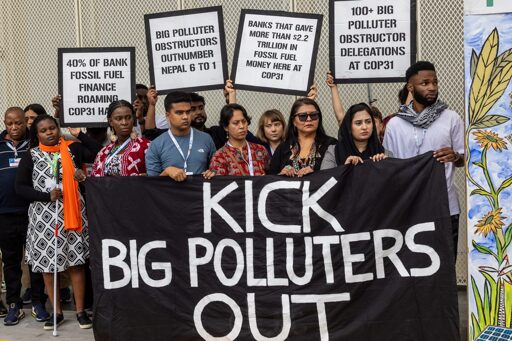

This article was originally published by Truthout on Nov. 16, 2026. It is shared here under a Creative Commons (CC BY-NC-ND 4.0) license.
With the 31st annual UN climate summit (COP31) currently underway in Antalya, Turkey, and deadly heat waves and catastrophic floods having been a hallmark of 2026, a year set to be the hottest on record, this is a propitious time to take stock of the progress made on climate change and the environment and reflect on the challenges of a world beyond fossil fuels.
No one anticipates any breakthroughs in negotiations at COP31, which concludes on Friday, November 20. Climate change is not even a major issue regularly getting the attention of global leadership, and global banks, including the largest U.S. banks, are dropping their climate commitments. If there was ever an international consensus in fighting climate change, it is surely gone, as British Prime Minister Andy Burnham told COP31. Indeed, recently re-elected Brazilian President Luiz Inácio Lula da Silva scolded fellow leaders at the UN climate summit in Turkey by saying they are interested in “talking more about weapons and tariffs than the survival of future generations.” It is thus not surprising that the leaders of major countries around the world (Germany, France, Italy, Canada, Japan, India, and China) skipped the event. U.S. President Donald Trump of course is also not attending since he (again) withdrew the United States from the Paris Climate Agreement.
Short-term political concerns have dominated past global climate summits, and it is no different this time around. COP31 has exposed yet again the deep divisions among developed and developing countries over adaptation funding and climate finance accountability. And Venezuela’s acting President Delcy Rodriguez objected to calls for an end to the age of fossil fuels by telling the conference that “we reaffirm our sovereign right to strengthen our energy and oil industry as a driver of our national development.” Sadly enough, this is a view that is now openly shared by many leaders around the world, including Turkey, the host of this year’s climate summit which remains heavily dependent on fossil fuels, especially coal-fired electricity generation. So while electrification has emerged as a major theme of this year’s summit, it seems more than likely that oil and gas could dominate for decades.
Moreover, like in all previous climate summits, the formal agenda of COP31 does not include an item on the relationship between militarism and climate action. No mention of the long-term environmental costs of war, militarism, and occupation — including the destruction of Gaza, which has unleashed massive greenhouse gas emissions — is expected to feature in COP31’s final text. In sum, COP31 will make clear yet again that the world cannot simply rely on summits to solve the climate emergency. Radical and legal activism are the best hopes for our future.
James K. Boyce is an author, naturalist, and a leading scholar of environmental economics and climate policy. In this interview, Boyce discusses the evolution of the political economy of the environment and of environmental movements, the opportunities and failures of global climate summits, and he highlights the links between climate change and inequality.
Boyce is professor emeritus of economics and senior fellow at the Political Economy Research Institute at the University of Massachusetts Amherst. He is the author of many books, including Economics for People and the Planet: Inequality in the Era of Climate Change. He is also the recipient of major awards including the 2025 Common Wealth Prize, the 2024 Global Inequality Research Award, and the 2017 Leontief Prize for Advancing the Frontiers of Economic Thought.
The interview that follows has been lightly edited for clarity and length.
C.J. Polychroniou: Climate change is the defining crisis of our time. We have also been in an environmental crisis since the late 1960s. Indeed, the first Earth Day took place in 1970 as a response to rising environmental concerns. Shortly thereafter, we also had the establishment of the U.S. Environmental Protection Agency (EPA), further evidence that the environment was becoming a top issue for voters. Now, you have devoted much of your career to investigating the dynamics of environmental degradation, including the link between inequality and the environment. Can you discuss a bit how the study of the political economy of the environment has evolved over the past 50 years?
James K. Boyce: Dirty air, polluted water, and depleted natural resources put environmental issues on the political map. As so often is the case, the economics profession was behind the curve. When I went to Oxford to study for my doctorate in 1980, the university did not offer a single course in environmental economics.
As the importance of environmental “externalities” — impacts of production and consumption that do not show up in market prices — became more evident, the new field of environmental economics developed with its focus on how to restore “efficiency,” in the cost-benefit analysis sense of maximizing net present value, once externalities are factored into the mix via “shadow prices.”
Initially, few economists connected the dots between environmental degradation and inequality. In part this reflected the times: The field emerged during the heyday of free-market fundamentalism, when most economists dismissed inequality as a non-issue. But two more things contributed to that neglect. One was the ideological axiom that the economic well-being of a society can be measured by summing the dollar value of output (adjusted, perhaps, for the imputed dollar value of environmental impacts) without considering how those dollars are distributed; that is, ignoring the elementary fact that a dollar is worth less to a billionaire than to a worker struggling to make ends meet. The second was ignoring the role of power — political power as well as purchasing power — in shaping how markets and governments alike function, including the role of power in shaping decisions on environmental policy.
Over time, this too has begun to change.
What about the evolution of the environmental movements? How has environmental activism evolved over the years, and what have been its main achievements so far?
There have always been diverse strands in environmental movements, within and across countries, so generalizations should be taken with a grain of salt. In the United States, I would say that in its early years the environmental movement saw the basic problem as one of protecting nature from people. “People” were seen as the problem. In practice, this often meant poor people who supposedly could not “afford” to care for the environment. This notion went hand-in-hand with the rampant Malthusianism of the time which portrayed population growth as the root of all ills.
Things began to change in the 1980s with the birth of the environmental justice (EJ) movement. Its initial focus was the disproportionate siting of hazardous waste facilities in communities composed primarily of Black people. Gradually, the movement widened its scope to disparities across a wide range of environmental impacts, along lines of class, ethnicity, and gender as well as race. Environmental justice reframed the environmental narrative not simply as protecting nature from people but protecting some people from environmental harms caused by the actions of other people.At the same time, the international women’s health movement effectively challenged the axiom that overpopulation is the main cause of poverty and environmental degradation.
In the U.S., race and ethnicity often are even stronger than income as predictors of exposure to environmental hazards.
A milestone was achieved in 1994 with the executive order issued by President Bill Clinton that directed federal agencies to address disproportionate environmental impacts on minorities and low-income people. The political fortunes of the environmental justice movement have risen and fallen over time — the Trump regime marks a nadir in this as in so many other respects — but environmental justice has made a lasting imprint on environmental activism.
Much has been achieved. Air quality and water quality have improved greatly, reducing illnesses and premature mortality from pollution. The Montreal Protocol, an international agreement that went into effect in 1989, protected the stratospheric ozone layer from depletion by chlorofluorocarbons. The decline of biodiversity has been arrested, though by no means halted. And a start has been made on the historic transition from fossil fuels to cleaner sources of energy. Much remains to be done, but it is important to recognize these achievements, if only to take heart from their evidence that we are on the right side of history.
Inequality is one of the biggest and most troubling issues of our time. What are the mechanisms by which economic inequality can lead to environmental degradation?
Economic inequality and the accompanying inequalities of power make it easier for those on top of the economic ladder to impose environmental costs on everyone else, and especially on those at or near the bottom.
This would be the case even in the ideal world of neoclassical economic orthodoxy, where maximizing the dollar value of net benefits is the touchstone for welfare optimization. Standard cost-benefit analysis is guided by the principle of “one dollar, one vote,” not “one person, one vote.” Under this formula, those people with more dollars have more votes. The cost of environmental harms is measured by willingness to pay to prevent them. If those who suffer the harms are poor — while those who reap the benefits from environmental degradation, via higher corporate profits and lower market prices, are relatively wealthy — then the so-called “efficient” level of environmental protection is weaker than would otherwise be the case.
The impact of inequality does not stop there, however. Political power often mirrors purchasing power. The result is to distort environmental policy-making even further by biasing decisions against those with less political voice. This helps to explain why in the U.S., race and ethnicity often are even stronger than income as predictors of exposure to environmental hazards.
It has been argued that climate change also increases economic inequalities. How so, and what can be done about that?
Like other kinds of environmental degradation, climate change tends to hit the poor harder than the rich. In part, this is because lower-income people have less ability to withstand environmental costs than do high-income people. If climate change led to a 10 percent decline in incomes that was equally distributed across the board, it would be a bother to the rich, a bigger deal for the middle class, and potentially fatal for some of the poorest people in the world. But it is also due to the fact that the costs of climate change are not, in fact, evenly distributed. Lower-income people often live in more vulnerable locations, and they are less able to afford house insurance, health insurance, air conditioning, and other means of escaping the worst effects of extreme weather events. This was vividly illustrated, for example, by the impacts of Hurricane Katrina in New Orleans in 2005, a disaster that has been described as “environmental injustice in a fast-forward mode.”
In principle, climate adaptation investment should and could be preferentially channeled to those at most risk. All too often, however, scarce resources for this purpose flow to those with the most economic and political power.
What can be done about this? The first order of business is to move as quickly as possible to phase out the use of fossil fuels, doing so in a way that enhances the energy security for working people in the short run by increasing the money in their pockets, and in the long run by freeing them from periodic shortages and price gouging on the world markets for oil and gas. The second task is to make those most responsible for climate destabilization — the world’s biggest fossil fuel corporations — shoulder a fair share of the costs of disaster response and climate adaptation, and to ensure that funds for these purposes reach those in greatest need. Both of these things are possible, but only if working people exercise their democratic rights to call the shots rather than leaving environmental policy in the hands of oligarchs.
The COP31 summit is happening this month in Antalya, Turkey. How much impact do these global summits have?
The fact that we are now on the 31st summit and have yet to phase out emissions of greenhouse gases shows that their impact has been limited. But this is not to say that summits are useless. They raise the visibility of the issues across the world, and to some extent, they offer a forum for concerted action in reducing emissions and funding investments for climate adaptation and for compensation for losses and damages that have not been averted.
Local and national action to combat climate change does not have to wait for an international agreement.
Much more needs to be done. The fact that the U.S. administration today has chosen to obstruct progress rather than cooperate (let alone play a leading role in addressing climate change) only makes matters worse.
But it is crucial to recognize that local and national action to combat climate change does not have to wait for an international agreement. Curbing carbon emissions is often depicted as a textbook collective-action problem: Why should any country reduce emissions if others fail to do so? This was the argument invoked by President George W. Bush when he refused to ratify the 1997 Kyoto Protocol. This pretext for inaction rests on the misleading premise that the transition from fossil fuels to clean energy necessarily is a cost rather than a benefit to the country and its people.
In reality, proactive climate policies can bring enormous health benefits to the public thanks to cleaner air, for the simple reason that fossil fuels spew out multiple toxic pollutants along with carbon dioxide. Moreover, fossil-fuel phasedown policies can be designed to raise the purchasing power of working people through energy security cashbacks. These benefits of cleaner air and higher incomes accrue regardless of what other countries do. In addition, being a leader in the development of clean energy technologies will confer a strong competitive advantage to the country’s economy in coming decades. So national moves to cut emissions need not be held hostage to decisions by other countries.
Are you optimistic about humanity’s chances in curbing the climate crisis before it destroys civilization as we know it?
Well, “civilization as we know it” today has deep flaws in terms of obscene economic inequality and needless environmental degradation. To improve human well-being, we need to fix both.
Rephrasing the question in terms of curbing the climate crisis before it irreparably damages human well-being, I am optimistic that is possible. There is no scientific or technical reason it cannot be done; instead, there are political obstacles. These are formidable, but when it comes to politics, I take inspiration from Antonio Gramsci’s optimism of the will.
From The Real News Network via This RSS Feed.