

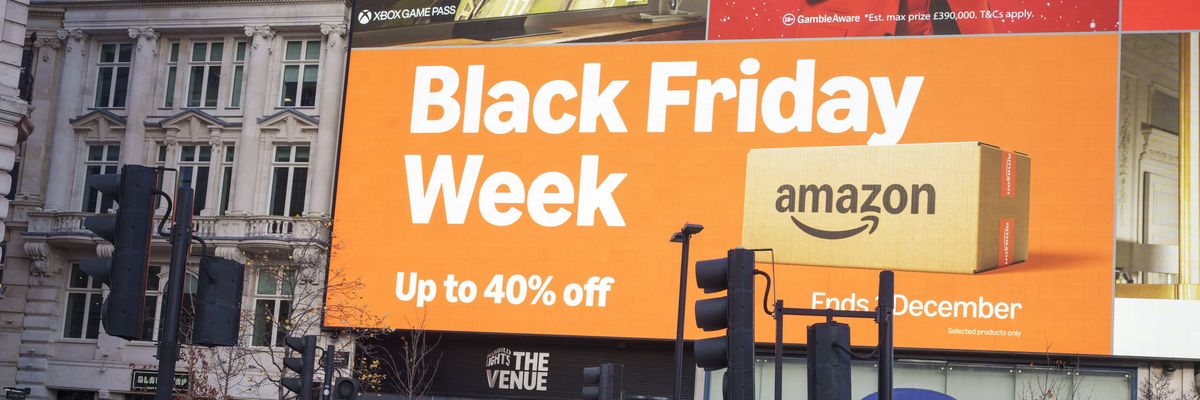
Families who have spent 2026 trying to keep up with soaring prices at the gas pump and grocery store, as well as the rising healthcare costs that have resulted from the Republican Party’s Medicaid cuts and ripping away of Affordable Care Act subsidies, may be looking forward to the Black Friday and Cyber Monday deals that typically follow Thanksgiving, hoping to save money on holiday gifts and other purchases.
A new analysis by the think tank Groundwork Collaborative warns that they should look beyond Amazon for those savings.
The group examined more than 350 products included on Amazon’s pages promoting what the $2.8 trillion e-commerce giant called its “best” deals in the 2024 and 2025 holiday seasons, and found that hundreds of the items were either just as expensive as they’d been weeks before the “deals” were announced—or even pricier than they’d previously been listed.
Nearly 30% of the products were priced the same or higher during the Black Friday and Cyber Monday events than they were in the month leading up to the “sales,” and 60% were just as expensive as they’d been 90 days earlier.
Even worse for people who wait until Black Friday and Cyber Monday to make big purchases, 1 in 10 of the products listed on the pages were more expensive during the so-called sales than they had been in the months leading up to the holiday season—sometimes significantly so—even though Amazon advertised the two traditional holiday shopping days as ones when users would find “some of the lowest prices of the year."
An Apple Watch Series 10 was listed at $679.99 during Amazon’s Black Friday 2025 sale—13% more than customers had paid for the same product nearly a month earlier, when it was priced at $602.
Those looking for women’s rain boots from the brand Hunter paid $126.99 for the boots during the sale, but they would have been charged just $79.97 if they had bought them nine days earlier. Waiting for what Worldwide Amazon Stores CEO Doug Herrington called “incredible Black Friday Week and Cyber Monday deals” with “deep discounts” would cost a customer 59% more.
Similarly, shoppers hoping to take advantage of Cyber Monday in 2025 were told they were getting a low price when they paid $179.98 for a pair of men’s UGG boots—but that was a whopping 83% more than they would have paid less than a month before the sale event, when it cost less than $99.
In addition to examining Amazon’s deal pages from the past two years—which the company removed from its website after learning that Groundwork Collaborative’s analysis was underway, but which the group accessed through archived versions—the organization analyzed how many days before the sales the product was selling at the sale price or cheaper, how much more so-called “deals” were than previous prices on average, and whether “same or worse deals” were more common in some product categories than others.
More than 40% of toys and games had “same or worse deals,” as well as more than 38% of electronics and 37% of household goods.
Groundwork Collaborative, which has extensively studied how corporations use deceptive pricing tactics and other ploys to boost their profits at the expense of families who are already struggling to afford necessities under President Donald Trump’s economic policies, emphasized that Amazon customers “aren’t shopping these marquee annual sale events for the excitement alone; they are increasingly looking to these events to offset rising prices.”
“Over the past few years, consumers have faced steep price hikes on essential goods and services, including groceries, rent, electricity, and healthcare,” reads the report. “Household savings diminished as prices climbed. These cost-of-living pressures have caused more consumers to plan around sale events, saving up and delaying purchases for weeks in anticipation of the sales. It is no surprise that more consumers planned to participate in sale events in recent holiday shopping seasons than in the past, strategically planning their spending to take advantage of discounts.”
This year, according to polling, 70% of Americans are planning to take advantage of Black Friday and Cyber Monday sales, up from 64% last year.
“Millions of Americans wait all year for Black Friday and Cyber Monday to score the biggest bargains on stocking stuffers and household staples," said Lindsay Owens, president and CEO of Groundwork and a co-author of the report. “Shoppers trust that the deals advertised to them deliver real savings because Amazon promotes them that way. But it turns out that these major sales aren’t all they’re cracked up to be. Instead, our investigation reveals that shoppers who wait for these major sale events may be playing rip-off roulette.”
The report notes that a number of states have laws to prevent companies from falsely advertising deals or discounts where none exist. In California, a former price must have been the prevailing market price within the three months before a sale is advertised, and in New Jersey, a former price “is treated as fictitious unless substantiated by a substantial number of actual sales within the prior 60 days, actively offered on at least 28 of the most recent 90 days, or a cost-plus-markup basis.”
The group called on federal and state regulators to start cracking down on Amazon’s deception “by enforcing the laws already on the books,” to keep millions of Americans from overpaying on goods marketed as bargains.
Regulators “must also broaden their definition of deceptive discount advertising to cover a retailer’s failure to prominently disclose that consumers could have gotten a better price leading up to the sale,” reads the report.
Owens said that "shoppers deserve to know they can trust every deal Amazon promises them. If Amazon can’t deliver that basic promise, lawmakers should hold them accountable.”
From Common Dreams via This RSS Feed.