

By Phill Gittins, World BEYOND War, November 16, 2026

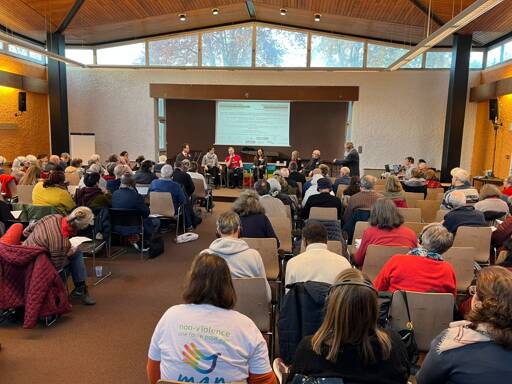
World BEYOND War’s Europe Organizer Annachiara Canetta and Education Director Dr. Phill Gittins joined around 150 participants from across Europe and beyond in Strasbourg, France, for the international conference Comprehensive Defence: The Contributions of Unarmed Civilian-Based Defense (UCBD) to Whole-of-Society Defence.
Held at the Centre Culturel Saint-Thomas on November 13–14, 2026, the conference aimed, in the organizers’ words, to explore “the value, the feasibility, and the limitations of unarmed civilian options in the field of defence.”
Across the two days, presentations, roundtables, and workshops ranged widely, from the history, theory, and strategies of unarmed civilian-based defense (UCD) to civilian resistance and resilience in Ukraine, responses to authoritarian regimes and armed groups, information warfare, deterrence, and preparedness. The conference also included a video address from Ukrainian human rights defender Oleksandra Matviichuk of the Nobel Peace Prize-winning Center for Civil Liberties. Participants came from a range of organizations, including FLACSO Ecuador, NOVACT, Greenpeace, Nonviolent Peaceforce, and other research and civil society organizations.
Despite the range of topics and perspectives, one question ran through the conference: what does it mean — and what does it take — to defend a society? What are civilians already doing, and what more could they do?
Different understandings of defense
There seemed to be broad agreement that civilians have a role in defense, but much less agreement about what that role should be. Some saw UCD as a complement to military defense. Others argued that UCD should be developed as an alternative, not simply an addition, to military defense. For some, the question was not just about effectiveness, but about what we are trying to defend. Military force can devastate the very people, communities, cultures, and environments it is meant to protect. Nonviolent action offers ways to defend them without resorting to that destruction.
Military defense remains the dominant approach in much security thinking, policy, and planning. Governments increasingly speak of comprehensive or whole-of-society defense. Yet UCD and its distinctive logic and strategies receive far less attention than military approaches. Practical training in how nonviolent civilian defense works is also far less established than military training, including across much of civil society.
A society’s greatest strength lies in its people and their capacity to act together, not in the latest and most lethal weapons systems. Communities, schools, local authorities, trade unions, and civil society organizations have knowledge, relationships, and skills that should be central to how we understand and pursue security.
Another important theme was the need to build defense from the bottom up, through cooperation, collective action, and shared decision-making — what might be called power with, rather than power over. There is a fundamental difference between involving civilians in existing military-led arrangements and supporting them to develop alternatives of their own. As I argued during the roundtable, this is the difference between renovating the existing system and transforming it: moving beyond reliance on military force and building a system in which peace is pursued by peaceful means.
Friday’s roundtable
Annachiara and I explored these questions during Friday’s roundtable on cooperation between institutions, civilians, and the military. The discussion brought together sharply different views. We argued for war abolition and nonviolent alternatives, while others saw military force as necessary alongside greater civilian involvement.
Annachiara discussed growing militarization in Europe, military spending, conscription, conscientious objection, and youth mobilization. She emphasized the importance of protecting the independence of civil society, including the right to refuse to kill or take part in military service. This raises another question: what opportunities are available for people who refuse military service to learn, organize, and contribute to protecting their communities through nonviolent means?
I drew on World BEYOND War’s research and education work, including our growing list of successful nonviolent actions used instead of wars. One distinction I raised was between responding to the “wars of the day” and addressing the wider War System: the institutions, political and economic interests, assumptions, and cultures that sustain the preparation for, financing of, and reliance on war. Responding to particular wars is necessary, but not sufficient. If we do not also address the systems that sustain war, we are likely to keep confronting new ones.
Some of the most interesting conversations took place outside the formal sessions. Over the two days, several people approached us to say that they had been thinking along similar lines. One woman said she had wondered whether she was at the wrong conference, given the arguments being made for military responses at an event devoted to UCD. Another felt that some discussions were not going far enough in questioning the wider War System.
Disagreement was to be expected, and it was worth having. We may agree that people need to be safe while disagreeing sharply about how best to protect them. Yet, as one participant asked during a session, what do we do when people simply refuse to listen? This raises a wider challenge for the peace movement: how do we engage people who believe military force is necessary and encourage them to consider nonviolent alternatives?
From knowing about alternatives to preparing for them
UCD should not be mistaken for passivity. It requires courage, discipline, and commitment, often in dangerous circumstances. But knowing that alternatives exist, or believing they can work, is not the same as being prepared to use them.
People need strategies, relationships, communication, training, and opportunities to practice making decisions and coordinating actions under pressure. Military institutions invest enormous resources in planning and preparation. UCD also requires serious preparation, yet it receives far less sustained attention and investment. We would not expect an army to improvise all its plans when a crisis begins. Why do we so often expect civilians to do so?
World BEYOND War’s six-week online course, Unarmed Civilian Defense Instead of War, was developed to help address this gap. Across three offerings, more than 500 people from over 20 countries and territories have registered. In our crisis simulations, participants take different roles and work through questions of civilian protection, noncooperation, communication, and coordination as a crisis escalates — without relying on military force.
Our next course is planned for February 2027.
Connections across the movement
Strasbourg was also a chance to reconnect with colleagues, meet others working in the field, and explore possibilities for future collaboration.
We caught up with Hans Hedrich, World BEYOND War’s Romania Co-Coordinator. Earlier that week, Hans and Annachiara had supported a submission to the International Criminal Court in The Hague concerning alleged U.S. complicity in crimes in Gaza, with Annachiara also speaking at the accompanying press conference.

I reconnected with Dr. Christine Schweitzer, a researcher and practitioner in nonviolent defense who contributed to an earlier offering of our UCD course. Her work includes research on unarmed civilian protection and its lessons for social defense.
It was also good to spend time chatting with Felip Daza Sierra, learning more about his research on civilian resistance and community resilience in Ukraine, including his recent report, Democratic Resilience in Ukraine: From Emergency to Transformation. We discussed ideas for a related course and a possible larger research collaboration.
| With Dr. Christine Schweitzer | With Felip Daza Sierra |
We also spoke with Xavier Major Roca, a longstanding conscientious objector and participant in our War and the Environment course, Martí Olivella of NOVACT, and other colleagues about conscientious objection and anti-war organizing in Catalonia.
Dr. Cécile Mouly and María Belén Garrido of FLACSO Ecuador shared research on community-led peace initiatives in Colombia. Having previously collaborated with colleagues from FLACSO on a webinar series about peace and security in Latin America, we discussed possibilities for further cooperation.
| With Xavier Major Roca. | With María Belén Garrido and Cécile Mouly of FLACSO Ecuador. |
What should happen next?
The closing discussions brought an important reminder: “Do not only speak to ourselves.” Participants also called for “larger international and intergenerational exchanges” beyond established networks.
A phrase I heard several times during the conference was “broaden the scope of possibility.” It stayed with me and reminded me of peace researcher Elise Boulding’s observation: “We can’t work for what we can’t imagine.”
This matters for how we think about defense. If military force is the only response we can imagine, it is likely to remain the only one we seriously prepare for. That means questioning familiar assumptions, examining the evidence, acknowledging limitations, and preparing credible alternatives. It also means bringing different people and perspectives into the conversation, including policymakers, military professionals, researchers, activists, and the communities whose security is at stake.
Participants also called for more in-person training, closer links between universities and civil society, and greater involvement of young people. The last point came up repeatedly, with one participant describing it as “the elephant in the room.”
After Saturday’s program, Annachiara and I joined steering committee members Dr. Alexandre Christoyannopoulos and Dr. Cécile Dubernet, other colleagues, and a group of young people to explore possible collaboration on UCD and related issues by, with, and for young people.
Looking ahead, a workshop at Loughborough University on March 22–24, 2027, will bring together researchers and practitioners to explore the barriers to wider adoption of civilian-based defense and how these might be overcome. I look forward to contributing to those discussions.
Strasbourg did not resolve our different understandings of peace, security, defense, and violence, nor was that necessarily the aim. Concepts such as these, alongside democracy and justice, illustrate what philosophers call essentially contested concepts: we may use the same words while disagreeing deeply about what they mean and how they should guide our actions. The point is not necessarily to agree on a single definition, but to listen carefully, understand what others mean, and be willing to question our own assumptions.
What matters now is whether these conversations build stronger relationships, encourage further research, and, most importantly, help people prepare to use nonviolent alternatives — and actually use them. For World BEYOND War, defense must mean more than preparing for the next war. It must mean developing the knowledge, relationships, institutions, and capacities needed to prevent wars, end those underway, and ultimately abolish war itself.
World BEYOND War thanks the conference organizers — Mouvement pour une Alternative Non-violente (MAN), Institut pour la Paix (IPP), Institut de recherche sur la Résolution Non-violente des Conflits (IRNC), Organization for Nonviolent Movements (ONM), and Center for Nonviolent Conflict Research (CNCR) — together with the steering committee, volunteers, speakers, and everyone who contributed.
The post Rethinking Defense: World BEYOND War Joins International Conference in Strasbourg appeared first on World BEYOND War.
From World BEYOND War via This RSS Feed.