



Photo by Julia Taubitz on Unsplash
Erin In The Morning is a reader-supported publication. To receive new posts and support my work, consider becoming a subscriber.
The election is now a couple of weeks behind us, and Democrats will take one of the largest majorities in Congress since Watergate. In the aftermath, postmortems have flooded national papers about what message the election sent to the new party in power. One major topic of discussion has been transgender people, with centrist commentators arguing, as they always do, that the party should sideline its trans and queer voices. But a new set of polls shows it was actually the Republican Party that suffered for its political approach to transgender people, after Republicans and their allies spent about $400 million on anti-transgender advertising in an attempt to scapegoat trans people in their quest for victory. The polls, released by the Human Rights Campaign and GLAAD, show this approach massively backfired: a majority of voters agreed that Republicans’ obsession with transgender people and children was “strange and over the top,” and voters said the ads made them less likely to vote for the Republican candidate, with the effect most pronounced in rural areas.
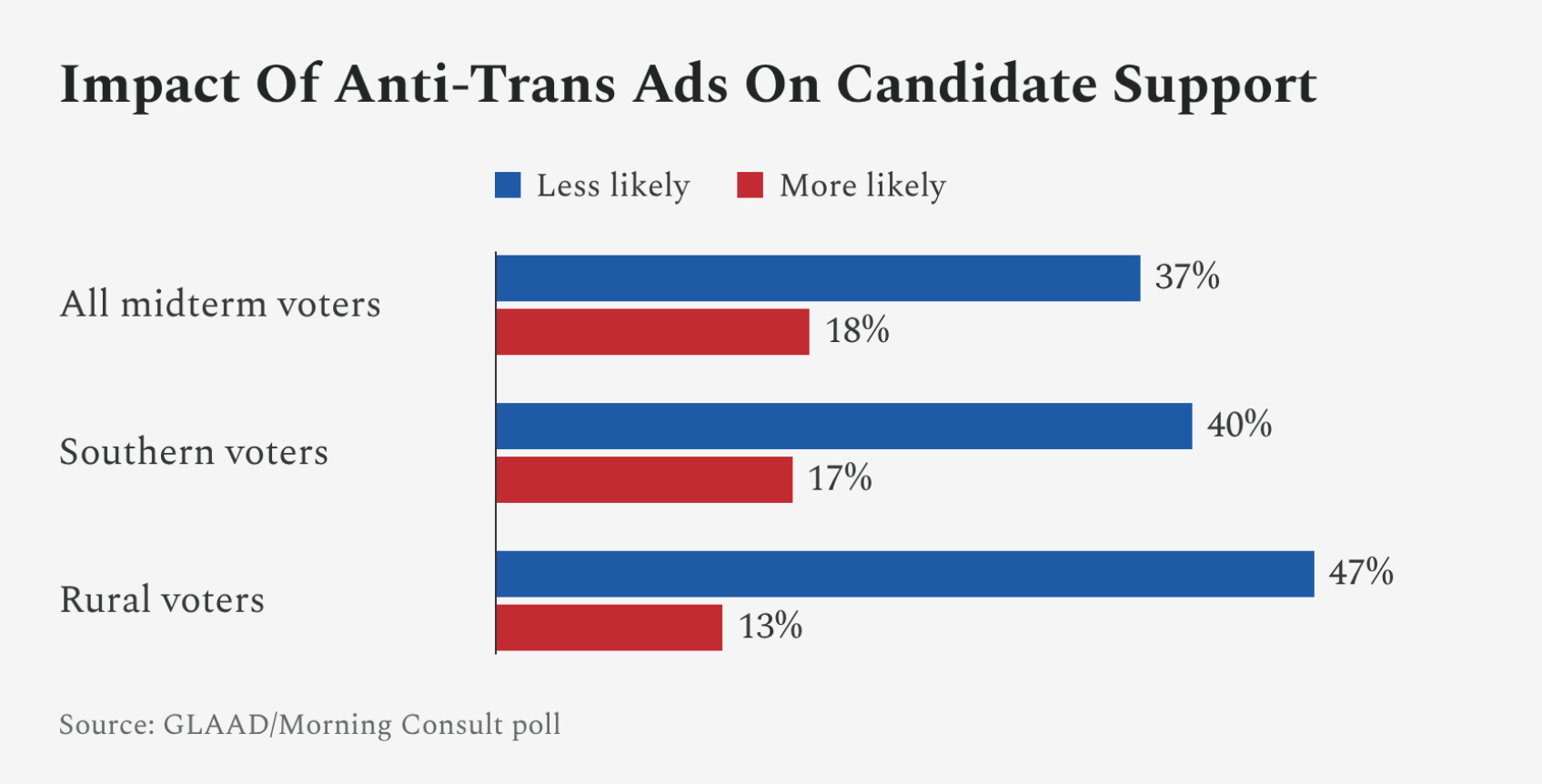
The first survey, conducted by Morning Consult for GLAAD, found that 37% of midterm voters were less likely to support a candidate who ran ads about trans issues, while only 18% said they were more likely. Importantly, the gap was more pronounced in the South, where 40% were less likely compared with 17% more likely. Among rural voters, it was the starkest of all: 47% said the anti-trans ads made them less likely to vote for the candidate who ran them, and only 13% said the ads made them more likely. It appears that one of the GOP’s biggest ad topics also created a substantial backlash, helping fuel Democrats’ wave election victories by turning off the voters Republicans rely on the most.
Equally important, the ads appeared to be aimed at an issue almost nobody was voting on. When asked why they turned out, only 5% of midterm voters named transgender issues as a main reason, even though 70% had seen, read or heard about the topic in the past month. Compare that with the other issues in the poll: 59% named the cost of living as a main reason they turned out, and 31% named health care. This means Republicans spent hundreds of millions of dollars on an issue few people turned out over, and the impact was negative rather than positive, with most voters saying the ads made them less likely to support the candidate running them than more likely.
“Campaign ads targeting transgender people are one of the most expensive failures in American history… Fearmongering about transgender people is a losing strategy for everyone. The American people have had enough of treating transgender people as political fodder, and rejected candidates who did so,” Said GLAAD in a press statement.
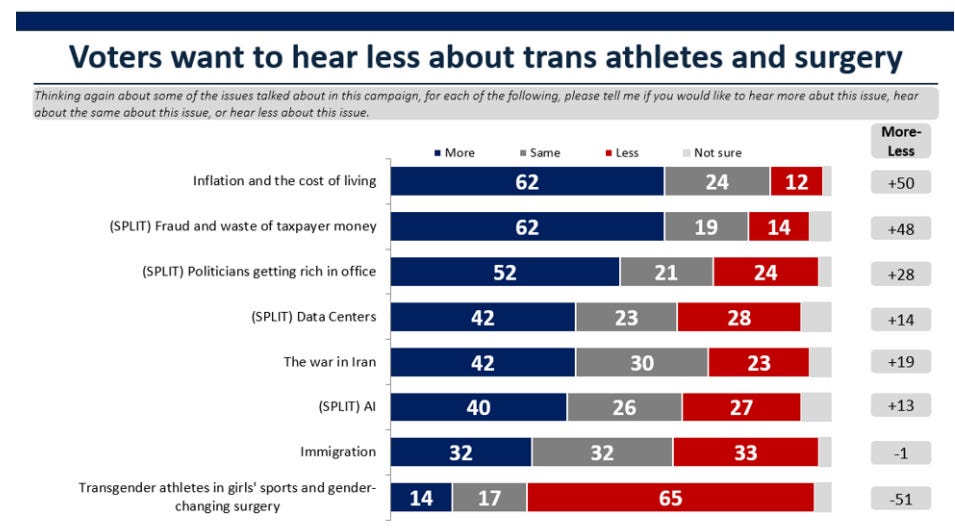
The GLAAD poll was joined by another poll released after the election by the Human Rights Campaign and conducted by GQR. In it, HRC asked voters whether they wanted to hear more or less about a variety of issues in political campaigns. Voters rejected hearing more about transgender issues by an extreme margin: 65% said they wanted to hear less about trans athletes and surgeries, while only 14% wanted to hear more, a -51 margin. Compare that with topics such as inflation and the waste of taxpayer money, which instead carried margins of +50 and +48, respectively, in favor of hearing more about them from politicians.
Voters didn’t just want to hear less about these issues from politicians; they were also heavily turned off by the Republican politicians who made them a major part of their campaigns. When asked whether they agreed with the statement “Republicans’ obsession with transgender people and children is strange and over the top,” 58% of voters did. Agreement was even higher among Hispanic voters (64%), independents (62%) and younger men (61%).
These polls spell out a substantial misplay by Republican strategists, who made targeting transgender people a priority in the 2026 election. While they did get a few victories, such as the passage of ballot measures in blue Washington and Colorado, the candidates who embraced the issue saw it backfire. Even those victories may not be durable: a lawsuit has already been filed challenging Washington’s initiative, and challenges are likely to succeed in getting anti-trans laws overturned in at least some of the states that passed them. Meanwhile, the saturation of the airwaves with anti-transgender ads turned away more voters than it won over and likely contributed to one of the worst campaign failures in American history.
Erin In The Morning is a reader-supported publication. To receive new posts and support my work, consider becoming a subscriber.
From Erin In The Morning via This RSS Feed.
I think this is underselling the issue. These weren’t the only regressive policies the electorate voted for. In Colorado we also got life in prison for payment to have sex with a child and drastically increased punishments for having any amount of fent for any reason (like, I will now no longer legally be allowed to pick up discarded pills from the park to dispose of at a pharmacy without risking 8 years in jail). While progressive candidates won, regressive policies did too. That tells me this was a repudiation of the people in charge, not necessarily their policies. Such a distinction, when not recognized and accounted for, will be detrimental to future progressives’ electoral chances once a “normal” competitor is back on the ballot.
If Colorado can vote for coaches looking at 5 year olds’ sexual reproductive organs than we’ve got a lot more educating before us in the next 2 years.