

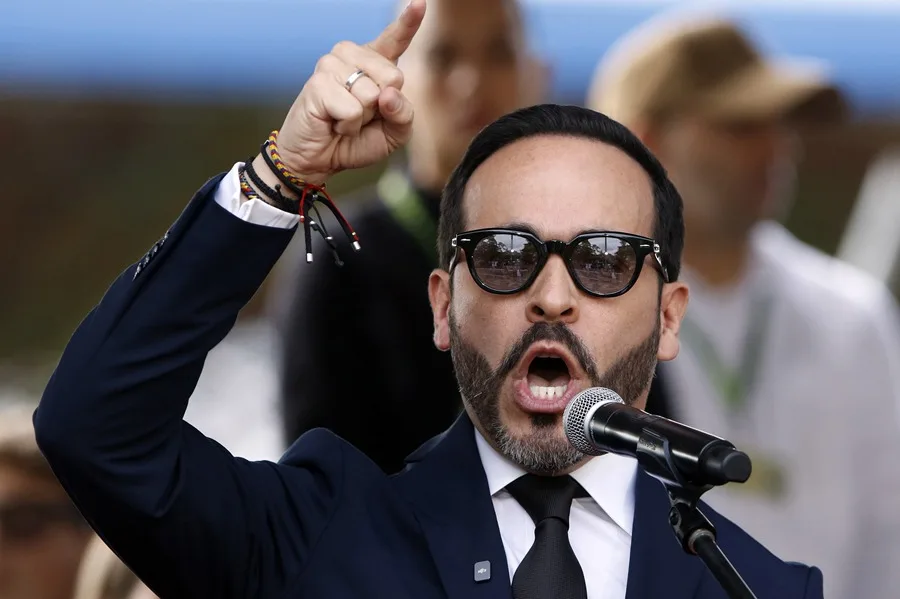
Colombian president Abelardo de la Espriella marks 100 days in office this Sunday with a presidency characterized by progressive radicalization, instability and personalism, focused on security policy, fiscal cuts and economic reactivation, after a magnitude 7.4 earthquake on August 10, three days after he took office, devastated central-western Colombia and forced him to adjust his right-wing agenda.
Nearly twenty officials have left their posts, including Education Minister Viviane Morales and Interior Minister Rodrigo Lara. The president has also radicalized his discourse and unleashed a “cultural battle,” rejecting the 2016 peace agreement with the FARC and attempting, unsuccessfully, to remove more than 60 works that he considered ideological from the National Museum.
RELATED: Colombia: More Than 45 Social Leaders Killed in De la Espriella’s First 100 Days in Office
Colombia is going through a delicate security situation, with armed groups growing to 29,000 members, including combatants and logistical and financial support networks. In late August he ended talks with all armed groups initiated by his predecessor Gustavo Petro. Since then, carrying a pistol and a radiotelephone and accompanying police and military operations, he has pushed a hard-line policy against guerrillas, paramilitaries and drug traffickers following the end of the “total peace” policy, relying so far on shock tactics, media announcements and displays of results.
The Ideas for Peace Foundation (FIP), in its analysis “Beyond the Narrative, What Has Happened in De la Espriella’s First 100 Days?”, noted that although security is at the center of the government’s agenda, there is still no strategy capable of translating operations into a real reduction in armed groups’ power. It argued that the president’s prominence in communicating results should be reviewed, warning that displaying the bodies of slain people, publicly confronting detainees and appearing in operations may yield immediate political dividends but displaces the institutions responsible for security and opens legal and legitimacy fronts. It added that presidential leadership is necessary, but personal prominence can weaken the institutions that should sustain policy.
#Colombia | President Abelardo de la Espriella marks 100 days in office with 51.7% disapproval, amid economic concerns and growing opposition to his proposed tax reform ahead of a November 19 strike.#PublicOpinion #TaxReform #NationalStrike #teleSUREnglish pic.twitter.com/VkclD7FQOx
— teleSUR English (@telesurenglish) November 13, 2026
Comparing August and September figures with the same period in 2025, FIP reported that homicides fell 10.6%, kidnappings dropped 66.3% and confrontations fell 61.9%, while attacks on infrastructure and civilian assets rose 44.4% and confinements grew 37.5%. It concluded that a reduction in some forms of violence does not necessarily mean armed groups have lost control or influence.
On the fiscal front, De la Espriella ordered his economic team to open talks with the International Monetary Fund, though support has not yet materialized, and announced a 13.8 trillion peso (about 4.158 billion dollars) cut in state spending attributed to austerity, lower debt service costs and eliminated contracts.
The government presented Congress with an Economic Rescue Law intended to curb public debt growth, strengthen finances, protect vulnerable sectors and incentivize private investment. The National Association of Financial Institutions (ANIF) warned that comprehensive approval of the law is the only scenario in which the government receives more than it spends before paying interest. Opposition leader and Senator Iván Cepeda told EFE on October 30 that the proposal severely affects citizens and amounts to repaying commitments to the IMF, describing it as a tax reform that breaks with the principle of progressivity and reverses the tax burden.
From teleSUR English via This RSS Feed.