

By Geraldina Colotti – Nov 13, 2026
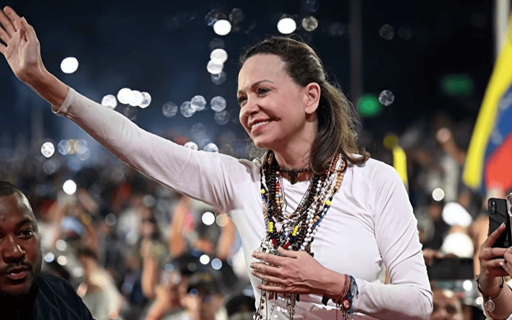
A show for a select few, staged for international media. That, in short, is the Bolivarian government’s view of María Corina Machado’s return to Venezuela. It is a view shared by several Venezuelans, both Chavistas and opposition supporters, whom we contacted for comment on some of the public events organized by the far-right Nobel Peace Prize winner, aimed at rekindling street violence in the country. One real estate worker described them as “a few roadblocks here and there, but usually nobody notices.” For a domestic worker, Machado is a discredited figure “because the armed aggression against the country, which she brought about, has brought no economic benefit.” A service worker said, “It is a miracle that the country is at peace, and it wants to stay that way, especially at Christmas.” Memes and satirical comments on the subject abound.
As Maduro had done in previous years, the Christmas festivities began early, and even the moderate opposition represented in parliament does not appear inclined toward new guarimba-style adventures. Machado, however, is trying, and the Venezuelan government is not taking the matter lightly, particularly given the far-right’s ties to major cross-border criminal networks. Machado’s main rallying cry is the so-called “political prisoners” who remain behind bars after the wave of releases under the amnesty law passed in the months following the January 3 kidnapping, when US special forces violated Venezuelan airspace to abduct the legitimate president, Nicolás Maduro, and his wife, Deputy Cilia Flores.
Photographs circulating of Machado and her supporters—few in number but determined—outside El Rodeo, one of Venezuela’s main prisons, seem to confirm this. The Vente Venezuela politician, megaphone in hand, appeared, embracing the mother of a man serving a sentence for a brutal double femicide carried out with the help of criminal accomplices. She is also supported by other relatives of drug traffickers or people convicted of serious terrorism offenses. Interior Minister and United Socialist Party of Venezuela (PSUV) General Secretary Diosdado Cabello provided further details on episode 589 of his program Con el Mazo Dando. Cabello presented documentary evidence of what he described as the organic ties between this sector of the extremist opposition and drug trafficking and organized crime networks, emphasizing that those connections can no longer be concealed. The Chavista leader condemned the media campaign to pass off common criminals, hitmen, and drug traffickers as “political prisoners.” He also said the far-right had established a registry called Constructores Venezuela as a front to set up a foundation and raise funds from abroad.
According to Machado’s entourage, her return means increasing pressure to accelerate the electoral timetable. Under Secretary of State Marco Rubio’s plans, that timetable would bring voters to the polls next year, perhaps in July, just after Maduro’s trial scheduled for June 2027. Under this scenario, Delcy Rodríguez, who governs as acting president under the Constitution, would declare the head of state’s “absolute absence” and call new elections. Although the Bolivarian government continues to defend the scheduled end of Maduro’s constitutional term—he was elected for the 2025–2031 term, ending January 10, 2031—all the actors involved are preparing for this crucial moment.
The domestic landscape, however, is far more fragmented than a simple divide between the government and the far-right. Alongside the leadership gathered around Delcy Rodríguez, Diosdado Cabello, and the senior political and military command—who are working to preserve macroeconomic stability and institutional continuity—various critical and dissenting currents have emerged both within and outside the Chavista camp. Within the revolutionary movement, some voices openly oppose economic concessions and negotiations with Washington. They include the intellectual Luis Britto García, who consistently invokes the principle of full sovereignty and warns that any political discourse that abandons the anti-imperialist struggle becomes hollow, and media figure Mario Silva, who has sharply condemns internal failings and the media marginalization he has experienced in recent months. Alongside them are figures rooted in local communities and grassroots media, such as Juan Contreras, director of the long-running Radio Al Son del 23, who maintain a firm line of anti-imperialist resistance and defend social gains from below. They insist on not yielding to neocolonial blackmail and strengthening popular power through consultations and communes.
On another front are currents representing a kind of moderate or “democratic” opposition that emerged from within the Chavista process itself, such as former minister and former vice president Elías Jaua, who participates in academic and political debates on the country’s transformation and calls for a return to the original democratic and constitutional dialogue. Completing the picture are Machado’s allies “on the left,” whose political trajectories are considerably more controversial and strange. They include the minority faction of the Communist Party of Venezuela (PCV), which is engaged in a fierce head-on confrontation with the current government, and former figures from the social-movement left who have now firmly joined the opposition, such as Juan Barreto, founder of the REDES party and former mayor of Caracas. Barreto openly disputes the legitimacy of the 2024 presidential election and calls for an even broader general political amnesty to emerge from negotiations between the government and the former 2015 National Assembly in order to “end the crisis.” Meanwhile, Chavista leaders are trying to resist the downward slope they have been forced into since January 3, relying on the one strength at their disposal: “peace diplomacy,” intended to disrupt the plans of both Washington and the fascist opposition while buying time.
After Maduro’s kidnapping, many expected Donald Trump, whom Machado had convinced that she had the majority of the country’s support, to give her his blessing to take power. The US administration has so far, however, kept her on the margins of the main negotiations between the government and the opposition. A formal role in those talks has instead been carved out for Dinorah Figuera, the former president of the far-right-majority parliament elected in 2015. For the White House, Machado appears to be a tool to be used selectively: a means of pressure to brandish against the government to extract further concessions, but not necessarily its preferred choice.
To understand this apparent contradiction, one must look at the different currents within Trumpism that coexist and clash over Venezuela. On one side are the neoconservative hawks and the Cuban American lobby in Miami, represented by Secretary of State Marco Rubio and figures such as Mauricio Claver-Carone. They push for ideological regime change at any cost, the total strangulation of Chavismo, and the direct installation of Machado as a loyal proxy in Caracas. On the other side is the pragmatic, nationalist, business-oriented wing of the Make America Great Again (MAGA) movement, close to Trump himself, emissaries such as Richard Grenell, and major US energy companies. For this wing, ideology matters little compared with business and control over resources. This second faction believes that an attempted coup led by Machado could plunge Venezuela into chaos, making oil extraction impossible and prompting new waves of migration to the United States. It therefore prefers to negotiate pragmatically with those who actually control the state and armed forces—the Bolivarian government—to obtain oil contracts, licenses, and operational stability. Machado’s return thus complicates the White House’s own foreign policy strategy.
Further complicating the US picture is the balance of forces that emerged after the US midterm elections, which reshaped Congress without weakening the substantial bipartisan support for interference against Caracas and for Machado. An emblematic example of this alignment is the election to the Florida House of Representatives of Samuel Vilchez Santiago, a prominent young Democrat known for his openly anti-communist positions and his close ties to Miami’s anti-Chavista opposition. He has repeatedly appeared alongside Machado in US political circles, confirming how hostility toward the Bolivarian Revolution serves as a bond between the liberal establishment and the Republican right.
Yet the gravity of the January 3 aggression opened an unexpected rift even within US institutions. Republican Representative Thomas Massie of Kentucky introduced a formal impeachment resolution in the House of Representatives, consisting of eight articles, against Defense Secretary Pete Hegseth, whom Trumpism has rechristened “Secretary of War.” Article VII of the resolution, titled “Kidnapping of a Sovereign Foreign Leader,” offers a detailed and damning account of the military operation. The text describes the raid in Caracas as an unauthorized act of war against a sovereign state. It notes the deployment of over 200 special forces personnel supported by more than 150 aircraft and drones and reports that at least 83 people were killed in the assault. Venezuelan authorities put the death toll at over 100 civilians and military personnel, including Cubans and Venezuelans. The indictment also dismantles the fraudulent cover of the “fight against drug trafficking,” describing it as a mere pretext to disguise a regime-change operation. It identifies the true economic motive by citing Donald Trump’s own public statements: immediately after the raid, he said he wanted to take control of the country, bring in US oil companies, and “start making money.” According to the resolution, Hegseth violated the Constitution, the War Powers Resolution, and international law, gambling with the lives of US military personnel solely to facilitate the illegal appropriation of Venezuela’s oil. The resolution was blocked in the House by a margin of just seven votes, 211 to 204, because of the decisive absence of 11 Democratic representatives—even though progressive figures such as Maxine Waters and Ilhan Omar had denounced the illegal invasion—demonstrating once again the bipartisan establishment’s underlying complicity.
Meanwhile, in the New York courts, proceedings against President Maduro and First Lady Cilia Flores, who have been held at the Federal Detention Center in Brooklyn since their first appearance on January 5, are entering a decisive phase ahead of the next preliminary hearing, scheduled for December 17. That hearing will address defense motions concerning sovereign immunity, while the trial is scheduled to begin on June 14, 2027. At the most recent hearing on October 15, prosecutors further intensified the charges, adding “conspiracy to commit torture” to accusations of “narcoterrorism,” cocaine importation, and weapons possession. Both Maduro and Flores firmly reiterated that they had no involvement in the alleged acts.
Just before the December 17 deadline, the case took a dramatic turn with the death, at age 92, of federal Judge Alvin K. Hellerstein, who had overseen the case since March 2020. On October 8, he had denied a request by Flores’ lawyers for bail and house arrest on serious health grounds. The Southern District of New York case was reassigned to federal Judge Analisa Torres, who was born in New York in 1959 to a family of legal professionals of Puerto Rican origin, graduated from Harvard, and was appointed in 2013 by Barack Obama. The reassignment has drawn attention in political and diplomatic circles: Torres has direct experience in Venezuela as an international election observer and is married to a Venezuelan citizen, factors that make her role still more sensitive in light of the defense team’s objections.
Maduro and Flores’ lawyers intend to invoke arguments raised in US congressional proceedings and political statements to seek the complete dismissal of the case. They argue that it was tainted from the outset by a kidnapping carried out in violation of a sitting head of state’s immunity and of international law. They also seek to dismantle the grotesque torture charges and urgently renew the request for Flores’ release, as her heart condition and the physical consequences of the January 3 military aggression are a source of serious concern. Further exposing the double standard of US justice is Donald Trump’s own statement in support of a pardon for former Honduran President Juan Orlando Hernández, who was convicted of drug trafficking in the US. According to the logic displayed by the White House tenant, if a leader traffics within his own country, “it’s not a problem” for Washington. This cynical admission once again confirms that the drug trafficking accusations against Venezuela are merely a hybrid-war weapon to justify the plunder of a sovereign people’s resources.
María Corina Machado’s Return Accelerates ‘D-Day’ in Venezuela
Meanwhile, Delcy Rodríguez is trying to break the circle of international isolation and the US stranglehold by pursuing diplomacy on several fronts, beginning with her participation in the COP31 climate conference in Türkiye. There she was photographed shaking hands with Lula da Silva, Brazil’s recently reelected president—the same Lula who had blocked Venezuela’s entry into BRICS and had not hesitated to describe Maduro’s government as undemocratic even after his kidnapping. However, this complex and difficult diplomatic course must also contend with coolness and contradictions among friendly countries. Continental tensions continue to surface at gatherings of progressive parties, fueling open clashes. At a recent international meeting of progressive parties in Mexico, the Chavista delegation, which included PSUV leaders such as Tania Díaz and Jesús Faría, clashed sharply with former Colombian President Gustavo Petro. When Petro criticized Venezuela as an extractivist country, the Venezuelan delegates unequivocally accused him of acting as a Santanderista and of effectively paving the way for the invasion. Pressed for an explanation, Petro defended himself with a disarming admission: “But they would have fired a missile at me.” The events behind this admission go back to the dramatic days preceding the January 3 kidnapping. At the time, a ground invasion was expected, but not an air attack. In response to a warning from Vladimir Padrino López—a danger seemingly contradicted by the smokescreen of Trump’s calls for negotiations, a lie following the same script seen in the first aggression against Iran—Maduro had called a secret meeting with Petro to ask him to launch Colombian drones in the event of a US attack. The Central Intelligence Agency (CIA) learned of that confidential meeting and directly threatened Petro, who, out of fear, took care not to warn Maduro, denying him the precious time needed to organize even a minimal defense and resistance.
Translation: Orinoco Tribune
OT/JRE/SF
From Orinoco Tribune via This RSS Feed.
You must log in or register to comment.