

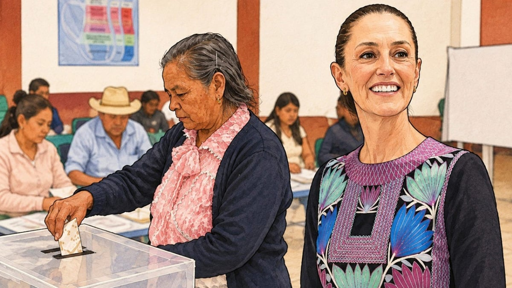
This article by Pedro Mellado Rodríguez originally appeared in the November 13, 2026 edition of SinEmbargo, a Mexican digital news outlet.
Photo: Cuartoscuro, enhanced with artificial intelligence.
“It will be very difficult for this majority of the poor, the helpless, the discriminated against, the abandoned, to stop backing the government of the Fourth Transformation.”
They are quiet, silent, unhurried, and they will be the first at the polls in the elections on Sunday, June 6, 2027, to cast their votes. They will arrive on their own or with the support of their children or grandchildren. They are Claudia Sheinbaum Pardo’s army that backs the government of the Fourth Transformation and will carry it to victory, giving the President of the Republic a majority in the federal Chamber of Deputies and in a large share of the state congresses whose legislatures will be renewed.
The Nominal List of Voters, updated by the National Electoral Institute (INE) as of Thursday, October 29, 2026, includes just over 101 million people with valid voter ID cards and reflects a very significant and impressive fact that had not been seen in the last eight years: by far, people aged 60 and older now represent the largest segment of those eligible to go to the polls in the elections on the first Sunday of June 2027, as they exceed 20 million citizens.
It should be recalled that older voters posted the most notable turnout figures in the elections held on Sunday, June 2, 2024: citizens aged 60 to 74 had an average turnout of 75 percent, above the 72 percent recorded in 2018. The hard data show that in the 2018 elections older adults represented 16.55 percent of the Nominal List of Voters, and by October 2026 they accounted for 20.65 percent.
The Sample Study of Citizen Participation in the 2023-2024 Concurrent Electoral Process, published by the National Electoral Institute’s Electoral Organization Commission on Monday, December 9, 2024, allows us to observe an increase of more than 4 million citizens in the older adult segment, compared with 2018, in the Nominal List of Voters as of Thursday, October 29, 2026.
In January 2018, when Andrés Manuel López Obrador became President of the Republic, the Nominal List of Voters included more than 87 million people, and there were just over 14.5 million older citizens with voter ID cards. In October 2026, that segment already totals more than 20.6 million people. This is very bad news for the opposition of all stripes and colors, as older adults have a particular preference for Morena, ever since López Obrador committed to giving priority in his government to the poorest people through well-being pensions.
The study of citizen participation in the 2024 elections, when the Nominal List of Voters included just over 98 million people, also concludes that there was a noticeable decline in young voter turnout between 2018 and 2024. Young people voting for the first time in 2018 had a participation rate of 64.7 percent, while in 2024 that percentage fell to 61.6 percent. It is also important to observe that abstention increased among voters aged 20 to 29, as only 48 percent of the citizens registered on the Nominal List of Voters went to the polls.
These two age segments, those aged 20 to 24 and those aged 25 to 29, are the largest after older adults. In 2018, together they represented 24.86 percent of the votes, compared with the 22.26 percent they total in 2026. This potential electoral force is not decisive at the polls, since while older adults turn out to vote at a rate of 75 percent, only 48 percent of young people go to cast their ballots.
It should also be kept in mind that in the 2024 elections women had a higher turnout than men, at 64.3 percent, a figure 9.5 percentage points above men’s turnout of 54.8 percent. In the current Nominal List of Voters, 52.03 percent are women and 47.96 percent are men. There are four percent more women who could go to vote next year.
The third-largest age segment among potential voters heading toward the June 2027 elections is people aged 30 to 34, who totaled 9.5 million citizens in 2018 and more than 10.7 million with voter ID cards in October 2026. However, the INE’s 2024 Sample Study of Citizen Participation reveals that between the 2018 and 2024 elections, this age segment’s average electoral turnout fell from 58.1 percent to 52.1 percent.
Well-Being Pensions
In the last four decades, from the PRI administration of Miguel de la Madrid Hurtado to that of Claudia Sheinbaum Pardo, no government had devoted so many resources to well-being pensions for the benefit of those most in need, which by the end of 2026 will directly affect more than 42.8 million people throughout the country, according to an estimate from the Secretariat of Well-being, assessed on October 23, 2026.
As of the end of October, the Single Register of Beneficiaries of well-being programs included 13.8 million people receiving the Pension for Older Adults. Another program with broad coverage is the Rita Cetina Scholarship, which, according to an October 11, 2026 report from the Secretariat of Education, serves 14.9 million children in preschool, primary and lower secondary education.
Add to this that the Benito Juárez Scholarship, which supports students in upper secondary education, assists 3.9 million young people; the Mujeres Bienestar pension totals 2.8 million people, in addition to programs with smaller enrollment such as Sembrando Vida, La Escuela es Nuestra, Salud Casa por Casa, Jóvenes Escribiendo el Futuro, the Pension for People With Permanent Disabilities, as well as the various initiatives supporting orphaned children, farmworkers and fishers.
After decades of neglect, of administrations that never cared about them, it will be very difficult for this majority of the poor, the helpless, the discriminated against, the abandoned, to stop backing the government of the Fourth Transformation, which allocated one trillion pesos (one million million pesos) to them in 2026, the same budget approved in the 2027 federal spending plan by the federal Chamber of Deputies last Tuesday, November 10, 2026.
The importance of programs supporting people’s well-being under the current federal government is reflected in the concrete fact that in 2027 they will represent 10 percent of the entire Federal Expenditure Budget, which totals 10 trillion pesos, that is, 10 million million pesos. All of this will motivate older people to be at the front of the voting lines in June 2027.
Pedro Mellado Rodríguez
A journalist who for five decades has been a meticulous and critical observer of public life in the country. He has covered every news beat and taken on every possible responsibility in the media. He has worked in print, radio, television and digital media.
-
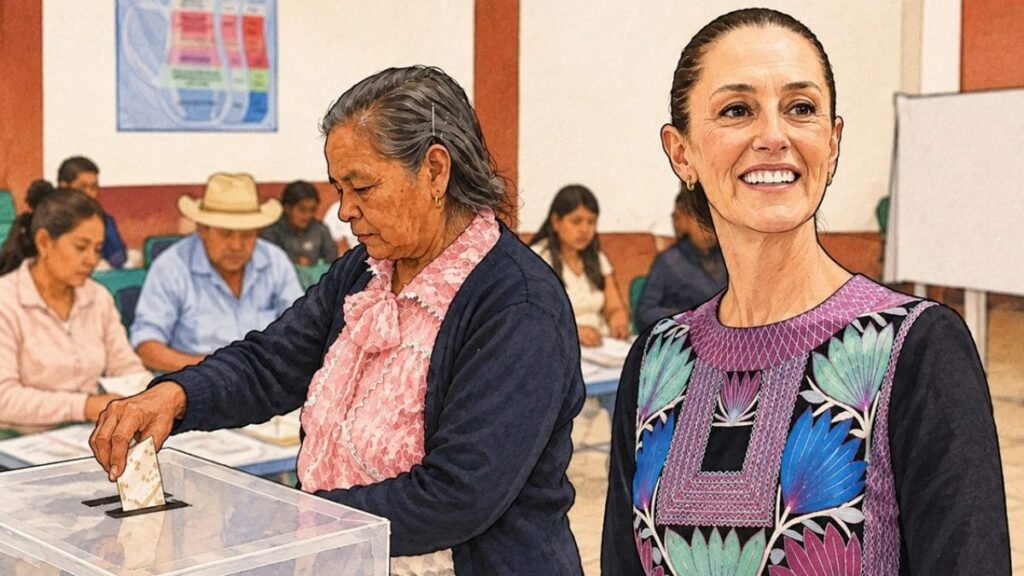
Claudia’s Strong Army, Which Backs the Fourth Transformation
November 15, 2026
“It will be very difficult for this majority of the poor, the helpless, the discriminated against, the abandoned, to stop backing the Fourth Transformation government,” writes Pedro Mellado.
-

Sheinbaum Is Already on Her Way to Shenzhen, China, to Attend the APEC Summit
November 15, 2026November 15, 2026
Traveling on a commercial airline, Mexico’s president will meet business leaders and join her morning press conferences from China.
-

Analysis | Let’s Talk About Migration | Migrant Justice
Violence Against Migrants: The Hatred That Must Also Be Investigated
November 14, 2026November 11, 2026
How underreporting, racial profiling and anti-immigrant rhetoric hide the true scale of hate and violence against migrants in the United States.
The post Claudia’s Strong Army, Which Backs the Fourth Transformation appeared first on Mexico Solidarity Media.
From Mexico Solidarity Media via This RSS Feed.