

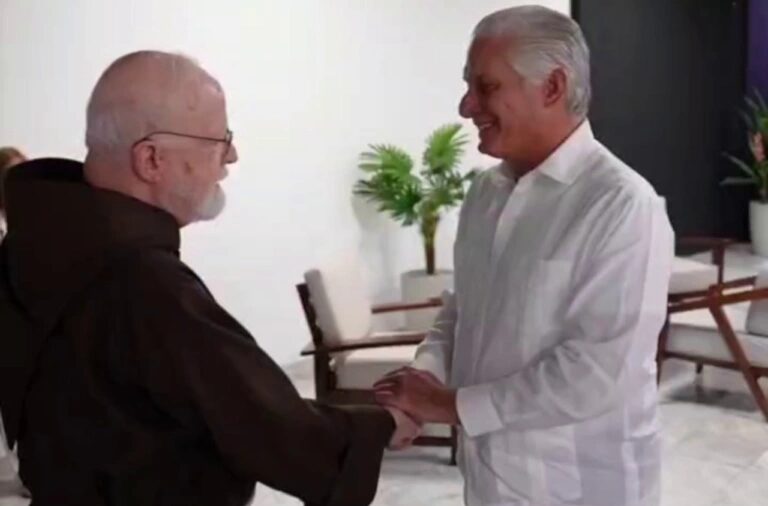
Cuba humanitarian aid advances as Díaz-Canel thanks US Catholic bishops for helping facilitate assistance arriving from several countries.
Related: Pope Leo XIV Cajamarca: 300-Year Jubilee Ends With Call for Unity
Cuba Humanitarian Aid: 1 US Bishops’ Delegation Strengthens Church Ties
Cuba has taken a new step in expanding Cuba humanitarian aid channels after President Miguel Díaz-Canel received a delegation from the United States Conference of Catholic Bishops. The meeting, held on Saturday, focused on the role of the Church in facilitating assistance arriving from several countries.[telesurtv]
Díaz-Canel thanked the delegation, led by Cardinal Sean Patrick O’Malley, for its efforts to “facilitate humanitarian aid” to the island. He said the Church and its organizations have played an important role in ensuring that assistance reaches those in need.[telesurtv]
The meeting also addressed the national realities of both countries and the broader international situation. Díaz-Canel described the exchange as an opportunity to strengthen dialogue and cooperation between Cuba and the United States.[telesurtv]
A Delegation With Deep Ties to Cuba
The U.S. delegation included Cardinal Sean Patrick O’Malley, who served as Archbishop of Boston from 2003 to 2024. He has visited Cuba on multiple occasions over the past decade, including during Pope Francis’s 2015 visit to the island.[telesurtv]
The delegation also included Archbishop Borys Gudziak, president of the Conference’s Justice and Peace Commission, and Christopher Ljungquist, director of its International Justice and Peace Office. Mario Jesús Paredes, executive president of the medical organization SOMOS Community Care, was also part of the group.[telesurtv]
The meeting was attended by the newly appointed Archbishop of Santiago de Cuba, Monsignor Juan Gabriel Díaz Ruíz, along with senior Cuban state officials. Their presence underscored the importance of the visit for both the Church and the government.[telesurtv]
United States Conference of Catholic Bishops
Caritas Cuba at the Center of Aid Delivery
The Catholic organization Caritas Cuba has been responsible for receiving food aid and hygiene packages that have arrived in recent months from various countries, including the United States.[telesurtv]
The organization has played a key role in distributing assistance to communities in need. Its work has become especially important as Cuba continues to face economic challenges and shortages of basic goods.[telesurtv]
The meeting between Díaz-Canel and the U.S. bishops highlights the growing importance of faith-based organizations in humanitarian efforts. It also reflects a broader trend of civil society actors stepping in where state capacity is limited.[telesurtv]
A Message of Dialogue and Cooperation
Díaz-Canel used the meeting to reaffirm Cuba’s commitment to dialogue and cooperation with the United States. He said the two countries share a responsibility to address global challenges and build a more just international order.[telesurtv]
The president’s message was reinforced by the presence of senior Church leaders from both countries. Their participation signaled a willingness to work together on issues of mutual concern.[telesurtv]
The meeting also comes at a time when Cuba is seeking to expand its diplomatic and economic ties. By engaging with U.S. religious leaders, Havana is opening a new channel for dialogue that goes beyond traditional state-to-state relations.[telesurtv]
Geopolitical Context
The Cuba humanitarian aid meeting takes place at a time when U.S.-Cuba relations remain complex. While formal diplomatic ties have been restored, economic restrictions and political tensions continue to shape the relationship.
The role of the Catholic Church has been central in efforts to build bridges between the two countries. From Pope Francis’s 2015 visit to the island to the work of Caritas Cuba, religious actors have played a key role in facilitating dialogue and humanitarian assistance.[telesurtv]
The broader geopolitical meaning is that the meeting reflects a shift toward greater civil society engagement in international relations. As governments struggle to address global challenges, faith-based organizations are increasingly stepping in to fill the gap.[telesurtv]
What Comes Next
The immediate next step is to continue expanding humanitarian assistance to Cuba. That will require coordination between Caritas Cuba, international donors, and local authorities.[telesurtv]
The meeting between Díaz-Canel and the U.S. bishops is also expected to open new avenues for dialogue. It could lead to further cooperation on issues such as health, education, and disaster response.[telesurtv]
For now, the Cuba humanitarian aid meeting represents a significant step in strengthening ties between Cuba and the United States. The next phase will determine whether the partnership can move from symbolic gestures to practical results.[telesurtv]
From teleSUR English via This RSS Feed.