

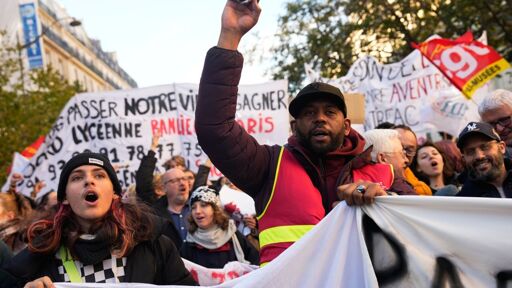
The strike on November 5 was paradoxical. On the one hand, it marked a significant step forward in uniting the labor movement with the youth revolt that began in early October. Not only did the day mobilize more than 1 million people, but it also saw high strike participation in parts of the SNCF (the national railway) and in secondary education, as well as mobilizations in sectors such as energy, petrochemicals, and the civil service.
On the other hand, the strike was far from “active.” On the contrary, union leaders did everything they could to turn it into a routine day of action. Worse still, they attempted to use this occasion to co-opt the movement and position themselves as the government’s negotiating partners, in order to bargain at young people’s expense. And this came after they waited nearly a month following the start of the high school students’ revolt to call a strike, despite the brutal repression being unleashed against it. On October 24 and 31, they even vouched for protest routes that skirted city centers and were far more tightly controlled and policed than on October 17.
The betrayal came quickly: the CFDT and FO, two of France’s major union confederations, stopped calling for strikes after the government granted them a 5-euro increase in the minimum wage. A real slap in the face for the mobilized youth and for all the workers who can no longer make ends meet. The CGT, for its part, is more responsive to pressure from the movement’s rank and file. It remains in the fight and is calling for a new day of mobilization in both the public and private sectors on November 17, but it is making no serious effort to build a genuine, open-ended general strike.
This situation fuels perfectly legitimate anger against the union bureaucracy and sparks a broad debate on social media. Several leading figures in the movement are therefore calling for the unions to stay out of the upcoming days of mobilization. However, this view overlooks the contradictions inherent in the days of revolt — even the most powerful ones — and the potential of the labor movement. Admittedly, union leaderships have long been co-opted by the regime, which tolerates and subsidizes them only on condition that they help keep it stable by keeping workers from becoming too radical. But at the rank-and-file level, they continue to organize the workers who keep the refineries, ports, power and telecommunications networks, logistics warehouses, and factories running, and even the data centers of the operators that the government is asking to stand ready to suspend TikTok.
Trade unions therefore hold the labor movement’s strategic positions. And without these battalions of workers joining the struggle, it is impossible to envision a victory against those in power. Furthermore, the workers’ struggles of the past 10 years are full of examples of highly progressive stances taken by rank-and-file union members. In recent weeks alone, think of the union members and education workers who defended high school students against the police in Le Havre, Saint-Denis, Paris, Toulouse, and Saint-Avold, to name just a few examples. To win, we must rally the vast majority of union members and workers to break with their own bureaucratic leaderships — including the rank and file of the CFDT and FO — by showing them that their leaders have betrayed their interests.
October 17: A Show of Force and Its Limits
October 17 was a “historic, independent action” by the masses that shook the powers that be. Hundreds of thousands of demonstrators — the vast majority of whom were young people, high school students, college students, and workers — converged on the seats of power and partly broke through police lines. A massive surge that surprised and terrified the ruling classes. They were quick to launch a media campaign against the “dangerous classes,” while the government barricaded itself behind the army and deployed unprecedented repressive forces against the young protesters.
Nevertheless, October 17 also revealed the limits of weekly days of action, even when they take a very radical turn. Mobilizing such energy comes at a cost — particularly in terms of repression — and it is difficult to maintain the same level of mobilization from one week to the next, especially now that the element of surprise that played a role that day is gone. Between days of action, the authorities have plenty of time to reorganize. The protesters, for their part, must return to work, where they face harassment from their bosses and low wages that barely cover the cost of the gas needed to get to work. In short, a large part of their time is still devoted to work and commuting.
As early as October 17, a pressing problem therefore arose: to strengthen the movement, it must first be extended to new sectors, particularly in the workplace. Next, a general strike must be organized — one capable of paralyzing both the government and the economy while freeing up a great deal of time for mobilized workers. But as the past few days have shown, a general strike will not fall from the sky; it must be organized and prepared. The movement is thus reaching the limits of what Anton Jäger calls “hyperpolitics.”
With this concept, Jäger describes a situation marked by massive and radical repoliticization, which makes it possible “to rapidly mobilize a large number of people”, but faces significant difficulties in “crystallizing this energy into sustainable structures capable of acting over the long term and transforming the mobilization into effective political decisions.” For class struggle, this observation helps explain the emergence of movements as powerful as the Yellow Vests, Black Lives Matter in the United States, or the October 17 movement in France, but also their lack of structure, in contrast with the revolutionary labor movement of the last century. This lack of organization means that even very radical outbursts can easily run out of steam and be co-opted by those in power.
Bringing the Labor Movement into the Fray Is the Decisive Issue
The sequence of events that began on November 5 offers a valuable opportunity to reflect on these strategic questions. Even if only partially so far, the labor movement has begun to enter the fray, with a march of 1.6 million people, making the movement even more unprecedented. This is no longer just a massive youth movement, a “revolt” like the Yellow Vests, Gen Z edition. This dynamic is now joined by hundreds of thousands of striking workers. This combination has no precedent in any struggle of the past decade.
By entering the fray, union leaderships have also forced the government to open negotiations, notably by breaking the “taboo” surrounding wage increases. Now, across the country — including far from the urban centers and among workers who felt no connection to the youth movement and did not march on November 5 — people are beginning to discuss the possibility of winning wage increases.
Everyone is struggling with the high cost of living. Before October 17, some had in fact expected an even broader movement, but it ultimately remained limited to young people, albeit mobilized on a massive scale. We therefore need demands that speak to all segments of the working class, not just the most politicized and radical sectors of the Left.
Even among the working-class base of the far-right National Rally, workers have every reason to strike for wage increases, even though Marine Le Pen opposes them. If these workers joined the struggle while Gen Z is mobilizing, it would be a major opportunity to develop their political and class consciousness — and to permanently weaken the party that threatens to take power.
In short, taking into account the uneven pace of such a process, current conditions could allow the radicalism of youth to spread to the labor movement. Restoring the working class as a whole to its status as a “dangerous class” to those in power — as it was for more than two centuries — is a central challenge. Today, it has been transformed. Its older members were raised on legalism and the idea that you shouldn’t get too political, that you should settle for case-by-case negotiations and politely ask for raises. But Gen Z’s courage and its demand for a future — coupled with the firm conviction that those running society are condemning them to a life without a future — can restore the labor movement’s prestige. This is all the more true given that young people make up the vast majority of workers in precarious jobs, including in certain sectors with large workforces, such as logistics.
Developing Demands and Cross-Industry Assemblies to Broaden the Struggle
Initially, the highly subversive movement of young people and certain more politicized sectors of the workforce may coexist with more limited, economic strikes. This was the case in other intense episodes of class struggle, such as the Russian Revolution of 1905. Lenin noted at the time the coexistence of political strikes — particularly in the metalworking industry, a more politicized and better-off sector — and economic strikes, which were especially prevalent in the textile industry, a more exploited and politically less advanced sector:
<BLOCKQUOTE>In the first quarter of 1905, for instance, economic strikes noticeably predominated over political strikes […] In the last quarter of 1905, however, the ratio was reversed […]. This means that in the early stage of the movement many workers put the economic struggle first, while at the height of the movement it was the other way round. But all the time there was a connection between the economic and the political strike. Without such a connection, we repeat, it is impossible to have a really great movement, one that achieves great aims.</BLOCKQUOTE>
But to develop these tendencies, a proactive strategy is needed to mobilize the entire working class, along with a policy to unify the most politically active and radical sectors with those who are entering the struggle for limited demands — and whom union leaderships seek to keep apart from the broader movement. This begins with promoting ambitious wage demands on a mass scale: for example, a 400-euro raise for everyone, as proposed by the cross-industry assembly in Toulouse, which brought together several hundred workers from various sectors, as well as college and high school students. These demands must be linked to those of the youth, such as the repeal of Parcoursup (the national university admissions platform), more funding for education and healthcare rather than the military, and the dropping of all legal and disciplinary action against those who have taken part in the protests.
The weapon for waging this struggle is bringing different sectors together in assemblies, in order to reach workers who have not yet joined the movement and rank-and-file union members, to set demands without ceding control to union bureaucracies, and to organize actions that break with legalistic routine. This is precisely what the dozens of cross-industry assemblies currently beginning to meet across the country — such as in Lyon, Bordeaux, Toulouse, the Île-de-France region, and Strasbourg — are doing.
All of them have a mixed membership, bringing together college students, high school students, and workers. They aim to propose frameworks that bring together all the perspectives within the movement, so that participants can discuss strategy together: how to build and expand the strike, fight repression, and solidify the common ground between young people and workers. Though still in their early stages, they have already helped organize the November 5 strike — something the union leaderships failed to do — as well as actions on the day itself, such as spontaneous demonstrations at train stations, in front of the Ministry of the Interior, and in the streets of Saint-Denis. In Paris, the cross-industry assemblies gathered several thousand demonstrators at the head of the march.
If the movement grows, these assemblies could develop into mass bodies, with delegates from numerous companies, neighborhoods, and educational institutions. They could thus begin to become genuine centers of counter-power and realize what V2 called for during his press conference at Paris Cité University, in preparation for October 24: “Students and workers alike, we’re all united; we’re all the ones keeping France running, so we can govern ourselves.”
The development of such organizations is a response not only to attempts by union leaderships to regain control, but also to similar attempts by the reformist Left, which deserves at least as much suspicion as the leaders of the CFDT, the CGT, or FO.
Neither Union Bureaucracy nor Mere Electoralism: Building a Revolutionary Perspective
From this perspective, it is surprising that certain figures in the movement who present themselves as the most “radical” opponents of union legalism are, at the same time, openly campaigning for Jean-Luc Mélenchon, the leader of La France Insoumise. Yet Mélenchon is a fervent defender of the “republican order” and expressed outrage over police understaffing on October 17. La France Insoumise’s strategy is based on taking over institutions and striking a compromise with big business, by persuading them to accept a few concessions in exchange for peace in the streets. Mélenchon regularly acknowledges this. In August 2025, during the party’s Amfis summer conference, he noted, for example, that a far-right government would lead to resistance and “barricades,” before concluding: “For the sake of public order, it’s better to elect La France Insoumise.” To achieve such pacification, they would rely heavily on the complicity of union leaderships and their expertise in “appeasement.”
So yes, we must “recapture the spirit of the 17th,” but with a hundred times more firepower. It is precisely for this reason that we must draw the labor movement and its organizations into the battle and push them to move beyond legalistic routine. For it is clear that the bosses do not feel threatened by the “merguez” marches (named for the sausage stands that follow union processions) between Place de la République and Place de la Nation. What they do understand is hard-hitting strikes, workplace occupations, and joint radical actions between students and workers. Transforming the labor movement so that it reconnects with the best of its tradition is the historic task of the segment of Gen Z that claims to be revolutionary.
This involves sustaining the youth movement, particularly in the high schools. Since the start of the school year, contradictions have been growing: the pressure of the baccalaureate is weighing on some students, and the difficulty of winning people over is fueling attempts to “harden the movement” in response to its shrinking ranks. To tackle this strategic problem, we need frameworks that allow these issues to be discussed, that seek to bring along the lagging sectors, that close ranks against repression, and that thus keep the vanguard from detaching from the mass of high school students. At the universities too, as general assemblies grow, convincing students that victory is possible is a central challenge. It must go hand in hand with strengthening coordination bodies, which keep the union bureaucracy from taking control of the movement, and with organizing actions that break out of the established limits, as when the banned demonstrations in Paris were held anyway. All of this helps influence the world of work positively.
But this also requires building an organization that sets itself long-term goals beyond immediate struggles: a major revolutionary party. Spontaneity alone will not suffice; it will eventually be dispersed or derailed. We need a party with a presence in thousands of workplaces and schools, spokespeople, and worker and youth activists from all sectors who are used to working together; a media network capable of disseminating ideas on a mass scale; and a resolute strategy to carry through the overthrow of the capitalist order and its institutions.
This is the proposal that Révolution Permanente puts forward to all those who truly want to end Macronism and the Far Right, but also imperialism and the capitalists’ power over our lives. To all those who want to fight for a social revolution, to expropriate those who exploit us and ravage the planet: join us. Révolution Permanente organizes open meetings in every city where we are active, in order to bring together all those who share our political vision. We want this movement to serve as a springboard for building an organization with thousands of members.
We also want to use Anasse Kazib’s candidacy in the 2027 presidential election to advance this goal — so that revolt bursts into the presidential race and these elections do not offer a respite to the regime, which hopes to see anger leave the streets and be channeled into “calm debates.” We refuse to let bourgeois politicians calmly debate how we will be devoured. Who better to spoil the party than Anasse Kazib, a railroad worker from the Paris suburbs and a central figure in all the major struggles of recent decades?
Originally published in French on November 12 in Révolution Permanente
The post France After November 5: Don’t Ditch the Unions, Outflank Them and Build the General Strike appeared first on Left Voice.
From Left Voice via This RSS Feed.