

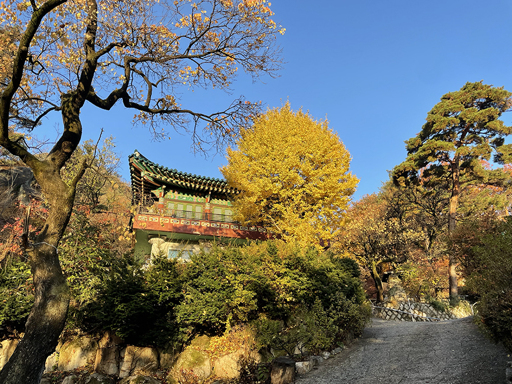

Photo in park adjacent to tribunal.
By David Swanson, World BEYOND War, November 15, 2026

David Swanson in Seoul
Contrasts in South Korea
Early in the morning, prior to the final tribunal hearing, I tried the door of a store in Seoul. It swung open. I entered. Nothing was hidden or locked up, but nobody was there. I learned that the stores don’t bother to lock their doors. That’s an undreamed of level of freedom where I come from.
Also the same morning, someone explained to me why the tribunal has made no mention of the atomic bombing victims who live in North Korea. South Korean law makes it a criminal offense to say anything nice about anyone in North Korea. That’s a level of oppression mostly unseen where I come from, although speaking honestly about Israel has become quite risky in some situations.
Two Takes on the Upcoming Trump-Putin-Xi Meeting

Madmen and Nuclear Weapons
November 14, 2026
No Comments
Is there a connection between mental illness and nuclear weapons? #WorldBEYONDWar

We Need Reykjavik 2.0
November 14, 2026
No Comments
Presidents Jinping, Putin, and Trump should pursue a diplomatic breakthrough in China, with an eye on a nuclear weapons-free world. #WorldBEYONDWar

Livestreamed Videos from Tribunal
- Closing Arguments
https://view.yololiv.com/live/1500628006031327232
- Delivery of the Preliminary Judgment and Recommendations
https://view.yololiv.com/live/1500634435945500672

Remembering Reality
Some of the remarks on Day 3 reminded us that, in contrast to later defenses of the atomic bombings as life-saving humanitarianism, at the time President Truman and many others referred to Japanese as beasts and barbarians and justified the bombing, not as life-saving, but as revenge.

Unlearning Propaganda
Eric Ross made the case on Day 3 that the very idea that atomic bombings could have possibly been legal in 1945 has been created by the victors’ justice that failed to prosecute clear crimes of which both sides of WWII were guilty, such as the bombing of cities with non-nuclear bombs.
Richard Falk asked Ross about a scenario in which a losing party to WWII had used nuclear weapons — would nuclear weapons then have been banned? Ross’s answer was, in short, yes, though he also pointed out that no theoretical nuclear bomb in Germany or Japan justifies the U.S. nuclear bomb development and use. The U.S. developed the nuclear bomb while Germany had abandoned similar efforts and after German surrender.
He also suggested a parallel between U.S. impunity for atomic bomb use and Israeli impunity for the destruction and killing in Gaza.


Final Arguments and Preliminary Judgement
At the close of Day 3 we heard the final arguments made for finding the atomic bombings to have been illegal, and for instructing the U.S. government to acknowledge, apologize, compensate, and commit to no use of nuclear weapons.


Your Honor, We Find the Defendant to Be Guilty as Sin
The preliminary judgement is lengthy, complex, and detailed, but the short version is the finding that the U.S. government violated the law by using atomic bombs in Japan.
The judges recommended that the U.S. government acknowledge the unlawfulness and criminality of the bombings of Hiroshima and Nagasaki, acknowledge its responsibility for the harm suffered by Korean victims including descendant victims and issue an apology, and recognize its responsibility to compensate victims.
The judges recommended that the Japanese government acknowledge and apologize for is responsibility for colonialism, guarantee Korean victims medical compensation at least equal to that offered to Japanese victims.
The judges recommended that the Korean government expand compensation to include victims’ descendants.
The judges recommended that the United States and the Republic of Korea develop a means to compensate victims.
The judges recommended that the U.S. and Japanese governments disclose and make public records and materials concerning Korean atomic bomb victims.
The judges recommended that the South Korean government investigate the circumstances of Korean victims and descendants and secure evidence.
The judges recommended that the U.S. and Korean governments expend memorialization and education.
The judges recommended that civil society expand knowledge of the stories and victims and urge the governments to act on the recommendations above.
The judges recommended that the UN and international community address this human rights issue.
The judges recommended that states involved in the testing of nuclear weapons acknowledge the harm done, disclose information, acknowledge responsibility, and issue apologies and compensation.
The judges recommended that states that have done nuclear tests facilitate the compensation of victims.
The judges recommended that nuclear armed states amend domestic laws consistent with the prohibition of nuclear weapons possession, threat, and use.
The judges recommended that the U.S. and the two Koreas acknowledge that their nuclear deterrence policies increase risk, and that they replace these policies with common security.
The judges recommended that all nuclear armed states acknowledge that the arms race undermines denuclearization of the world, and abide by Article VI of the NPT, and sign and ratify the TPNW.
The judges recommended that Japan and Korea sign and ratify the TPNW and take the lead.
The judges recommended that states end military hostilities on the Korean peninsula and agree to a non-aggression treaty, and establish a nuclear-free zone in Northeast Asia.
Video: Scenes from Day 3


The post Seoul Tribunal Reaches Preliminary Ruling on U.S. Atomic Bombing of Japan appeared first on World BEYOND War.
From World BEYOND War via This RSS Feed.