

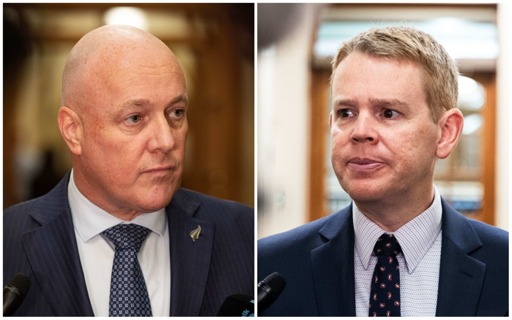

National and Labour campaigns focused on who was more credible, but voters want “a deeper account of how to achieve meaningful change” that they can identify with, writes Sacha McMeeking.(Image: RNZ)
Voters favour parties that offer them a way of making sense of the world and a clear account of what needs to change, writes academic and lawyer Sacha McMeeking.
Pondering how we ended up with a political tie (or thereabouts) is a popular discussion point right now, and it often comes down to dissecting why the major parties (or at least one of them) didn’t rise. There are several go-to answers, all of which are right, I think, but also miss the underlying issue.
The most popular explanations are these: MMP has matured, and tactical voting is part and parcel of the process. Voter fragmentation is increasing, potentially reflecting greater ideological polarisation. We’ve lost trust in politics and government institutions, and there’s a distinct “anti-incumbent” punishment effect in play. The evidence suggests that each of these affected New Zealand’s election outcome.
There’s also an important global backdrop. Many developed countries are experiencing a similar pattern of the “major” parties falling from their pedestals.
In Australia, the combined first-preference vote for Labor and the coalition fell from around 77 percent in 2016 to 66 percent in 2025. In Britain, Labour and the Conservatives attracted just 57 percent of the vote between them in 2024, down from 82 percent in 2017. And in 2025, Germany’s traditional governing parties, the Christian Democrats and the Social Democrats, managed just 45 percent between them.
New Zealand’s preliminary result, with Labour and National combined vote below 60 percent, fits neatly into that picture.
While there are exceptions, and the trajectories aren’t identical, the broad pattern is that voters are increasingly comfortable looking beyond the parties that have traditionally dominated government.
One line of analysis is that the major parties are languishing in a culture of managerialist incrementalism. They’re offering voters a credible, safe pair of hands that will cautiously address the problems of the day. That means the wrestle between the major parties was largely about claiming: “We’re more credible than the other team.”
But credibility, while necessary for being electable, doesn’t create a strong identity link for voters, and without identification, mobilisation won’t happen. Equally, asserting credibility doesn’t heal broken trust or mitigate an anti-incumbent effect.
The counterpoint is that minor parties are thriving because they offer a deeper account of how to achieve meaningful change that people can, and do, identify with.
Taken together, this can be interpreted as our political destiny being set for a “hollowing of the middle”, with an ever more ideologically divided society voting at the margins. (Cue social tensions, unrest, and wider calamity.)
Before panicking, I think we need to ask whether it‘s really an ideological departure at play or a more garden-variety issue the major parties could do something about.
The human mind craves a story with a beginning, middle and end. In this election, the major parties’ story was, loosely, that there’s a cost-of-living problem, and people need A, B, C, which we will deliver.
The minor parties seemed to be able to tell that story with an extra layer of depth that broadly went like this: There is a cost-of-living problem, which is the result of (insert party-aligned structural or deeper cause). We will do X, Y, and Z things that meet the immediate need AND address the deeper issue. That extra step appeals to the human mind because it’s a fuller sensemaking system.
We will all be noticing cost-of-living realities in a way that’s unsettling, but most of us couldn’t give a clear account of why a block of butter is as ridiculously high as it is. The major parties’ story validates what we’re noticing, but it’s the minor parties that help us make sense of the why and the way forward: Things are expensive because our system is geared in X or Y ways, and here’s what we should do.
Importantly, this isn’t simply a distinction in spin-doctor storytelling. It’s a whole-of-party theory of change — a coherent explanation of what causes the conditions we experience and how specific choices can change them.
I wonder whether our major parties have become so focused on policy wooing that they’ve neglected the harder intellectual work of developing a coherent account of how society operates, what needs to change, and how their interventions will produce that change.
Arguing for clearer reasoning in politics might seem naïve, until you look at the differences in how the minor and major parties campaigned. Regardless of political leanings, I think many people could have a decent stab at describing a whole-of-party theory of change for the Greens, ACT, or Te Pāti Māori.
For the Greens, economic inequality and environmental degradation are connected features of the way our economy operates. For ACT, excessive government intervention constrains prosperity and individual autonomy. For Te Pāti Māori, the distribution of power and resources through colonial institutions constrains Māori wellbeing and self-determination.
You don’t have to agree with any of these explanations to recognise that they offer voters a way of making sense of the world and a corresponding account of what needs to change.
I don’t think the same could be said of either major party. I spent a decent amount of time poring over the campaign materials, and neither major party offered what I recognised as a coherent sensemaking system. More confoundingly, their policy offerings sometimes seemed to pull in different directions, making it harder, not easier, to understand what they believed would actually change New Zealand for the better.
For National, the tension seemed particularly pronounced in working out why we should be allergic to government prescription in some spheres (for example, resource management), but embrace it in others (for example, school curriculum and teaching practices).
For Labour, there was a comparable murkiness about when we should look to markets to deliver better outcomes (for example, groceries) and when we should look to state provision (for example, housing).
Of course, political parties should use different levers for different issues, but they also need to stitch together a story of why they look like the traditional version of themselves on one issue, while on another, they’re reaching well outside their traditional repertoire. Failing to do so can breed perceptions of political opportunism, which feed the cycle of mistrust and anti-incumbency.
Even when a party offers voters a coherent explanation that isn’t correct or desirable, it still matters because sensemaking is at the centre of the onion. To mobilise voters, parties need to give them something to identify with, and one way identification happens is through sensemaking. When a party’s account resonates with our own experience, and helps us to make sense of what we’re experiencing and work out a plausible way forward, we have something more substantial to identify with than a party brand or a collection of promises.
The equation, roughly, is that coherent sensemaking creates the conditions for identification, and identification creates the conditions for mobilisation.
Our major parties seem to have dropped the ball on this type of work. They’ve chosen a strategy of credibility over coherence. If they continue to neglect this work, I suspect the political contest will keep fragmenting into a flotilla of smaller parties. That’s not necessarily a bad thing — MMP was designed to accommodate a diversity of political voices. But it would be a significant departure from the major-party-dominated politics we’ve grown accustomed to.
If the major parties want to reverse their decline, there is some international reassurance that it’s possible. In 2025, Canada went dramatically against the global trend, with the Liberals and Conservatives capturing around 85 percent of the vote between them.
At the time, threats to Canadian sovereignty and economic security came from a clear “enemy” in the form of US President Donald Trump, and the major parties responded, in my view, with a fuller sensemaking system. Mark Carney’s Liberals, in particular, connected the problems Canadians were facing with a larger account of what was at stake and what needed to happen, and were ultimately rewarded at the ballot box.
Canada’s first-past-the-post electoral system is very different from ours, and the external threat created unusual circumstances, so this isn’t evidence that better sensemaking alone can reverse major-party decline. But it does suggest that the decline isn’t inevitable.
Perhaps our major parties could follow this trend, but it would take an intentional move away from managerialist politics towards being active interpreters of the turbulent world we’re experiencing.
This doesn’t mean more visionary or ambitious politics, although I, for one, would welcome that. But it should at least mean starting with something more basic: more intelligible politics.

Sacha McMeeking. (Photo supplied)
Sacha McMeeking (Ngāi Tahu, Ngāti Mutunga) is an academic and practitioner working at the intersection of policy, design, and social change. Her writing explores how Indigenous knowledge can lift collective wellbeing.
The post How did we end up in political limbo? appeared first on E-Tangata.
From E-Tangata via This RSS Feed.
You must log in or register to comment.