

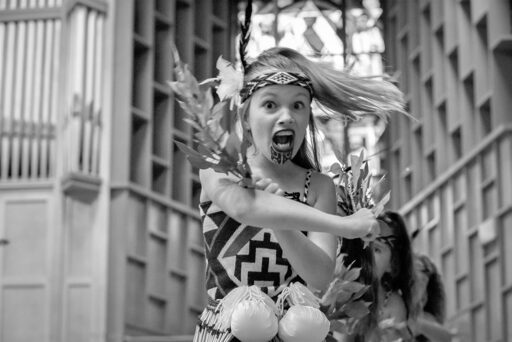

Leaves are often used in kapa haka, not just as an interesting visual element, but also to connect kaihaka (kapa haka performers), physically and spiritually, to the taiao, the environment (Photo: Melissa Banks)
Photographer Melissa Banks (Pākehā) and her husband Jeremy Banks (Ngāti Rārua, Rangitāne ki Wairau, Ngāti Kuia, Ngāti Apa ki te Rā Tō) raised their three daughters, Xanthe, Lucia and Ariana, in te reo Māori. The girls became competitive kapa haka performers, or kaihaka, and Melissa photographed their groups over seven years, including at Te Matatini 2023.
Their book Te Ara o Hine Rēhia: Kapa haka through a lens*, written by Jeremy and illustrated by Melissa, is an intimate look at kapa haka life on stage and behind the scenes.*
Although our kōtiro (girls) were raised with te reo as their first language, and our whare is constantly full of te reo Māori, their language journey has been travelled alongside our own as parents. Melissa and I did not have any reo Māori before our kōtiro came along.
When Melissa fell pregnant with our mātāmua, our firstborn, Xanthe, I began learning te reo, and before Xanthe arrived, I decided that my goal would be to speak only te reo with our tamariki. This meant that in the early years, especially with Xanthe, there was a constant challenge to learn quickly enough to stay ahead of their developmental journey.
When our kōtiro were attending kōhanga and kura kaupapa, they were surrounded by reo speakers of a much higher quality than we were able to provide. It became clear to us that the language they heard at home couldn’t help but have a significant impact on how much te reo they’d use, especially when they were outside their learning environments.

Black lipstick is applied to a kaihaka just before taking the stage. A primary-school kapa will often have stations where helpers are responsible for specific aspects of preparation, all in a predefined and intentional order. It’s not unusual for an adult helper to spend all day with a single job, whether it’s drawing tā moko or pressing moko stencils, helping with make-up, putting on piupiu (skirts), pare (bodices) or tīpare (headbands), or arranging hair. (Photo: Melissa Banks)
We didn’t have the luxury of surrounding our kōtiro with native-speaking role models at home — their main example was a second-language learner with a very limited vocabulary.
This limited vocabulary resulted in things being expressed in strange ways — an inevitable part of my dogged effort to stay in te reo no matter what. Nonetheless, even though their reo hasn’t come from a native speaker, it does flow freely and naturally.
The Taranaki reo stalwart Dr Ruakere Hond talks about how important it is to create opportunities to use and practise te reo in the many different domains of your life, over and above the often-narrow domain in which you learn the language.
Raising tamariki in te reo, especially for a couple like us whose own upbringings in the deep south couldn’t have looked more different, was a constant effort to replace the default English-speaking world with a Māori alternative. As well as the language being used day to day, this included the books and media that they were surrounded by — which meant that we were constantly trying to find aligned activities.
Our kōtiro have always been involved in a variety of sports and activities. I often coached their basketball or netball teams, and they would stand out as the one team communicating in te reo Māori. Reactions to a team communicating only in te reo spanned the whole spectrum of societal opinions, from positive to not so much.
The environment that kapa haka provides for our kōtiro is so important. There isn’t a Pākehā way to do kapa haka. Our kapa don’t stand out as being different from each other, as kaupapa Māori-led groups do in other activities. Kapa haka is Māori. The kōtiro are surrounded by te reo and tikanga, and also by their whāea and mātua and whanaunga, and they get to just be Māori.

Kapa haka is a family affair, writes Jeremy Banks, with babies and children raised on the sidelines of their parents’ rehearsals. “Being surrounded by kapa haka training, it is completely normalised. They learn by osmosis.” (Photo: Melissa Banks)
Waiata has constantly surrounded our kōtiro in their home environment. A shower is seldom a silent affair, the neighbours know favourite playlists well, and our piano is played more days than it’s not.
Long car trips are full of riff-offs and sing-alongs, and who leads, who sings the melody, and who harmonises is decided wordlessly, with a glance and a raise of the eyebrows.
The kōtiro frequently accompany the song they’re playing on the piano with waiata, often together in harmony. If my brain tries to play the piano and sing simultaneously, it’s like watching a five-year-old try to rub their puku and pat their māhunga at the same time.
It’s not unusual for someone in our whānau to find themselves in a situation that requires a waiata tautoko to complement a mihi or kōrero. It’s always comforting to know that as long as the kōtiro are there, the waiata is sorted.
Most trips as a whānau to a kaupapa involve a kōrero in the car about making sure we have a waiata tautoko or two up our sleeve, just in case. There will be a discussion on which waiata are — and more importantly aren’t — appropriate for the particular marae, hapū, iwi or kaupapa in front of us.
The kōtiro are incredibly supportive of Melissa and me during waiata, doing their best to make sure we don’t see their reactions when we go flat, sing the wrong words, or jump unwittingly from melody to harmony, and they do a great job of appearing sincere in their praise afterwards.

Jeremy Banks: “The widening of eyes, gnashing of teeth and puckering of lips are all forms of pūkana that you will see both wāhine and tāne performing. Eyes perform a similar role for both pūkana wāhine and pūkana tāne, where kaihaka will make their karu look as large and white as possible. A particularly skilful kaihaka may be able to roll their karu far enough backwards so that only the whites of the eyes are visible.” (Photo: Melissa Banks)
A kapa haka bracket is a significant vocal performance and requires kaihaka to strengthen and care for their throats and their voices. At training, lemon and honey drinks are frequent, drink bottles are filled with warm water — never cold — and pockets are often full of throat lozenges.
Vocal warm-ups are many and varied, and often fun and amusing. It’s an “if you know you know” situation. If you were to say: “The tip of the tongue, the teeth, the lips”, “My mum makes me munch my M&Ms on a Monday morning”, or “Sliiiiice” to other kaihaka from your rōpū, they will know exactly what you’re talking about.
Likewise, there are a multitude of exercises to massage your face, throat and nose, practise over-enunciating vowels, and prepare the full range of your vocal register for a performance or practice. Kapa haka is vigorous and energetic, so equal focus is placed on general physical health. Your voice needs to be ready to go at the end of warm-ups — so, too, does your entire body.
The waiata tira (choral song) is sung by the whole group, in harmony, like a choir. A tutor acts as conductor, and the waiata can be accompanied by a guitar or sung a capella. The waiata tira is optional, performed without actions and sung at the start of a bracket.
It is an opportunity to provide the crowd with a soft introduction to the kapa, and to set a positive tone for the whole performance before the more flamboyant whakaeke (entrance). The kapa can ensure that their voices are warmed up and ready and that nerves are settled before commencing the remaining aggregate items.

Kaihaka will often twirl back and forth when preparing to perform, the rhythmic swish of the piu calming the nerves and clearing the mind. (Photo: Melissa Banks)
When waiata tira was introduced as a performance item, it was to demonstrate that Māori could perform successfully in choral singing, a field that at the time was traditionally dominated by Pākehā.
The experience of being in a kapa haka audience is different from other events or activities. Movement and noise during a performance are considered unacceptable. Distractions are minimised to make sure that all kapa have an equal opportunity during their time on-stage.
An army of kaimahi, often volunteers, are deployed throughout the venue to help manage the crowd. Between performances, they help those entering to find their seats, and those leaving to exit the venue as quickly as possible.
If the competition is being held at an inside venue, kaimahi will shut the doors when it’s time for the next performance, and make sure that no one enters or exits. If there are media restrictions, which there often are, kaimahi constantly police the crowd, telling people to put their phones down and preventing them from taking photos or videos.
Media restrictions are frequently in place because organisers want to ensure that videos and photographs of the event are the high-quality ones taken by the professional photographer and videographer.

Warming up on the bus trip to the competition venue. (Photo: Melissa Banks)
Melissa has often been the official photographer for competitions held throughout Te Tauihu, which is a very busy day’s work. When taking stage photos, you want to make sure every kaihaka is well represented, so their whānau has a good memento of the day.
Although there are scheduled breaks during a competition, a day of watching kapa haka can require a lot of planning. An audience who wants to maximise the number of performances that they watch is constantly alert for opportunities to take a break.
If the competition is at a venue where the audience is able to come and go without disrupting the performance, a waiata tira that is perceived as not quite up to scratch can be the catalyst for audience members to rush off to the whare paku or grab a quick kai and cup of coffee.
A tutor will often use this to motivate their kapa — that if their waiata tira is subpar, they run the risk of the audience suddenly and discreetly disappearing.

Jeremy and Melissa Banks, photographer and writer respectively of the new book Te Ara o Hine Rēhia: Kapa Haka Through a Lens. In the foreword, Melissa writes that haka is “role-modelling at its best. Mātua show their tamariki that their culture is beautiful, powerful and important. Tamariki show their mātua that their years of effort for language and cultural revitalisation are worth it.” (Photo: supplied)
Te Ara o Hine Rēhia: Kapa haka through a lens*, by Melissa and Jeremy Banks (Potton & Burton, RRP $79.99), is on sale on November 16. These extracts have been lightly edited for clarity.*
The post Kapa haka through a lens appeared first on E-Tangata.
From E-Tangata via This RSS Feed.