

This article by Pablo Moctezuma Barragán originally appeared in the November 13, 2026 edition of Contralínea, an investigative Mexican news outlet.
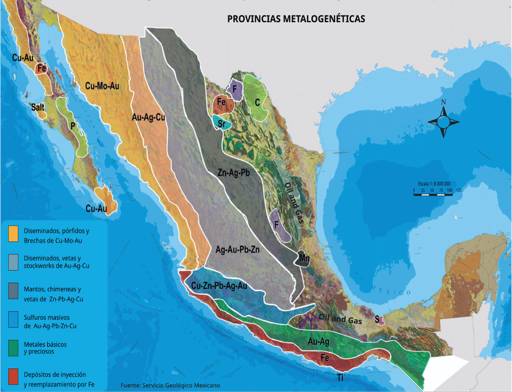
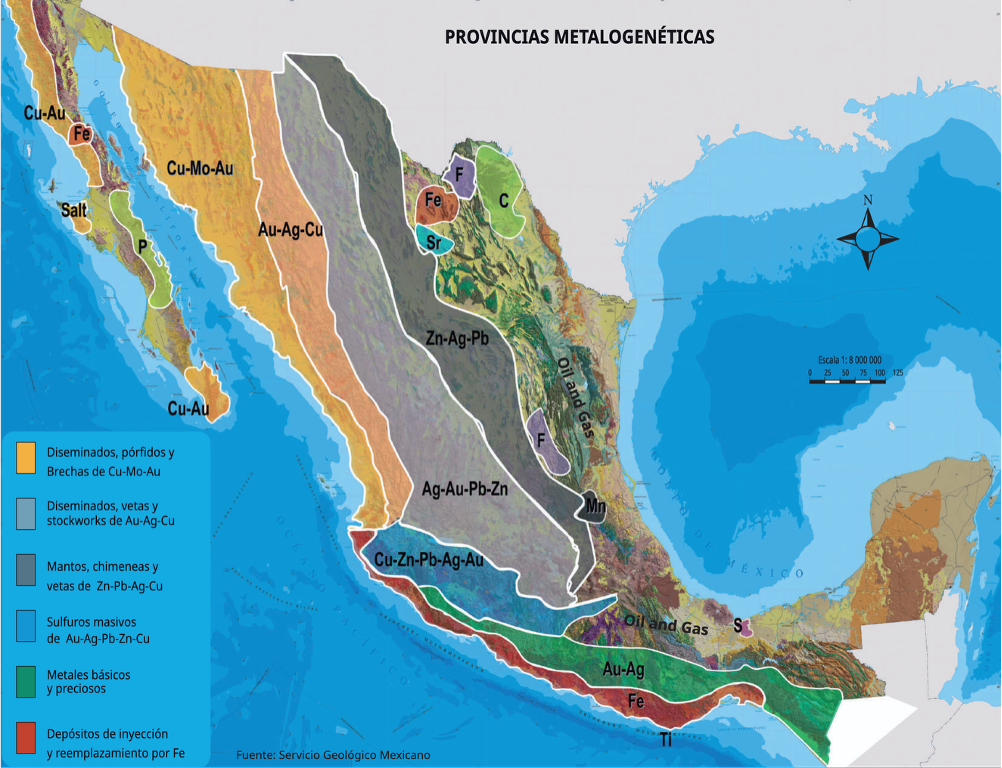
Mexico possesses extraordinary mineral and energy wealth in its subsoil. Thanks to a vast tectonic variety and complexity (volcanic systems, magmatic arcs and orogenic belts), the national territory is a major player on the world mining stage. Currently, the country consistently ranks among the planet’s ten leading producers of around 16 to 17 different minerals, consolidating this activity as a fundamental pillar of the national economy.
The undisputed standard-bearer of this industry is silver, a sector in which Mexico ranks first in the world, contributing approximately 24 percent of the global supply –more than 200 million ounces annually–, surpassing powerhouses such as China and Peru. Likewise, the country ranks second worldwide in the production of fluorite (essential for the chemical and refrigerant industries), fifth in lead (vital for storage batteries and alloys) and sixth in zinc (key to galvanizing steel). This list also includes strategic minerals such as gold and copper, the latter of vital importance in the face of the global energy transition and electric mobility, with vast deposits in the state of Sonora. The nation’s mineral mix is rounded out by significant volumes of molybdenum, manganese, graphite, gypsum and salt.
In the era of critical minerals, it is important to recognize the country’s geological potential. In the current context of technological transformation, Mexico has the geological conditions to identify and develop deposits of critical and strategic minerals. International demand for semiconductors, electric vehicles and clean energy (driven by industrial relocation or nearshoring and the USMCA framework) exerts positive pressure on the nation to strengthen its supply chains.
Among the resources identified as having high potential for discovery or development, the following stand out:
-Copper and manganese, key inputs for electrification processes and battery manufacturing.
-Acid-grade fluorite: essential for the high-precision chemical and semiconductor industries.
-Graphite and coal: used in battery anodes for electric vehicles and in advanced industrial processes.
-Lithium: located mainly in clay deposits in the north of the country, such as in Sonora.
-Rare earths and radioactive minerals: geological samples and analyses by the Mexican Geological Survey (SGM) have identified traces of uranium, thorium and other nontraditional minerals in various regions of the national territory.
Despite this geological abundance, converting these indications into usable reserves faces significant challenges. Success in locating new deposits depends directly on the budget, investment capacity and technology provided to public exploration agencies such as the SGM. In the case of lithium in clay, the main challenge is not locating it, but having the appropriate technology and processing costs to make its extraction economically viable without consuming excessive volumes of water, a technical aspect that still requires development to be fully profitable.
Monetary Sovereignty: The Silver Standard Proposal
Taking advantage of the leading position in silver production, the possibility of reintroducing the metal as monetary backing or currency in circulation at the national level has been raised. This scheme seeks to function as a strategic mechanism to reduce dependence on the US dollar.
Implementing a silver standard (or effectively monetizing the metal) involves a complex technical, legal and financial process, but one that is feasible through two main avenues:
-
Reserve accumulation: the Banco de México (Banxico) would have to allocate a fraction of its international reserves (which exceed US$250 billion) to the large-scale acquisition of physical silver to back the issuance of banknotes or bank deposits under a legally convertible parity.
-
Legal reform and the banking system: this would require amending the Monetary Law to incorporate silver coins as a formal means of payment. At the same time, the banking system would have to adapt its platforms to allow the opening of deposit and checking accounts denominated in ounces or grams of silver, enabling digital transactions backed by physical metal, as well as reaching agreements with international partners to settle imports in backed national currency.
It is necessary to implement strategies to reduce gas imports. On the energy front, Mexico has around 35 trillion cubic feet in total natural gas reserves. However, dependence on imports to meet domestic demand remains a considerable challenge. To reverse this situation and move toward meeting its own consumption needs, it is necessary to act on several fronts: the primary step is to accelerate the extraction of non-associated natural gas and increase the use of associated gas in existing oil fields. This requires reorganizing investments by Petróleos Mexicanos (Pemex), prioritizing basins rich in non-associated gas (such as the Burgos and Veracruz basins) instead of concentrating capital almost exclusively on crude oil.
It is urgent to curb gas flaring by installing capture, compression and transport infrastructure in Gulf of Mexico fields to make use of the resource that currently ends up in the atmosphere. Likewise, the country needs to develop large-scale strategic underground storage –using depleted mature fields or salt caverns– that would allow it to maintain security reserves for at least 5 to 10 days of national consumption.
There are alternative sources to guarantee the gas supply. Incorporating biogas and biomethane represents a high-purity renewable alternative. Obtained through the anaerobic digestion of organic waste (agricultural and livestock waste, sewage sludge and urban waste), purified biogas meets specifications similar to those of conventional natural gas. Its development would allow it to be injected directly into the national gas pipeline network or used as vehicle fuel (CNG/LNG), gradually replacing gas of fossil origin.
According to Article 27 of the Political Constitution of the United Mexican States, minerals and substances in the subsoil are the inalienable property of the nation, not subject to prescription or seizure. Private parties cannot directly appropriate the subsoil.
The state grants temporary concessions to private companies (domestic and foreign) to carry out exploration and extraction work. Granting a concession confers the right to exploit resources under the regulatory framework in force, but does not transfer ownership of the land or subsoil to corporations. Regarding this scheme, the need for greater transparency in the sector’s tax collection has historically been noted to ensure that tax contributions match the value of the wealth extracted.
In the particular case of lithium, recent constitutional reforms reserved its exploitation exclusively for the Mexican state through dedicated public agencies.
Despite the principle of national ownership, mining operations in the country are heavily concentrated in a few domestic conglomerates and multinational companies: Canadian and US capital controls highly significant deposits. Newmont Corporation (US) operates Peñasquito in Zacatecas, the country’s largest gold mine and a key center for silver, lead and zinc. Torex Gold Resources (Canada) manages massive gold complexes in Guerrero, while firms such as First Majestic Silver and Pan American Silver hold a considerable number of concessions devoted to precious metals in northern and central Mexico.
Among domestic corporations, Grupo México (headed by Germán Larrea) stands out, considered one of the world’s largest copper producers through operations such as Buenavista del Cobre and La Caridad in Sonora. Grupo BAL (the Baillères family, through Industrias Peñoles and Fresnillo Plc) leads silver extraction with the Fresnillo mine in Zacatecas, in addition to producing lead, zinc and gold. Grupo Carso (Carlos Slim’s Minera Frisco) operates various base and precious metal units such as Tayahua. For its part, Compañía Minera Autlán (the Rivero González family) specializes in manganese ferroalloys and precious metals.
In the face of this concentration and in order to ensure that the benefits of extractive activity directly affect the population, analysis of the advisability of reviewing the private concession regime remains on the table. The alternative of direct extraction by public companies, with active participation by local communities and strict transparency frameworks, is presented as a way to consolidate sovereignty over the country’s mineral resources.
-
Mexico’s Mineral Wealth
November 14, 2026
“Private parties cannot directly appropriate the subsoil,” writes Pablo Moctezuma Barragán, who advocates public mining with community participation.
-

Sheinbaum Says Government Will Assist Migrant Caravans Without Repression
November 13, 2026
Trump threatened to double tariffs unless Mexico stops the caravans; Sheinbaum says migrants will receive basic care and information.
-
World Bank Estimates That 17.3 Million Left Poverty in Mexico from 2018 to 2026
November 13, 2026November 13, 2026
Higher real labor incomes and expanded social programs helped drive the decline, with minimum-wage increases identified as a key factor.
The post Mexico’s Mineral Wealth appeared first on Mexico Solidarity Media.
From Mexico Solidarity Media via This RSS Feed.