

Bukele security model Haiti deploys 2,000 Salvadoran troops outside UN command, raising concerns over sovereignty and regional replication.
Related: Bukele Says El Salvador Could Dismantle Haiti’s Gangs
Bukele Security Model Haiti: 2,000 Troops Test Regional Blueprint
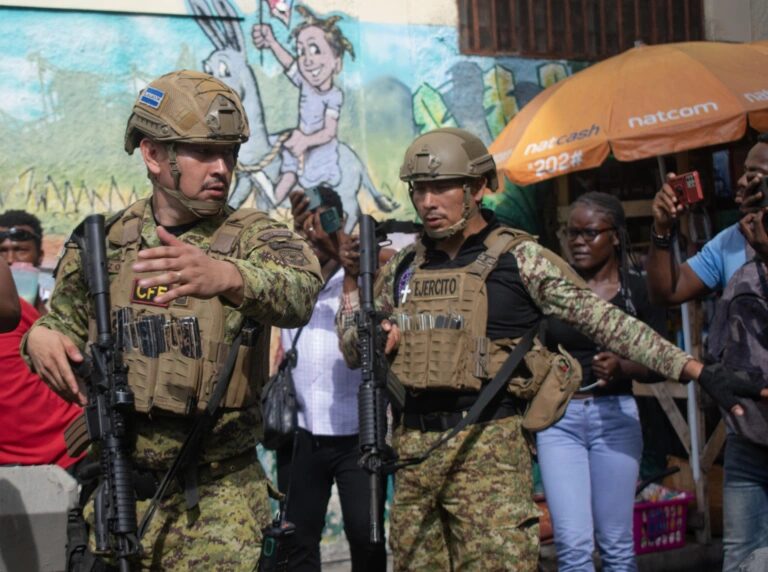
The Bukele security model Haiti deployment has become the first major test of El Salvador’s approach to security outside its own borders. More than 2,000 Salvadoran soldiers are operating in Haiti, largely outside UN command, without a publicly released agreement governing their mandate, duration, or rules of engagement.[telesurtv]
On November 12, about 20 Salvadoran armored vehicles entered the Sylvio Cator stadium in central Port-au-Prince. Haiti’s National Police said the stadium and surrounding areas, occupied by gangs for years, had been recovered and would serve as a base for the Salvadoran troops.[telesurtv]
The deployment began on October 22, when the first Salvadoran commandos arrived. Six days later, El Salvador’s Foreign Ministry confirmed that more than 2,000 soldiers were on Haitian territory.[telesurtv]
A Force Outside UN Command
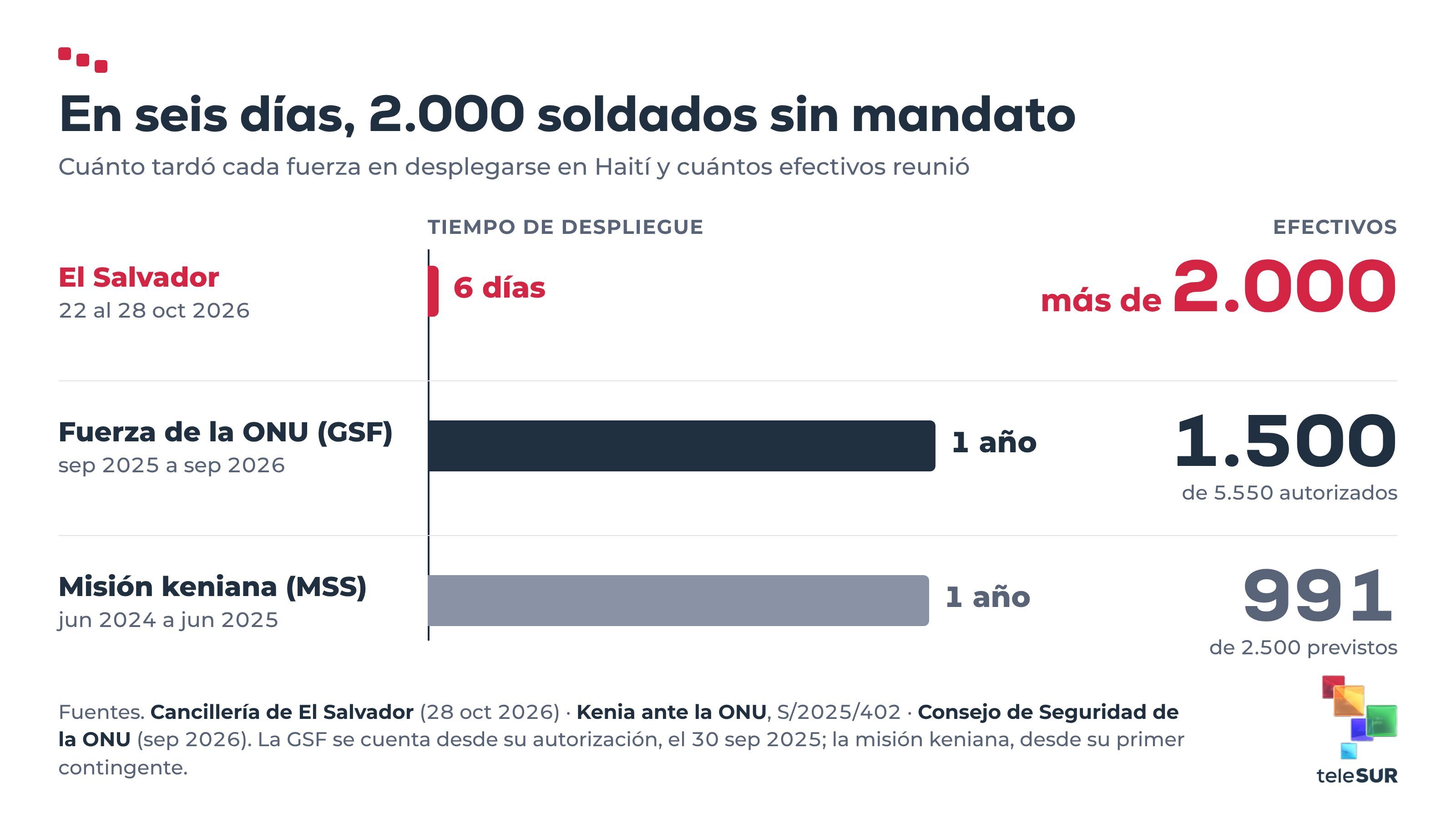
The UN-backed Gang Suppression Force (GSF) had about 1,500 personnel one year into its mandate, out of 5,550 authorized by the Security Council. The Kenyan-led mission that preceded it never exceeded 991 police officers, well below the 2,500 originally planned.[telesurtv]
Most Salvadoran troops operate outside that force. The United Nations has described the deployment as a bilateral matter between El Salvador and Haiti, and no public document has established the mission’s mandate, duration, or rules for opening fire.[telesurtv]
That lack of transparency raises a question that extends beyond Haiti: who can authorize a foreign army to wage war in a country that has not held elections in a decade, and to whom will that army answer if it makes a mistake?[telesurtv]
The Legal Basis Remains Unclear
Until October 18, El Salvador had about 100 military personnel in Haiti, mostly aviation technicians supporting medical evacuations, under an agreement signed by the two countries’ ambassadors before the Organization of American States in October 2024.[telesurtv]
On September 29, El Salvador’s Legislative Assembly approved a transitional law extending that participation for one year. The law states that El Salvador retains jurisdiction over its soldiers and cannot hand them over to international courts or third countries without complying with the treaties it has ratified.[telesurtv]
Four of those technicians disappeared on October 18 after a gang ambushed their vehicle in Santo, northeast of the capital. The first commandos landed on October 22, and by October 27, with about 1,300 soldiers already on the ground, Bukele called President Donald Trump to ask for support for the escalation.[telesurtv]
Trump reportedly told him to “do what you have to do.” Haitian Prime Minister Alix Didier Fils-Aimé, who was attending a wedding in Mexico, returned on October 28 and issued a statement describing the cooperation as taking place “within the framework of the GSF.”[telesurtv]
Consent Without Elections
International law allows one state to send troops to another if the latter invites them. The International Court of Justice recognized that principle in its 1986 ruling in Nicaragua v. United States.[telesurtv]
Legal doctrine requires that the invitation come from a government recognized as legitimate, be explicit, and arrive before troops cross the border. In Haiti, the first Salvadoran soldiers landed on October 22, while the agreement—if it exists—was approved six days later by a government that did not emerge from elections and without a parliament able to ratify it.[telesurtv]
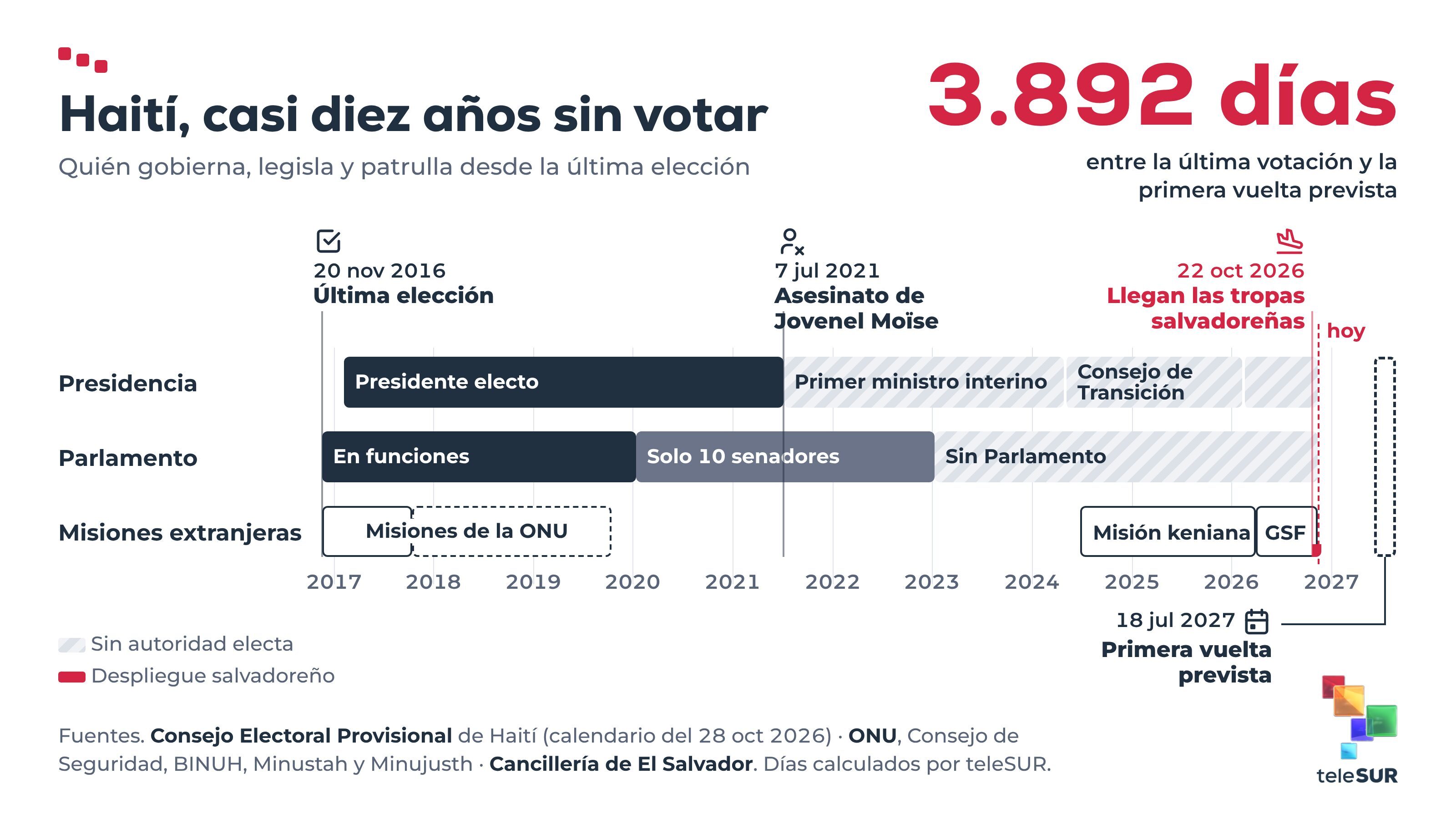
Haitian security and defense expert Emmanuel Paul called the deployment a “flagrant violation of Haiti’s sovereignty.” He argued that such an agreement should pass through a parliament that no longer exists and be signed by an executive that has lacked a president since the assassination of Jovenel Moïse in July 2021.[telesurtv]
Fils-Aimé, who has led the executive since the Transitional Presidential Council dissolved on February 7, defended the operation on November 3. He said Haiti retains direction over all foreign forces and that the Salvadorans “are here to support us.”[telesurtv]
What Happens if a Soldier Commits Abuse?
Under El Salvador’s September law, if a Salvadoran soldier commits an abuse in Croix-des-Bouquets, only a court in El Salvador can try him. The United Nations cannot monitor the troops because those operating outside the GSF fall outside the human rights due diligence policy the organization applies to that force.[telesurtv]
That raises concerns about accountability. The Salvadoran judicial system, which would have the final say, appeared before the Inter-American Commission on Human Rights on October 26, where the organization Cristosal documented 454 deaths of people in state custody since 2022, including 33 women, three girls, and one boy.[telesurtv]
Haiti last voted on November 20, 2016. Since then, Moïse was assassinated, the last 10 senators left their seats in January 2023, and the country has been governed by an appointed prime minister.[telesurtv]
For the first round of elections scheduled for July 2027, 759,257 voters are registered, in a country with about 6.5 million people of voting age.[telesurtv]
Inter-American Commission on Human Rights
Inside Haiti: Hope and Fear
In Haiti, many people welcomed the Salvadoran troops with applause, and crowds in Port-au-Prince chanted Bukele’s name. Pierre Espérance, director of the National Human Rights Defense Network, welcomed the speed of the deployment but warned that not everyone living in gang-controlled areas is a gang member.[telesurtv]
Activist Monique Clesca acknowledged that Bukele has spoken to Haitians more than their own leaders, but reminded him that Haiti is not his backyard. Jocelyne Noël, director of the Episcopal Commission for Justice and Peace, criticized Haitian authorities for failing to take responsibility.[telesurtv]
In the Cul-de-Sac plain, where the 400 Mawozo and Chen Mechan gangs operate, security operations killed at least 21 people in Croix-des-Bouquets between October 18 and November 2, according to the conflict observatory ACLED.[telesurtv]
Médecins Sans Frontières treated about 30 people wounded by gunfire and explosions in the eight days following the ambush, nearly a third of them women and children. The drones of the Haitian task force, operated with support from Erik Prince’s Vectus Global, had already been linked to more than 1,200 deaths in a year, according to Human Rights Watch.[telesurtv]
A Model With Regional Reach
The Bukele security model Haiti deployment is being watched across Latin America. InSight Crime counted 16 prison projects in 10 countries inspired by El Salvador’s Center for the Confinement of Terrorism (Cecot).[telesurtv]
Costa Rica inaugurated a megaprison for 5,100 inmates in October, whose foundation stone Bukele laid in January. In Peru, Keiko Fujimori has offered five similar prisons, and in Colombia, Abelardo de la Espriella has proposed 10.[telesurtv]
The model’s appeal lies in its promise of rapid results. But critics warn that exporting a security strategy built on mass detention, military force, and limited judicial oversight could deepen authoritarianism rather than solve the underlying causes of violence.[telesurtv]
Geopolitical Context
The Bukele security model Haiti deployment reflects a broader shift in how security is being organized across the Americas. Instead of relying solely on multilateral institutions, governments are increasingly turning to bilateral arrangements, private military contractors, and regional coalitions.
The operation has drawn comparisons to the 1965 intervention in the Dominican Republic, when the Organization of American States approved the creation of an Inter-American Peace Force after more than 40,000 U.S. troops landed in the country.[telesurtv]
Unlike that operation, the Salvadoran deployment has neither an OAS resolution nor a Security Council mandate. That absence of multilateral authorization is what makes the case legally and politically unprecedented.[telesurtv]
The broader implication is that Haiti may become a testing ground for a new security architecture in the Americas. If the model is seen as successful, other governments could seek to replicate it, raising questions about sovereignty, accountability, and the role of the United States in regional conflicts.[telesurtv]
What Comes Next
The immediate question is whether the Salvadoran troops will remain in Haiti beyond the GSF’s mandate, which expires on March 31. The UN political mission is set to renew in January, but no public document says how long the more than 2,000 soldiers will stay or whom they will answer to if something goes wrong.[telesurtv]
For Bukele, the deployment is also a political gamble. He is seeking a third consecutive term in February 2027, after the Assembly controlled by his party approved indefinite reelection and moved up elections originally scheduled for 2029.[telesurtv]
The Haiti operation gives him a platform to present himself as a regional security leader. But it also exposes him to criticism if the mission produces civilian casualties, lacks transparency, or fails to deliver lasting stability.[telesurtv]
From teleSUR English via This RSS Feed.